Follow the Thread
CANADA OUT, BELARUS IN: ANOTHER DOT IN THE TRUMP-RUSSIA PATTERN?
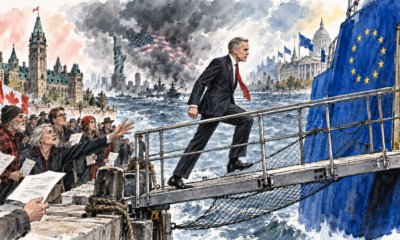
Five years ago, the idea that the United States might deliberately weaken its economic relationship with Canada while opening new commercial opportunities with Belarus would have sounded implausible. Add growing tension with NATO allies, deteriorating relations with Europe, pressure on Ukraine and Donald Trump’s long and unusual relationship with Vladimir Putin, and it starts to sound like the premise of a political thriller.

Five years ago, the idea that the United States might deliberately weaken its economic relationship with Canada while opening new commercial opportunities with Belarus would’ve sounded implausible. Add growing tension with NATO allies, deteriorating relations with Europe, pressure on Ukraine and Donald Trump’s long and unusual relationship with Vladimir Putin, and it would’ve been difficult to imagine this as American foreign policy.
Yet that’s where we are.
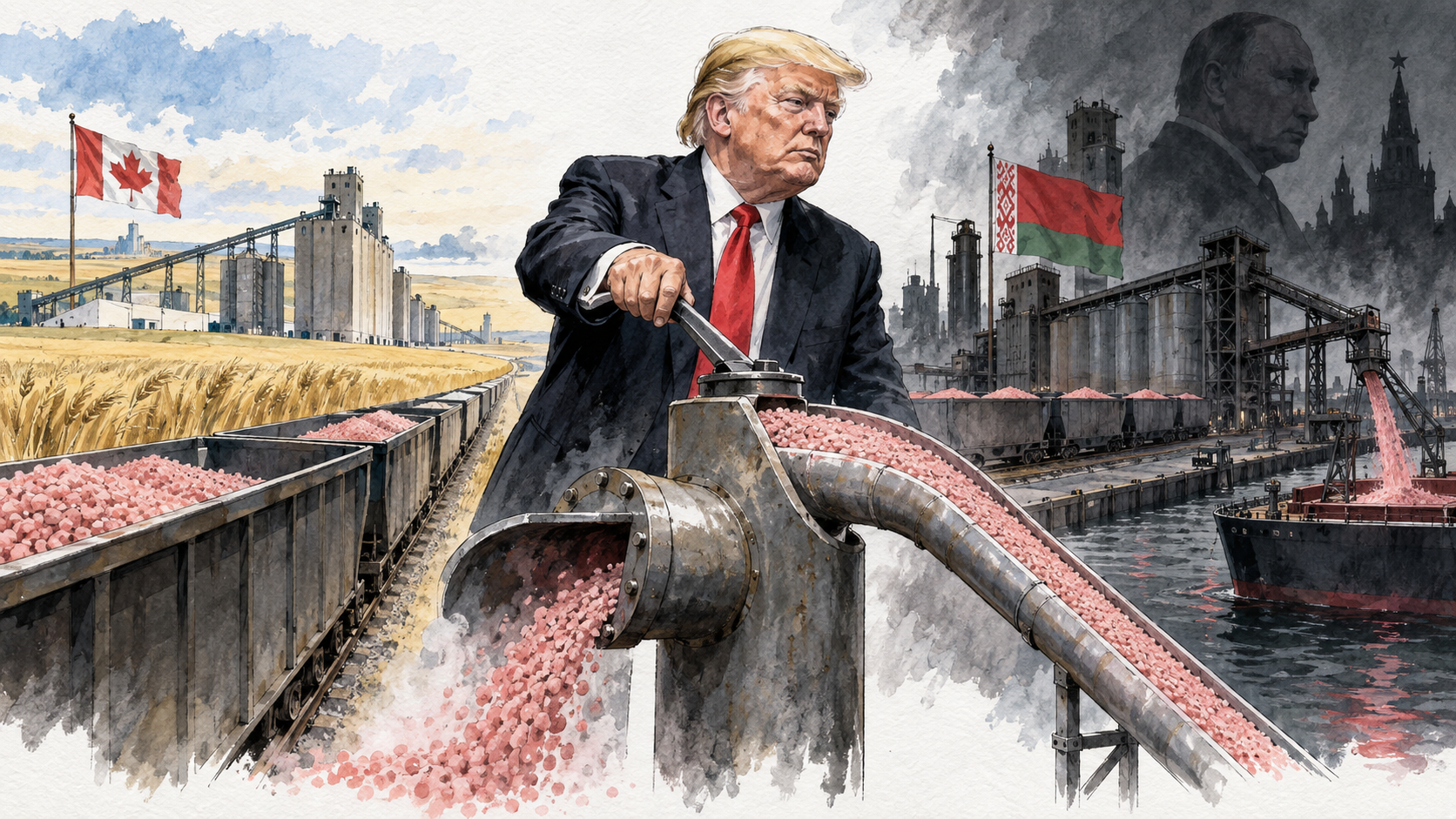
The latest development is potash. Trump announced this week that the United States is working on what he called a “massive” agreement to buy potash from Belarus, claiming it would cost substantially less than what American buyers currently pay Canada. Canada supplies roughly 80 per cent of the potash imported by the United States and has spent decades building an integrated North American fertilizer supply chain.
Belarus isn’t simply another competing supplier. It’s one of Russia’s closest allies. Alexander Lukashenko allowed Russia to use Belarusian territory to launch part of its 2022 invasion of Ukraine, and Belarus continues to maintain deep military, economic and political ties with Moscow. European sanctions on Belarusian potash remain in place in part because of Minsk’s support for Russia.
American business that’s traditionally gone to Canada could now generate revenue in Belarus instead.
There’s an important limit to that argument. Buying Belarusian potash isn’t the same thing as transferring money to Vladimir Putin, and it would be irresponsible to suggest otherwise. The commercial revenue would go into the Belarusian economy, not directly into the Russian treasury. It would, however, financially benefit a government closely aligned with Moscow and one that materially assisted Russia’s invasion of Ukraine.
There’s another contradiction here. Trump has repeatedly objected to Canada diversifying its economic relationships. His reaction to discussions about closer Canada-European Union ties has included threats of further economic retaliation and warnings that a deeper relationship could be considered hostile to the United States.
Canada seeking stronger economic and strategic ties with democratic European countries is therefore treated as a problem, while the United States replacing Canadian business with Belarus is presented as sensible diversification.
That’s difficult to reconcile.
The Trump administration does have a legitimate explanation for part of its recent engagement with Belarus. Washington has negotiated prisoner releases in exchange for limited sanctions relief, and hundreds of political prisoners have been released through various agreements. That’s a real result and shouldn’t be ignored. Engagement with an authoritarian government isn’t automatically evidence of support for that government.
The potash proposal goes further. It would establish a new commercial relationship in an industry that’s been specifically targeted by Western sanctions while reducing American dependence on a long-standing Canadian supplier.
Taken on its own, none of this establishes anything about Trump’s relationship with Russia. It attracts attention because of the history that precedes it.
Trump’s connections with Russian and post-Soviet business interests stretch back decades. One important figure was Felix Sater, a Russian-born businessman associated with Bayrock Group. Bayrock operated from offices in Trump Tower and partnered with the Trump Organization on developments including Trump SoHo. Sater later became involved in efforts to develop Trump Tower Moscow.
The timing of the Moscow project is important.
Trump signed a letter of intent for Trump Tower Moscow in October 2015, several months after announcing his candidacy for president. Michael Cohen and Sater continued pursuing the project during the campaign. The Mueller investigation subsequently established that the Trump Organization continued working on the proposal until at least June 2016.
Cohen also contacted the office of Putin’s press secretary seeking assistance with the project. Sater promoted the deal to Cohen in language that mixed Trump’s business ambitions with his political campaign and boasted about his ability to use Russian connections to help make the project happen. Whether Sater had anything close to the influence he claimed has never been established. What is established is that Trump’s organization was pursuing a potentially valuable business project in Moscow while Trump was campaigning for president.
There was also the 2013 Miss Universe pageant in Moscow, which helped develop Trump’s relationship with Russian developer Aras Agalarov and his son Emin. Three years later, that relationship became part of the chain that led to the June 2016 meeting at Trump Tower involving Donald Trump Jr., Jared Kushner and campaign chairman Paul Manafort.
Trump Jr. agreed to the meeting after being told that information damaging to Hillary Clinton was available as part of Russian government support for his father.
The bipartisan Senate Intelligence Committee later found that two participants in the meeting had significant connections to the Russian government, including Russian intelligence. The same investigation found no reliable evidence that useful information was actually delivered at the meeting and no evidence that Donald Trump knew about it beforehand.
Those qualifications are important. The Senate committee also found no evidence that Trump or his campaign colluded with the Russian government to conduct Russia’s interference in the 2016 election.
It did, however, confirm that Russia interfered in the election. The committee described the Russian operation as aggressive and multifaceted. It reviewed the American intelligence assessment that Vladimir Putin ordered an influence campaign intended to damage Hillary Clinton and that the Russian government developed a clear preference for Trump. The Republican-led committee concluded that those assessments were supported by the intelligence.
That context made Trump’s performance in Helsinki in July 2018 extraordinary.
Standing beside Vladimir Putin, Trump was asked whether he believed his own intelligence agencies or Putin’s denial that Russia had interfered in the election. Trump acknowledged what his intelligence officials had told him, then said Putin had denied Russian involvement and added that he didn’t see why Russia would’ve done it. He described Putin’s denial as extremely strong and powerful.
Trump later said he’d misspoken and intended to say that he could see no reason why Russia “wouldn’t” have been responsible. The correction is part of the record. So is the original press conference.
Trump’s treatment of Putin has remained an unusual feature of his political career. It would be inaccurate to say he’s never criticized the Russian president. He has. Trump has expressed anger and frustration with Putin over Ukraine and has supported measures that have damaged Russian interests.
Most recently, Trump signed major new sanctions legislation targeting Russia’s energy and defence sectors, banks and shadow oil fleet. The legislation passed both houses of Congress before reaching his desk, but Trump signed it. Any serious examination of his Russia record has to include that.
There are other facts that complicate a simple pro-Russia interpretation of Trump’s policies. His demands for higher NATO defence spending have led European governments to spend considerably more on their own militaries. The United States remains a central member of NATO. American military cooperation with European allies hasn’t simply disappeared.
The question isn’t whether every Trump decision benefits Russia. Clearly, they don’t.
The more useful question is what the cumulative effect of his foreign policy has been on the strategic environment Putin has spent years trying to change.
NATO remains intact, but trust within the alliance has weakened. European governments are investing more heavily in their own defence partly because they’re no longer certain they can assume indefinite American support. Reuters reported this month that Trump’s pressure is changing European defence planning and encouraging governments to reduce their dependence on the United States.
The relationship between Canada and the United States has also deteriorated sharply. Canada is actively trying to diversify its trade and deepen its relationship with Europe because depending so heavily on one increasingly unpredictable American market has become a strategic risk. Trump, in turn, has threatened economic consequences over those efforts.
Ukraine has repeatedly faced pressure from Washington over the terms on which the war should end and the extent of future American support.
Washington is now relaxing parts of its economic isolation of Belarus and considering shifting some American potash demand away from Canada toward a government closely aligned with Moscow.
For decades, Russian strategy has sought to weaken the unity of the Western alliance, create divisions between the United States and Europe, undermine NATO cohesion, reduce Western support for Ukraine and other states along Russia’s borders, and encourage acceptance of a Russian sphere of influence.
A deterioration in the relationship between the United States and Canada would also serve Russian interests. Canada is a founding NATO member, an important Arctic country and one of America’s closest economic and security partners. Conflict between Washington and Ottawa weakens cooperation inside the Western alliance without Russia having to cause the dispute itself.
European uncertainty about American commitments works in the same direction. So does disagreement over Ukraine. So does greater normalization of Belarus.
None of that proves Trump is carrying out a Russian plan. Similar outcomes can result from very different motivations. Trump’s economic nationalism, hostility to multilateral institutions, transactional approach to alliances and belief that other countries have taken advantage of the United States provide alternative explanations for many of his decisions.
Intent and effect aren’t the same thing. A policy can be motivated by America First nationalism and still produce an outcome favourable to Russia.
That’s the part of Trump’s record that deserves closer examination.
The business relationships came first. Trump Tower Moscow was pursued during the presidential campaign. Russia subsequently interfered in the election in an operation American intelligence concluded was intended, in part, to improve Trump’s chances. Trump later stood beside Putin in Helsinki and publicly gave unusual weight to Putin’s denial of that interference. His relationship with NATO has created uncertainty among allies. His relationship with Canada has deteriorated dramatically. Ukraine has repeatedly found itself under American pressure. Belarus is gradually being brought back into economic engagement with Washington.
Now there’s potash.
None of those facts proves that Vladimir Putin recruited Donald Trump, controls him or directs American policy. There’s no publicly established evidence supporting such a conclusion, and the investigations into Russian interference didn’t establish a conspiracy between Trump and the Russian government.
That doesn’t make the broader pattern irrelevant.
The word “asset” is usually heard in an intelligence context, meaning someone recruited or controlled by a foreign power. There’s no public evidence establishing Donald Trump as an asset in that sense. In the ordinary meaning of the word, however, an asset is something or someone useful to another party’s interests.
That leaves a legitimate question about results.
Putin has benefited from weakening relationships between the United States and some of its traditional allies. Russia benefits from uncertainty inside NATO. Moscow benefits when Canada and the United States increasingly treat each other as economic adversaries instead of strategic partners. Russia benefits when Western support for Ukraine becomes less certain. Greater American economic engagement with Belarus benefits one of Russia’s closest allies.
Those observations don’t establish why Trump makes the decisions he makes. They describe some of their consequences.
The Belarus announcement deserves attention for exactly that reason. The United States is considering moving business away from Canada and toward Belarus while criticizing Canada for trying to reduce its own economic dependence on the United States.
A few years ago, that would’ve been extremely difficult to imagine. Today it’s an American policy proposal.
Trump has also just signed major sanctions against Russia. Belarus has released political prisoners through negotiations with Washington. European defence spending has increased under American pressure. Those facts complicate any theory that Trump simply does whatever Putin wants, and they should be included in any serious assessment of his record.
So should the rest of it: Trump’s history with Russian-linked business figures, Trump Tower Moscow, Russian interference in 2016, Helsinki, NATO, Ukraine, Canada and Belarus.
The potash proposal doesn’t prove that Trump is acting on behalf of Russia. It does add another development to a record in which American decisions under Trump have repeatedly produced outcomes that coincide with long-standing Russian strategic interests.
That’s the question worth examining.