


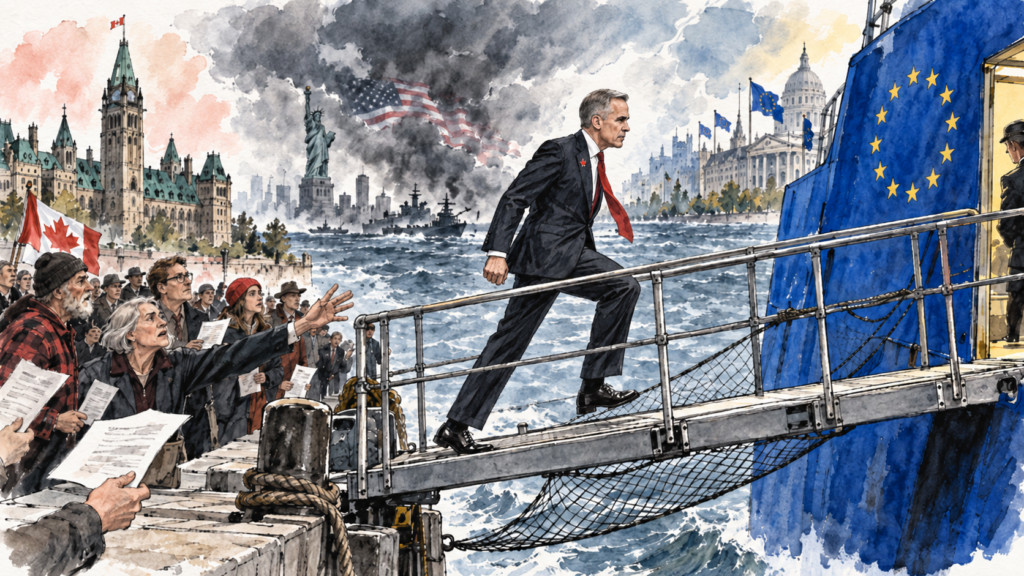
Six weeks ago, almost no one in Canada was talking about becoming an “associate member” of the European Union. Today, Prime Minister Mark Carney is openly welcoming the idea, European leaders are encouraging it, Donald Trump is threatening retaliation over it, and Canadians are being told that whatever eventually emerges will come before Parliament. That is an extraordinary amount of movement in a very short period of time.
There are good reasons for Canada to look beyond the United States. Our dependence on one market has always carried risk, and the current administration in Washington has made that risk impossible to ignore. Diversifying that exposure is prudent. Europe is an obvious place to look. Canada already has CETA, and there are opportunities in energy, critical minerals, defence, technology and artificial intelligence. Canada should be pursuing them aggressively.
But trade diversification and a new institutional relationship are not necessarily the same thing, and Canadians have not been given enough information to understand where that line is.
“Associate member” sounds reassuringly limited. We are not joining the European Union, we are told. The problem is that there has never been an associate member of the European Union before. The designation has no established precedent, the structure is still being worked out, and the relationship being discussed appears to extend well beyond tariffs and market access into defence, energy, critical minerals, artificial intelligence and broader strategic policy.
So what exactly are we talking about? What would Canada agree to? Which European rules or standards might Canada eventually be expected to align with? What obligations would come with deeper defence integration? What does associate membership provide that CETA, bilateral agreements and individual defence partnerships cannot already provide?
Those are questions about Canada, not arguments against Europe.
There is another reason for restraint. Germany voted this weekend, and the results were a reminder that Europe is undergoing its own political upheaval. In Mecklenburg-Western Pomerania, the Alternative for Germany won more than 38 per cent of the vote while Chancellor Friedrich Merz’s CDU collapsed to under five per cent. In Berlin, politics moved sharply in the opposite direction, with the Left Party finishing first. Europe has angry voters, weakened traditional parties and growing pressure on the political centre just as we do.
That does not make Europe undesirable. It does mean Canadians should resist the temptation to view Europe as a permanently stable alternative to an unstable United States. Britain is not even part of the European Union, yet Canada is deepening ties with Britain and other European countries through arrangements outside the EU. “Europe” and “the European Union” are not interchangeable.
Donald Trump has no veto over Canadian foreign policy. Calling closer Canada-EU ties a potentially “hostile act” should have no bearing on whether Canada pursues them. Canada chooses its own partners. But Trump’s opposition to something does not automatically settle the argument in its favour either.
That creates an uncomfortable problem for Pierre Poilievre, whose criticism of Carney now overlaps, at least visually, with opposition coming from Washington. Their arguments are not the same, but the optics make legitimate scrutiny easier to dismiss as siding with Trump. That would be a mistake. Canadians should be capable of rejecting American interference while still demanding answers from their own government.
Carney has said the eventual agreement will be debated and voted on in Parliament. Good. But there is a significant difference between Parliament considering a finished agreement and Parliament, committees, provinces and the public participating while the relationship is being designed.
This was not a defined proposition put before Canadians during the last federal election. Most Canadians had probably never heard the phrase “EU associate membership” because there was no such arrangement to explain. Now it is being discussed internationally at remarkable speed, while the details remain uncertain.
Perhaps the final agreement will be modest. Perhaps “associate membership” will become little more than a convenient name for deeper cooperation Canada should have pursued years ago. Perhaps it will be much more consequential. We do not yet know, and that is exactly why the public conversation should be happening now.
Canada should diversify its trade, strengthen its alliances and reduce vulnerabilities exposed by the current crisis with Washington. None of that requires us to make a generational decision at crisis speed.
Before this new relationship begins to feel inevitable, Canadians deserve to know what Canada is being asked to join, what we receive in return, what obligations we assume and how much of our economic, regulatory or strategic policy could eventually be affected.
There is urgency. There should also be restraint.