


As Canada debates stronger hate laws, the real challenge isn’t punishment. It’s drawing the line between criminal incitement and offensive speech. Getting that line wrong would have consequences far beyond the people the law is trying to stop.
Canada is once again debating how to deal with hate.
Bill C-9 is part of that discussion. Proposals like this are meant to strengthen penalties connected to hate-motivated acts and expand the legal framework around hate speech. The goal is to better protect people from harassment, intimidation, and violence directed at them because of who they are.
Protecting people from violence should not be controversial. If someone assaults another person because of their religion, ethnicity, sexuality, or any other identity, that’s not a grey area. It’s a crime. If someone openly calls for violence against a group or encourages others to harm them, that’s just as clear.
Those are actions. The justice system already knows how to deal with actions.
Where things start getting complicated is when the conversation moves from violence to speech.
There’s a difference between hatred and bad taste.
And there’s also a difference between offensive speech and criminal speech.
The word “hate” gets used constantly in politics and law, but the definition can be surprisingly vague. That becomes a problem the moment you try to write it into legislation. Vague definitions create room for interpretation, and interpretation changes depending on who is applying the law.
Imagine someone standing on a street corner arguing about religion and claiming their faith is superior to others. People have done that for centuries. If they lie about someone in a way that damages their reputation, defamation laws already exist. If they go further and say “go attack those people,” the situation changes immediately. That becomes incitement.
But suppose someone simply shouts something ugly and racist. Something ignorant that most decent people would reject outright.
Is that hate speech?
Or is it just an ignorant person telling the world exactly who he is?
Where the Line Matters
“Canada can’t become a country where the government tries to police what people think.”
That’s the uncomfortable line lawmakers have to deal with. People are allowed to hold bad opinions. Some people hold truly vile ones. That reality can’t be legislated away.
What the law can do is respond to behaviour that creates real harm.
The legal system already works this way in other areas. Context matters. Words aren’t judged in isolation. Their meaning depends on how they’re used and what they’re intended to do.
Take a simple example involving threats. If someone says, “I want to kill that person,” it might be nothing more than an angry outburst. If someone says, “I’ll pay you to kill that person,” the meaning changes entirely. If someone says, “Go kill that person,” the law may treat that as incitement.
The words look similar, but the legal consequences are completely different because the context is different.
Hate legislation needs to operate with that same precision.
Violence should be punished. Threats should be punished. Direct calls to harm people should be prosecuted. Those are clear lines and very few people would disagree with enforcing them strongly.
But Canada should be careful about expanding laws so broadly that every ugly or ignorant remark becomes a potential criminal issue. That risks pushing the law into the territory of policing expression rather than addressing real harm.

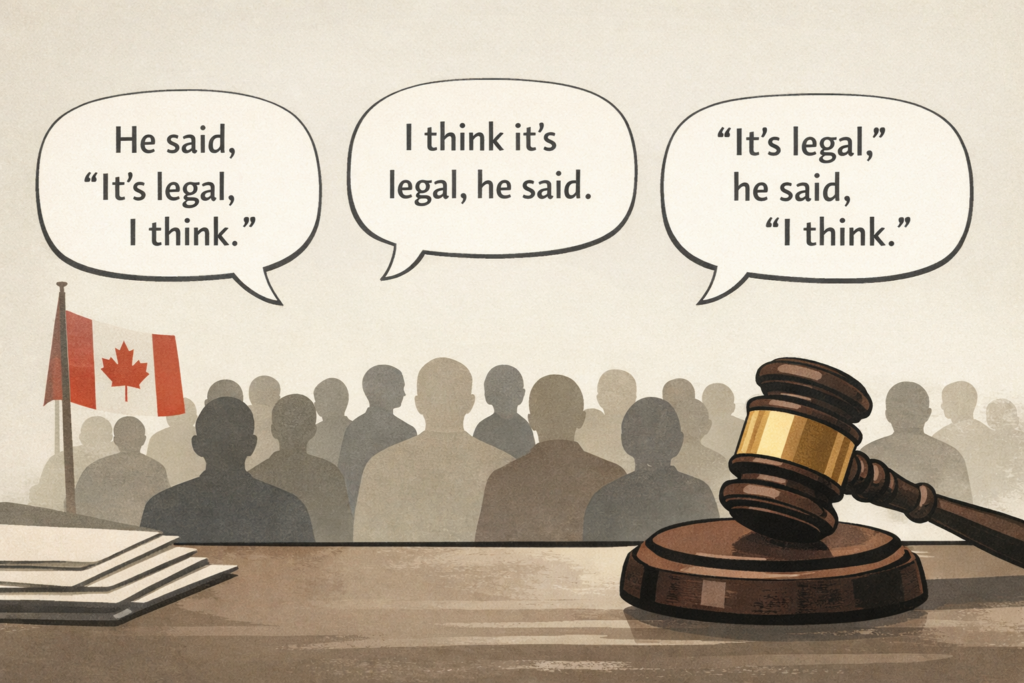
And it’s unlikely to solve the problem anyway.
Hatred doesn’t disappear because a law is written against it. Hatred fades when societies develop stronger cultural norms about how people treat each other.


That’s where the broader idea of Canadianism comes in. Canadianism, as I describe it through the Five Pillars, rejects hate outright. It emphasizes coexistence, civic responsibility, and the idea that people who live in this country are part of the same national community even when they disagree strongly about religion, politics, or culture.
When those values are widely shared, hatred tends to isolate itself. People who cling to hateful ideas expose themselves quickly because they stand outside the values most Canadians recognize.
Violence will always require enforcement. Laws will always be necessary to deal with threats and intimidation. But the long-term answer to hatred isn’t turning Canada into a place where every offensive remark becomes a legal case.
Canada needs laws that punish violence and real incitement. But it also needs the confidence to draw the line carefully.
Because once a society starts blurring that line, it isn’t just hate that ends up on trial.
It’s freedom itself.