


As Pierre Poilievre struggles to expand beyond the Conservative base, deeper questions are beginning to surface about the party’s coalition, its national appeal, and why Canada may need a stronger political centre.
For more than a year, Pierre Poilievre appeared to be the inevitable next prime minister of Canada. The Conservatives held large polling leads, their message was disciplined, and the party looked united behind a leader who had succeeded in energizing its base more effectively than any Conservative leader in years.
Politics, however, rarely stays still for long. The national conversation has shifted, and so have the questions surrounding the Conservative Party itself.
What is beginning to emerge is not simply a debate about Poilievre’s leadership. The larger issue is whether the coalition that forms the modern Conservative Party can hold together under the pressures now building inside it.
Within the party, Poilievre remains popular. Conservative members and activists continue to support him strongly, and his message on issues such as inflation, housing affordability, and government spending resonates with the voters who form the core of the Conservative base.
The difficulty lies elsewhere. Federal elections in Canada are not won by mobilizing the base alone. To form government, the Conservatives must build a coalition that stretches far beyond their traditional supporters. That means winning suburban voters, persuading moderates in Ontario, and attracting Canadians who are not ideological conservatives but who are willing to vote for the party if they see it as a stable governing option.
That is where the challenge becomes clear.
Poilievre’s political style has proven highly effective at channeling frustration, particularly among voters who feel that the economic system is no longer working for them. But the same confrontational tone that energizes supporters often makes it harder to broaden the party’s appeal nationally.
Many Conservatives understand this dilemma privately. The qualities that make Poilievre powerful within the party are not always the qualities that translate easily into broad national support.
Under normal circumstances, a party confronting this kind of tension would already be debating alternative leadership paths. Yet today there is no obvious successor waiting in the wings. The Conservative bench is unusually quiet, and no senior figure has begun positioning themselves publicly as a replacement.
That silence does not necessarily indicate stability. In politics it often means that people are waiting to see how events unfold.
There are already subtle signs of movement. Some Conservative MPs who previously stayed firmly in the background are raising their profiles, speaking more independently, and testing their own public voice. These shifts are small, but they are noticeable.
At the same time, another pressure point is growing inside the Conservative coalition, and it comes from the West.
Frustration in Alberta with Ottawa has been building for years. Debates over energy policy, equalization, and federal authority have fueled a rising separatist sentiment among a segment of the province’s population. While it remains a minority view, it is nevertheless a powerful emotional force within parts of the Conservative base.
Poilievre’s rise to leadership coincided with a broader populist surge that included the trucker convoy protests and a wave of anti-establishment activism. That movement helped energize the party and solidify his support among grassroots conservatives.
But it also left the party navigating a delicate balance.
To win government, the Conservatives must present themselves as a national party capable of governing the entire country. That requires building support not only in Alberta but also in Ontario, Quebec, and Atlantic Canada. Lean too heavily into Western grievances and the party risks alienating voters elsewhere. Distance itself from those grievances and it risks angering some of its most passionate supporters.
It is an uncomfortable strategic position.
Political coalitions tend to remain stable as long as victory appears possible. When the path to power becomes uncertain, internal divisions that once stayed hidden can begin to surface.
None of this means the Conservative Party is collapsing today. It clearly is not.
What it does suggest is that the party may be approaching a moment where it must decide what kind of coalition it intends to be: a movement anchored primarily in Western populism, or a broader national party capable of appealing to the political centre.
And that brings us to a larger question about Canada’s political landscape.
If the Conservatives struggle to broaden their appeal and drift further toward the margins, the country faces a narrowing set of choices. In that scenario, many voters who are dissatisfied with the governing party may find themselves with nowhere else to go. Some will reluctantly return to the Liberals. Others may drift toward smaller protest parties on the fringes of the political spectrum.

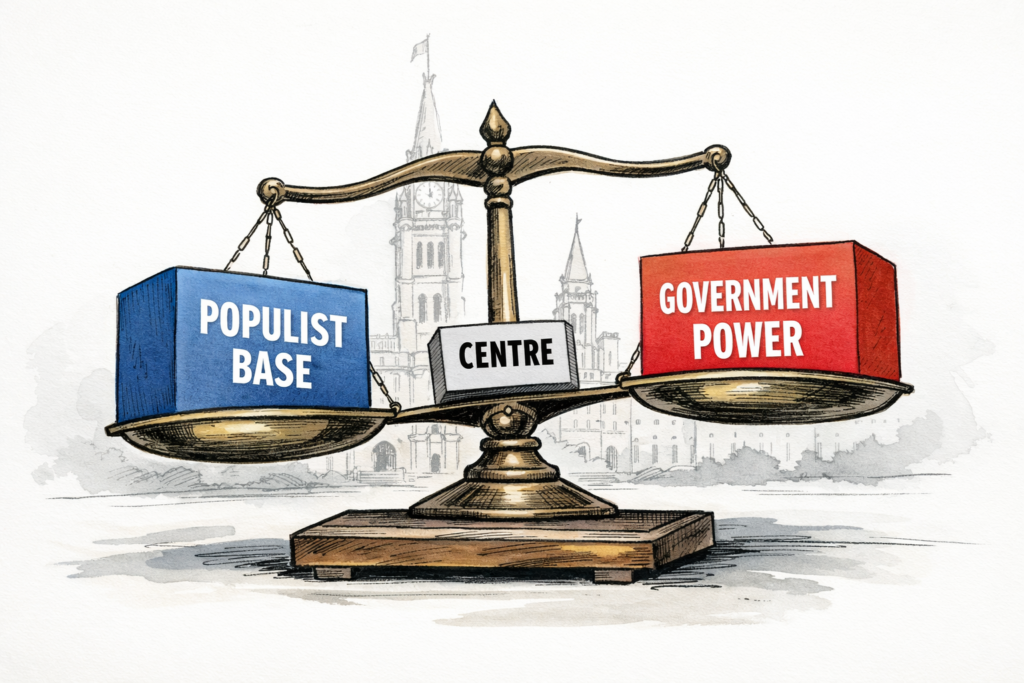
Neither outcome strengthens the country’s political system.
Canada has historically functioned best when its politics were built around compromise rather than ideological dominance. Confederation itself was the result of a negotiated balance between regions, cultures, and economic interests. That tradition of compromise remains one of the defining characteristics of Canadian democracy.
It is also why a viable political centre matters.
The United Canadian Centrists argue that Canada needs a party capable of occupying that middle ground, one that can acknowledge legitimate frustrations in the country without turning them into permanent divisions. A centrist party does not exist to replace other political movements, but to restore balance when the political system begins to tilt too far in one direction or another.
In fact, the goal is not to see the Conservative Party disappear. The concerns expressed by many of its supporters are real and deserve representation. But those voices must exist within a system where voters are offered more than a binary choice between opposing camps.
A healthy democracy requires competition, balance, and options.
Whether the Conservative coalition ultimately stabilizes or faces deeper fractures remains to be seen. What moments like this remind us, however, is that Canada’s political system works best when voters have a genuine voice of choice in the centre as well as on the edges.