


By Christopher M. Michaud | The Canadianist
November 5, 2026
I spent many years working in radio, where ratings were practically a religion. Every station wanted to be number one, and with enough demographic data, almost every station could find a category where it was. You might be number one among people walking their dogs between six and seven in the morning. It was a legitimate statistic, but hardly the whole story. The trick was knowing which numbers to show, which ones to leave out and how to make the results sound as impressive as possible.
Watching the Liberals and Conservatives argue over Mark Carney’s federal budget this week took me right back to those meetings. The government points to investments, growth and projected benefits. The opposition points to spending, borrowing and immigration targets. Both sides have numbers, and both are presenting them in the most flattering light. Too much of the debate is about the deficit, the fiscal anchors and whether 380,000 includes this group or that one, and not nearly enough about what any of it means for the people paying the bills.
Meanwhile, the average Canadian reacts to a federal budget in one of two ways.
Most tune it out. It’s dense, it gives them a headache, and after enough years of big announcements, they’ve stopped believing it’ll change anything in their lives. It’s hard to blame them.
The rest actually pay attention. They wait for budget day hoping to hear that things might get a little easier, that rent, groceries or a family doctor might finally come within reach. Then they go looking and can’t find it. Even when the relief is in there, it’s buried in hundreds of pages of tables and program names that only a policy analyst could love.
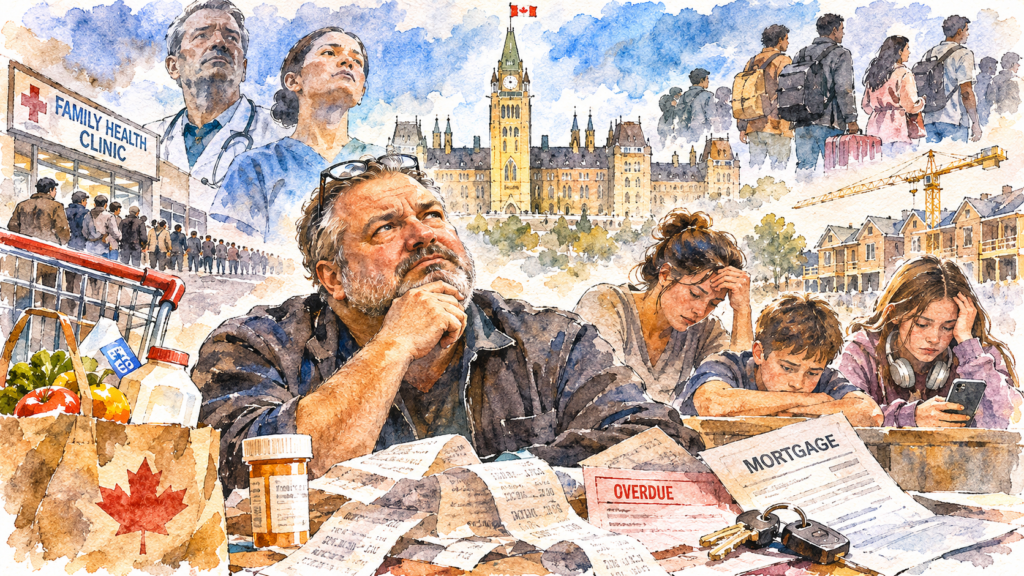
Either way, it’s a nothing burger. The budget comes and goes, the politicians go back to arguing about numbers, and the three monkeys on our backs (housing, health care and the cost of living) are right where they were the day before. And when nobody explains what a budget means, Canadians fill in the blanks themselves, usually with whatever they’re already worried about.
I’ve been reading this budget, and the problem isn’t that it’s complicated. A federal budget should be comprehensive. The problem is that the government presents its conclusions without the reasoning that would let Canadians see how those decisions are supposed to fix the problems they’re living with.
The immigration numbers are a perfect example.
Immigration: Yeah, But How Many Doctors?
According to Health Canada’s own workforce figures, which the Canadian Medical Association has been citing, Canada is short 22,823 family physicians. This week’s budget confirmed that Ottawa will admit 380,000 permanent residents a year through 2029.
The first thing I went looking for was the line connecting those two numbers. Of those 380,000, how many are coming in as family doctors who’ll actually be licensed and seeing patients? How many years before the shortage closes? What has Ottawa worked out with the provinces, which control medical licensing, so those doctors aren’t left waiting years for permission to practise?
I looked for that in the budget. It isn’t there.
To be fair, Ottawa does sort its admissions into categories, and it has run selection rounds aimed at health workers. But a category isn’t a commitment. Nowhere does the government say how many doctors it expects to land, by when, or how many will be treating patients at the end of it.
What the public got instead was a number. And a number, dropped on a country that’s already uneasy about immigration, doesn’t stay neutral for long. The blanks get filled in, and not kindly. Hand 380,000 to people carrying those three monkeys and the first reaction is perfectly natural: that’s another 380,000 people looking for an apartment, a family doctor and room in the grocery budget.
Being a Canadian, I often find myself thinking about this in terms of professional hockey. A general manager has to assess the team’s strengths and weaknesses, figure out which positions need attention and decide how to build a competitive roster. Sometimes that means taking the best player available. Sometimes it means fixing an immediate weakness. Either way, it takes a strategy he can defend.
Imagine a team struggling with poor goaltending and a weak defence. The general manager announces he’s bringing in a bunch of new players and assures the owners the team will improve. The owners would naturally want to know which positions those players are expected to fill, what they’ll cost and how they’ll fix the team’s weaknesses. They’d also expect him to account for the results at the end of the season.
The number of players signed wouldn’t be the measure of success. The team’s performance would. Canada’s weak spots aren’t a mystery. We’re short on doctors, nurses and tradespeople. Ottawa needs to be held to the same standard as any general manager.
Now picture the same announcement turned around. Canada needs 22,823 family physicians. Over the next five years, we’ll bring in a set number each year through immigration. We’ve reached agreements with provincial licensing bodies so they can start practising, and we’ll report back on how many are actually treating patients. Then do the same for nurses, personal support workers, the skilled trades and every other field where Ottawa has already identified a shortage. Account for the housing and infrastructure those newcomers will need. Lay out the timelines and what Canadians should expect to see at the end of them.
Then add it up, and let that be the number. Maybe it comes to 380,000. Maybe it’s higher, maybe it’s lower. I’m not arguing about the figure. I’m arguing about the order. Start with the problems, and the number takes care of itself.
Anyone who follows immigration closely will tell me that’s not how the number works, that much of it is family reunification and refugees, people who aren’t chosen to fill a job at all. Fair enough. But I’ve been reading this budget line by line, and that’s still where the government’s messaging led me. If someone paying close attention walks away with the wrong picture, imagine what the number means to someone who hears it for thirty seconds on the drive home.
And if the honest answer is that 22,823 doctors in five years isn’t realistic, then one of two things is true. Either our immigration system isn’t aimed at the jobs we most need filled, or something else is stopping those people from doing the work once they get here. Either way, Canadians deserve to be told which, and what’s being done about it. That’s exactly the kind of answer that never makes it into the announcement.
Delivered problem first, the number stops sounding like a threat. It becomes the answer to a problem Canadians already understand, because they live it every time they spend an afternoon in a walk-in clinic.
This week’s budget made the picture even murkier. Alongside the 380,000, Ottawa announced a pathway for up to 200,000 temporary residents to become permanent by the end of 2027, counted on top of the main target. These are people who already live here. They aren’t new arrivals. But with nobody explaining that, plenty of Canadians will simply add the two figures together and get angrier.
An immigration target isn’t a commitment to fix a labour shortage. If immigration is being sold as part of the solution, the government needs to tell Canadians exactly what those admissions are committed to delivering.
The Opposition Has a Responsibility, Too
Pierre Poilievre and the Conservatives are entitled to challenge the government’s immigration targets, spending and economic assumptions. That’s their job.
But challenging a number isn’t the same as offering an alternative. If 380,000 is too many, Canadians deserve to hear what the right number is and which shortages a lower figure would leave unfilled. If the government is spending too much, they deserve to know what the Conservatives would cut. And when the Conservatives do name cuts, they rarely say what Canadians get in their place.
Without that, the opposition gets an easy ride. It doesn’t have to win an argument about what immigration is for, because the government never made one. It only has to say the number’s too high, and the whole national conversation shrinks to a fight over a figure that was never the real issue.
I don’t expect the two sides to agree. I do expect them to give Canadians enough information to understand what they’re disagreeing about. Right now, both are back in the ratings meeting, each holding up the number that suits them.
Speak to the Room
There’s a rule I’ve carried through my career in broadcasting and entertainment: speak to the room. When I’m in front of a French-speaking audience in Quebec, I speak French. English may be the language I think and write in, but the audience shouldn’t have to accommodate my convenience.
The government needs to work the same way. A budget is built by economists, researchers and policy specialists who’ve already identified the problems, weighed the options and settled on recommendations. The government knows what it believes it’s fixing, what it assumes along the way and what it expects to happen. Canadians shouldn’t have to reconstruct that work themselves. Government needs to tell them.
I was reminded of this when I interviewed Leslie Farkas during his campaign for mayor of Wasaga Beach. Les developed a municipal policy he calls “Show Your Work,” which asks elected officials to lay out the facts, alternatives, costs, risks and expected outcomes behind major decisions. We got there independently, Les at the municipal level and me looking at Ottawa, and that tells you something. This isn’t one level of government’s problem.
Nor is it about dumbing anything down. Keep the forecasts and the technical analysis available for anyone who wants them. Just give everyone else an explanation they can use.
From the Grocery Shelf to Parliament Hill
Here’s the test I’d apply. When I’m standing in the grocery aisle looking at the price of a loaf of bread, which is nothing but flour, water, yeast and salt, and the government tells me it’s making life more affordable, I need to be able to draw a straight line, with no detours, from that shelf to a specific line in the budget. This measure, this much money, this much difference to what I pay, starting on this date.
To be fair, this budget does have grocery measures in it. A low- or modest-income family of four can get up to $2,570 over the year through the Canada Groceries and Essentials Benefit, counting the new top-up. That’s real money, but it’s a cheque, not a lower price. The budget also puts $3.2 billion into a National Food Security Strategy meant to boost competition and “help deliver more affordable prices.” How much more affordable, and by when? It doesn’t say. The bread still costs what it costs, and most Canadians couldn’t draw that line if they tried.
This isn’t the first time Ottawa has promised to bring grocery prices down. Back in 2023, François-Philippe Champagne, then the industry minister, went shopping for a foreign grocer to shake up a market dominated by Loblaw, Metro and Sobeys. By 2024 he had a list of a dozen chains, with Aldi and Lidl at the top. Two years later, I still can’t buy my groceries at either one. The promise made the headlines. The follow-up never made it to the grocery aisle. Champagne is the finance minister now. This week, he tabled the budget with the grocery cheques in it.
That’s the pattern with most of the benefits Ottawa announces. The grocery benefit, the workers’ benefit, the carbon rebate, even the pandemic cheques. They soften the blow, but they weren’t built to fix what’s causing it. They blunt the impact on Canadians while the underlying problem carries on untouched. Relief isn’t a solution. It’s what governments hand out when they don’t have one.
The same goes for everything else. When the government announces billions for housing, tell us how many homes that money is committed to producing, where and by when. When it announces health-care funding, tell patients what should improve, how it’ll be measured and what the provinces have agreed to deliver. When it promises growth, explain how that growth reaches a household that’s struggling to fill the fridge.
There’s a difference between announcing money, committing to an outcome and actually accomplishing something. We’ve gotten used to treating the first as proof of the third. It isn’t.
Every major government initiative needs to come with a plain explanation of the problem, the reasoning behind the solution, the cost, the commitment and the results it’ll be measured against. If circumstances change, the government needs to explain the change. If a commitment isn’t met, it needs to explain why. That’s the standard Canadians are entitled to.
Canadians Deserve the Reasoning
I don’t believe Canadians are incapable of understanding public policy. I believe they’re perfectly capable of noticing when the important questions haven’t been answered. That’s a big part of why so many have tuned out, and why the ones still paying attention keep coming away empty-handed.
Government communication has become so focused on announcing decisions and defending them politically that the reasoning gets lost along the way. Parliament has the research, the projections and the analysis behind every one of these decisions. Canadians shouldn’t have to spend days digging through hundreds of pages to piece together an explanation their government needs to be handing them.
I spent enough years in radio to know how this broadcast sounds. Red jerseys and blue jerseys going at it in the corners, and each team’s ratings guy up in the booth telling you his side is number one in some category or other. Meanwhile, the owners of this team, Canadians, are sitting in the stands watching the clock. We’re not asking who’s winning the scrum. We’re asking whether anybody’s going to score before time runs out.
Start with the problem. Show how the commitment solves it. Promise a result. Then give us the number.
Not the other way around.
Sources
Government of Canada, Budget 2026 (November 5, 2026)
CMA: Health workforce report reaction
CBC: Canadians need doctors
CTV News: Budget 2026 immigration plan