


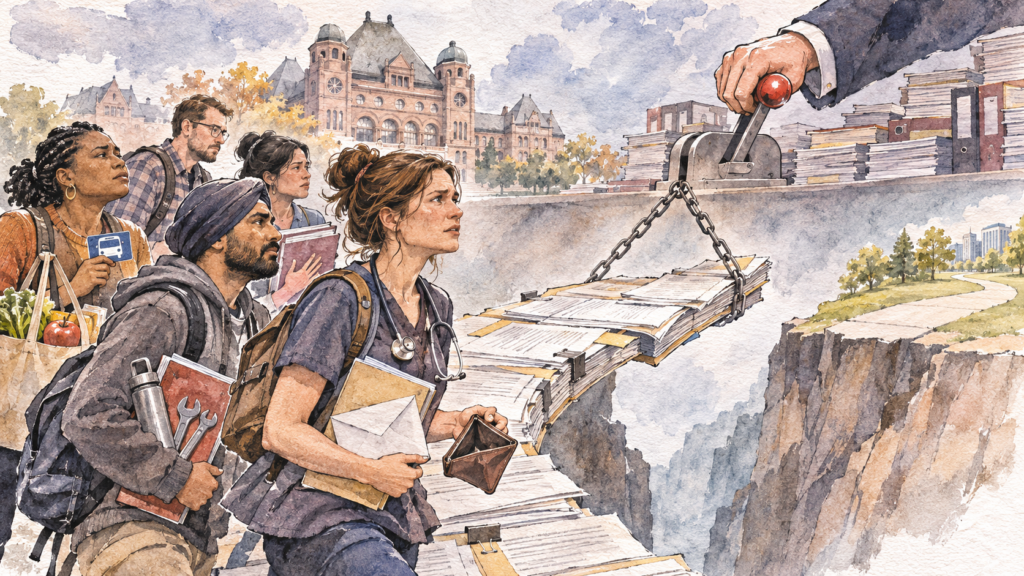
Doug Ford’s government knew about suspicious student assistance activity long before it restructured OSAP and suspended payments to private colleges. A month into the freeze, students are still waiting for their money, and the premier cannot tell them when it will arrive.
By Christopher M. Michaud | The Canadianist
November 5, 2026
Premier Doug Ford’s government has spent much of 2026 making consequential decisions about Ontario’s student assistance program while an investigation into suspected fraud has continued in the background. The province first announced a major restructuring that would shift substantially more of the cost of postsecondary education onto students. Months later, it suspended payments across the private postsecondary sector altogether. These decisions followed years of warnings about suspicious activity, yet the government has offered little explanation of how its successive responses fit together or why students with previously approved assistance have been left without a reliable means of supporting themselves.
On October 6, Ontario suspended payments under the Ontario Student Assistance Program (OSAP) to private postsecondary institutions while investigators examined irregularities involving applications, enrolment practices and institutional compliance. The decision came after many students had already made financial commitments based on expected assistance. On November 4, Ford said auditors from KPMG had been instructed to prioritize lower-risk institutions so payments could resume sooner, but he provided no firm timetable. Colleges and Universities Minister Nolan Quinn has previously indicated that a strengthened approval process may not be ready until the new year. For students still attending classes, that leaves an extraordinary degree of uncertainty about financial assistance they had every reason to expect.
Years of Warnings, Followed by Two Sweeping Decisions
The history of this problem begins well before October. In 2020, the Ford government expanded OSAP eligibility to online and asynchronous programs, including certain courses that did not require live instruction. The change broadened access to assistance but also increased the province’s responsibility to ensure that publicly financed education was being delivered and students were genuinely participating.
By January 2023, Career Colleges Ontario, the association representing private career colleges, had begun raising concerns with provincial officials about suspicious OSAP activity. According to correspondence subsequently reported by The Canadian Press, the association met with ministry officials several times that year, with further concerns continuing into 2024. In January 2025, it identified ten institutions showing extraordinary increases in applications. At one institution, the number reportedly climbed from 107 in 2022 to 2,992 in 2024. Such an increase does not establish fraud, but it certainly warrants investigation.
The province says it was examining irregularities internally and subsequently expanded targeted inspections. By May 2026, it had moved to deny OSAP eligibility to several campuses, decisions that became the subject of legal challenges. These actions demonstrate that Ontario possessed mechanisms for investigating particular institutions and restricting assistance where concerns warranted intervention. They also raise questions about the adequacy and timing of the government’s response to warnings it had been receiving for several years.
On February 12, 2026, Quinn announced a substantial restructuring of postsecondary financing. Provincial OSAP grants would be eliminated for students beginning programs at private career colleges on or after August 1, while students at public colleges and universities would also receive a substantially smaller proportion of provincial assistance in grants. For affected students, assistance that might previously have been provided without repayment would increasingly take the form of loans.
The government presented the restructuring as a response to financial pressures on the postsecondary system and concerns about OSAP’s long-term sustainability. Those are legitimate considerations, and the February policy extended beyond the private colleges subsequently affected by the freeze. Nevertheless, the decision was made while the province was already investigating serious questions about program integrity. The relationship between those investigations and the restructuring deserves a more detailed explanation. If weaknesses in verification and institutional oversight were contributing to improper expenditures, reducing grants and increasing loans would not, by itself, correct those weaknesses. An improperly approved application does not become legitimate simply because the assistance must eventually be repaid.
In August, Ontario engaged KPMG to examine broader concerns involving OSAP applications at private postsecondary institutions. On October 2, issues arising from preliminary findings were referred to the Ontario Provincial Police. Four days later, Quinn announced a suspension of payments across the private postsecondary sector, citing concerns involving student verification, enrolment practices, institutional ownership arrangements and unusual concentrations of applications.
The province has every responsibility to investigate suspected fraud, recover improperly paid funds where warranted and prevent further misuse of public money. But much of the activity described in its public statements concerns applications and payments from previous periods. The October decision extended the consequences of that investigation to financial assistance students were expecting in the present, including continuing students at institutions where no wrongdoing had been publicly identified.
Preventing future losses may justify stronger verification before disbursements are released. It does not, without further explanation, establish why payments had to be suspended across an entire sector. The province had already used targeted enforcement against particular campuses. What changed between those measures and October 6 that made a blanket suspension necessary? What alternatives were examined, and why were they considered inadequate?
The Continuing Students Ontario Could Verify
One of the most difficult aspects of the government’s response concerns students already well into their programs. Consider someone in the second year of an intensive healthcare training course who has completed substantial coursework, passed examinations, maintained satisfactory grades and previously received OSAP assistance. That student applies for the next period of funding, receives approval and continues attending classes, only to discover that the expected disbursement has been suspended.
This is a materially different situation from a first-time application at an institution whose enrolment practices have raised concerns. A continuing student has an academic history that can be examined, including transcripts, course records, completed assignments, attendance information and, in some programs, supervised practical assessments. These records cannot automatically be accepted as conclusive, particularly when the integrity of institutional reporting is part of the investigation. They do, however, provide a foundation for individual verification, supplemented where necessary by independent checks.
Ontario already requires schools to confirm enrolment before OSAP funds are released. The system also distinguishes between amounts directed toward tuition and funds deposited into students’ bank accounts for other educational and living expenses. Those existing procedures raise a practical question: why hasn’t the government established an interim process for continuing students whose eligibility and academic progress can be independently verified?
Such a process could prioritize students who were enrolled and receiving assistance before the freeze, remain in the same program and can demonstrate satisfactory academic progress. Additional verification could include independent examination of records, confirmation of attendance, direct contact with students and safeguards appropriate to the risks identified at particular institutions. Where eligibility is sufficiently established, the province could consider releasing the living-expense portion of approved assistance while continuing to withhold institutional tuition payments pending further review.
Colleges could potentially be offered conditional payment undertakings or deferred arrangements where appropriate, protecting students’ ability to continue studying without immediately releasing money to institutions still undergoing investigation. Any such arrangement would require clear legal authority, financial controls and procedures for addressing cases where eligibility remains uncertain. It would not eliminate every risk, nor would it be suitable for every institution or applicant. But the existence of risk is precisely why governments develop verification procedures rather than treating all applications identically.
Career Colleges Ontario has called for the restoration of assistance to previously approved students actively attending their programs in person. The ministry should explain whether it has examined a comparable interim arrangement and, if so, what prevented its implementation. If the government believes even independently verified continuing students cannot safely receive living-expense assistance, it should identify the specific obstacles. An explanation grounded in evidence would be considerably more useful than another assurance that auditors are working as quickly as possible.
The Costs Continue While the Payments Don’t
For students, suspended assistance is not simply an administrative delay. OSAP helps eligible applicants cover educational costs and living expenses, and many organize their household finances around expected disbursements. Some reduce working hours to attend intensive programs. Others have children, rental obligations, transportation expenses or family responsibilities that continue regardless of the status of a government investigation.
The immediate difficulty is particularly acute for continuing students whose academic responsibilities have not changed. They are still expected to attend classes, complete assignments, prepare for examinations and meet the standards necessary to remain in their programs. Their tuition obligations have not necessarily disappeared, and neither have their household expenses. They are being asked to continue investing in an education whose financial support has become uncertain through no individual finding of wrongdoing against them.
A delayed payment may create consequences that persist long after the original assistance is released. Rent arrears can accumulate, bills can become overdue and students may be forced to take additional work at the expense of their studies. For a household already managing a narrow financial margin, an interruption lasting several weeks can undermine arrangements developed over many months.
Private colleges also face difficulties when tuition payments stop. Institutions depend on operating revenue to retain instructors, maintain facilities and provide practical training. On November 4, The Canadian Press reported that an administrator at a dental hygiene college said students were withdrawing and layoffs were becoming a possibility. For students in regulated healthcare and vocational programs, an institutional closure could interrupt clinical placements, jeopardize credits or complicate the completion of qualifications for which they have already invested substantial time and money.
These consequences should have been considered before a sector-wide suspension was imposed. Ontario needs to disclose how many approved disbursements have been interrupted, how many affected students are continuing in multi-year programs and what protections exist if otherwise viable institutions cannot survive the funding interruption. The historical number of students receiving OSAP at private colleges does not establish how many individuals have actually experienced delayed payments this fall. The government should provide that figure rather than leaving the public to rely on estimates.
An Investigation Without a Payment Timetable
Ford’s November 4 announcement suggests that the province recognizes the need to distinguish institutions according to their level of risk. KPMG has been instructed to prioritize lower-risk colleges, potentially allowing some payments to resume before the broader investigation is complete. That approach invites further questions about the original suspension. If institutions can now be assessed and prioritized individually, why wasn’t a comparable process incorporated into the government’s response from the beginning?
There may be operational reasons. The province may have lacked sufficient evidence in October to establish reliable classifications, or preliminary findings may have raised concerns that required additional verification. If so, it should explain what information was missing, what standards are being applied and when institutions can expect decisions. Those directly affected should not have to infer their financial futures from occasional announcements at Queen’s Park.
Quinn has also discussed exploring third-party loans through financial institutions as a possible means of helping students during the interruption. Such arrangements could present additional borrowing obligations or costs for people who had already qualified for student assistance. As of November 5, no comprehensive interim program had been publicly confirmed that would ensure affected continuing students could meet their living expenses while the government’s investigation proceeded.
There is also uncertainty about the eventual release of the KPMG findings. Quinn has declined to commit to publishing the report, while Ford has suggested that it would ultimately be made public, subject to concerns about compromising the investigation. Confidential student information, commercially sensitive material and evidence relevant to police inquiries may require protection. Those concerns do not preclude the government from providing a sufficiently detailed public explanation of the findings, criteria and reasoning behind decisions affecting an entire sector.
Accountability Must Extend to the Government
The chronology is difficult to overlook. Ontario expanded eligibility in 2020. Industry warnings emerged by 2023, followed by more specific concerns in 2025. In February 2026, the government announced a restructuring that shifted more future education costs onto students. In August, it commissioned a wider audit. In October, it suspended payments across the private postsecondary sector. Now, in November, the premier cannot provide a firm date for restoring assistance.
It would be inaccurate to claim that Ontario did nothing during those years. The government conducted inspections, investigated particular campuses and took enforcement measures. Those actions deserve to be acknowledged. They also make it reasonable to examine why the province’s later response became so broad and why a workable transition arrangement for legitimate continuing students was not in place before payments were interrupted.
Students have responsibilities to apply honestly, attend their programs and maintain academic eligibility. Colleges must comply with provincial standards, maintain reliable records and deliver the instruction they promise. The government has corresponding obligations to oversee the system competently, respond promptly to credible warnings and consider the foreseeable consequences of its own decisions.
Ontario should publish a clear account of how the February restructuring related, if at all, to the ongoing fraud investigations. It should explain the evidence that justified the October suspension, identify the criteria used to assess institutional risk and provide a measurable timetable for reviews and payment decisions. Most urgently, it should address the possibility of an interim process that protects independently verified continuing students while institutional investigations proceed.
The proposed separation of living-expense assistance from institutional tuition payments deserves a specific response. The existing OSAP system already recognizes those different purposes. If the province cannot adapt its procedures to support eligible students without compromising its investigation, the public is entitled to understand why.
The government has spent years addressing concerns about the administration of student assistance, yet the immediate financial consequences of its latest decision are being experienced by people who may have complied with every requirement placed upon them. For those students, the questions about institutional oversight and government accountability are inseparable from the ordinary obligations they must meet tomorrow.
They need to know when their approved assistance will arrive. If Ontario cannot yet provide that date, it should explain what it is prepared to do to ensure legitimate continuing students can afford to remain in school while the investigation continues.
This is the first instalment in The Canadianist’s ongoing examination of Ontario’s OSAP decisions, their financial consequences and the government’s accountability for the administration of student assistance.