


Conservative MP Dean Allison gave me the subject for my next podcast this week, although probably not in the way he intended. Allison shared a Toronto Sun editorial carrying the headline, “Poilievre was right about everything.” It was presented as vindication. After everything that has happened since the election, the argument seems to be that Canadians can now look back and see that Pierre Poilievre had been right all along.
Fine. I’m willing to concede the headline completely. For the purposes of this argument, let’s assume Pierre Poilievre was right about everything.
If that’s true, why isn’t he Prime Minister?
Poilievre had an enormous polling lead. He faced an unpopular Liberal government after nearly a decade in office. He had years to make his case to Canadians, define the problems facing the country and convince enough people that he was the person to fix them. He didn’t. The Conservatives lost the election and Poilievre lost his own seat.
There are two ways to look at that. Poilievre may have been wrong about some of the major issues, in which case Conservatives have a problem with the argument they were making. But Allison is asking us to remove that possibility. Poilievre was right about everything. Okay. Then Conservatives have a different problem to confront: their leader couldn’t convince enough Canadians that he was right.
That’s a leadership problem.
Being right is about the argument. Leadership requires taking that argument to people who don’t already agree with you and persuading some of them to reconsider. A national leader has to be able to walk into a room containing people who voted Liberal, NDP, Bloc or Green, people who don’t particularly like him, and start a conversation. “Hello, my name is Pierre. Here’s how I see things. Here’s what I think needs to change. Let me explain why.”
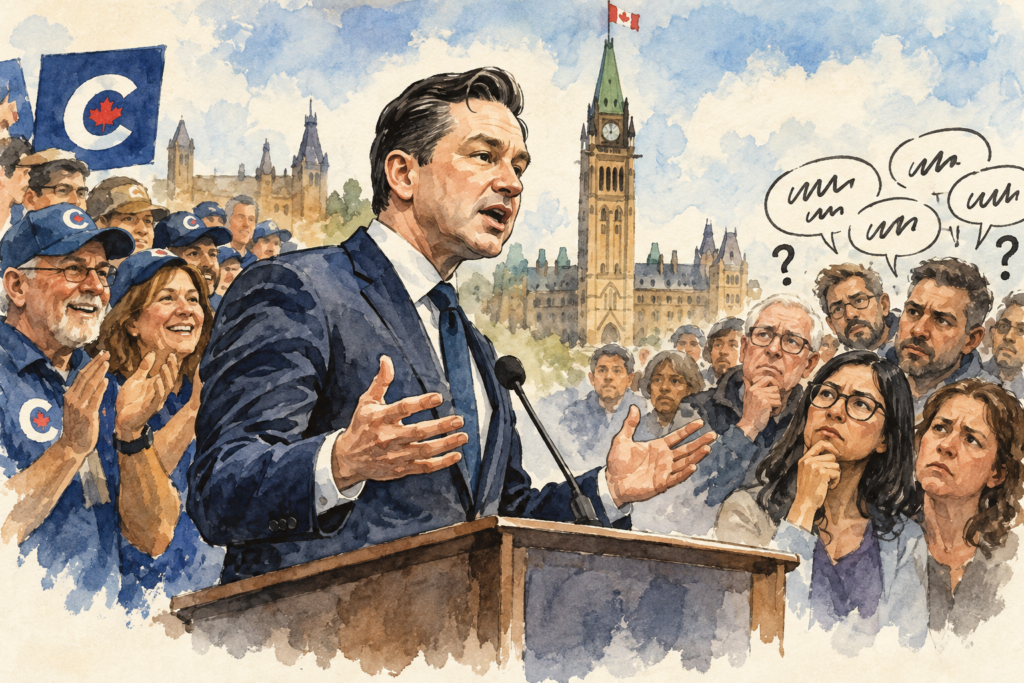
Poilievre has been very good at talking to Conservatives. He can fill a room with people who already believe the Liberals have damaged the country and give them an articulate, forceful explanation of how it happened. They understand him perfectly. They already speak the language.
The problem is the other room.
This is where Charlie Brown comes to mind. Inside the Conservative tent, people hear every word Poilievre says. Outside it, a considerable part of the country seems to hear “wah wah wah, wah wah.” You can complain about that audience. You can tell yourself they weren’t listening, were misled by the media or were frightened by Liberal attacks. Or you can recognize that communicating successfully with that audience was the job.
I know the response because we’ve heard it repeatedly since the election. Donald Trump changed everything. Justin Trudeau resigned. Mark Carney arrived. Canadians became concerned about the United States. The media environment changed. The Liberals frightened people. Events overtook the Conservative campaign.
Yes. They did.
Political leaders don’t get to choose the circumstances in which they lead. Opponents change. Wars start. Economies turn. Presidents get elected. Issues that seemed decisive six months ago suddenly become secondary. Public priorities move. The test of leadership is what you do when that happens.
Every political party that has ever lost an election can produce a list of things that happened to it. The more useful exercise is asking what it failed to overcome.
And Conservatives don’t own this problem.
I’ve been making essentially the same complaint about Liberal governments from the opposite direction. For years, Canadians have asked perfectly reasonable questions about housing, immigration, affordability, healthcare and the cost of living and too often received a talking point instead of an explanation. Criticism gets dismissed as partisan. A government announces a policy, explains its intentions and seems surprised when people judge it by what is actually happening in their lives.
Good intentions don’t communicate themselves. Neither do good policies.
If you believe you have a sound immigration policy but Canadians are increasingly worried about the pressure population growth is putting on housing and public services, telling them they’re wrong to be concerned isn’t communication. Explain the policy. Explain the numbers. Explain the trade-offs. Listen to what people are experiencing. And if circumstances have changed, change the policy.
The same applies to affordability. Governments can produce charts showing inflation slowing, announce temporary relief and point to economic indicators. The person standing at a grocery checkout looking at the price of three ordinary items doesn’t live inside a Statistics Canada spreadsheet. If the government believes conditions are improving, it has to explain why that person isn’t feeling it yet and what it intends to do about it.
I have criticized the Liberals for exactly this reason. Questions get answered with talking points. Concerns are sometimes treated as political attacks instead of information about what citizens are actually experiencing. Eventually people stop believing you’re listening.
So I’m not creating a special standard for Pierre Poilievre. I’m applying the same standard to him.
If Liberals have a policy they believe is right and cannot explain it to Canadians, that is their failure. If Conservatives have an argument they believe is right and cannot persuade Canadians to support it, that is their failure. Voters are not obligated to decode what political parties are trying to tell them.
The responsibility runs the other way.
That’s why Dean Allison’s post interests me so much. Instead of asking how a leader who was supposedly right about everything managed to lose an election he once appeared overwhelmingly likely to win, the headline celebrates the correctness of the diagnosis. It treats eventual vindication as though that settles the question.
I think it raises a much more uncomfortable one.
If Pierre Poilievre was right about everything, why couldn’t he convince enough Canadians to follow him?
That question extends well beyond Poilievre. Canadian politics has become remarkably good at reinforcement and increasingly poor at persuasion. Conservatives talk to Conservatives. Liberals talk to Liberals. New Democrats talk to New Democrats. Each group has its vocabulary, its media, its villains and its explanation for why the people outside the tent just don’t get it.
Our political system encourages some of this. Political identities have hardened as a wide range of Canadian views gets compressed into a small number of competing blocs. Once politics becomes primarily a contest between those blocs, there is an obvious incentive to motivate your own side rather than undertake the harder work of persuading somebody from the other one.
That is precisely the culture the Radical Centre has to reject.
There would be no purpose in building another political tribe whose members sit around congratulating one another for being reasonable. If the United Canadian Centrists eventually become another room filled exclusively with people who already agree with me, I will have failed too.
I want the Conservative who thinks I’m too liberal to listen. I want the Liberal who thinks I’m too conservative to listen. I want someone to hear an argument they initially reject and remain in the conversation long enough to consider it. And I have an obligation to listen when they tell me why I haven’t convinced them.
That doesn’t require surrendering principles every time somebody disagrees. It requires understanding that disagreement is where political leadership begins, not where it ends.
Canada was built through negotiation among people and regions that did not always want the same things. Our parliamentary tradition itself was designed around representation, debate and compromise. We seem to have replaced too much of that political instinct with an endless effort to prove that our side was right.
Being right is useful.
Getting somebody who thought you were wrong to hear you out, reconsider and eventually come with you is leadership.
So, Dean Allison, thank you. Genuinely. Because in trying to demonstrate Pierre Poilievre’s vindication, you may have provided one of the cleanest illustrations of the problem.
If Pierre Poilievre was right about everything, why couldn’t he convince enough Canadians to follow him?
And when did Canadian politics stop measuring leadership by our ability to persuade people who disagree with us?