


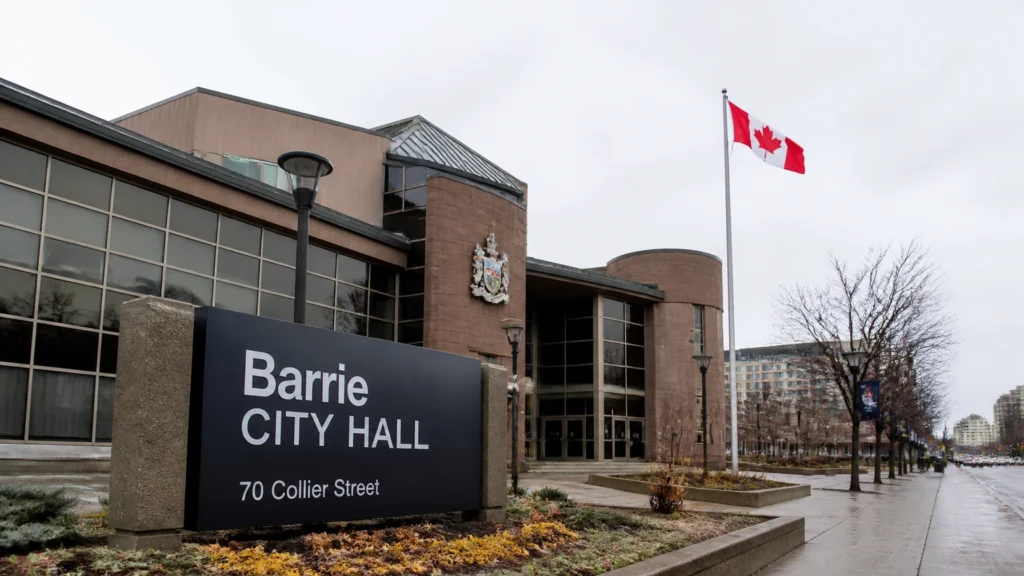
It was September 9, 2025, when Barrie Mayor Alex Nuttall stood before reporters and declared a municipal state of emergency over the city's escalating encampment crisis. Framed as a bold, decisive stroke to restore public order, protect sensitive waterways, and reclaim public parks, the declaration granted city hall sweeping emergency powers. Tents were proliferating along boulevards, public safety concerns were mounting, and municipal leaders promised that swift intervention would turn the tide.
Fast forward to July 2026. One full year later, that very same state of emergency remains officially in effect.
For followers of local barrie news, city hall’s narrative is one of relentless progress: a steady drumbeat of statistics celebrating hundreds of cleared sites and restored public spaces. But for anyone looking past the press releases, a more sobering truth emerges. Sweeping tents off municipal land and rewriting bylaws do not equal solving homelessness. As Barrie City Council prepares to navigate another summer under emergency bylaws, it is time to strip away the political optics and ask hard questions: What has a year of emergency powers actually achieved, and who is footing the bill for this superficial brand of crisis management?
The Anatomy of an Emergency: September 2025
To understand where Barrie stands today, we must revisit the climate that triggered the emergency order. By late summer 2025, public frustration in Barrie had reached a boiling point. The growth of visible encampments in parks, near commercial corridors, and along transit routes had become a flashpoint for residents and business owners alike.
Mayor Nuttall’s emergency declaration was built on a dual imperative: addressing acute public health and safety hazards while reasserting municipal control. City officials pointed to severe environmental contamination: including E. coli levels multiple times above allowable thresholds in streams adjacent to encampments: along with mounting fire hazards and reports of crime and disorder.


Under the emergency framework, Barrie City Council authorized the formation of specialized response units, accelerated the dismantling of temporary shelters near critical infrastructure, enforced stricter bylaws against public camping, and mobilized inter-agency coordination with the County of Simcoe.
The political calculus was straightforward: declare a state of emergency, project absolute control, and use expedited powers to clear the streets. But emergencies are designed to be temporary measures to bridge a crisis: not permanent governing frameworks. The fact that Barrie’s emergency order remains active twelve months later signals a fundamental failure to transition from reactive policing to sustainable solutions.
The Numbers Game: 184 Addressed, 702 Unhoused
City hall loves a clean metric. According to municipal tracking data heading into mid-2026, no fewer than 184 encampments have been "addressed" across Barrie since the emergency was declared. As of June 2026, just 5 known encampments remain on municipally owned land. On paper, these figures are presented by administration as proof of operational success.
Yet, a municipal ledger counting dismantled tents tells only half the story.
Behind those statistics lies a staggering human toll. Regional data identifies 702 individuals actively experiencing homelessness across the Barrie area. When a downtown park or railway corridor is cleared under emergency protocols, the tents disappear from that specific parcel of municipal land: but the human beings occupying them do not vanish into thin air. They are displaced into alleys, wooded fringes, neighboring jurisdictions, or hidden makeshift shelters further away from the very social services meant to support them.

Critics and local advocates have repeatedly challenged barrie city council over this shell game. Displacement is not housing. While the Encampment Response Team and local outreach partners have successfully connected a portion of displaced residents to temporary shelter beds or transitional housing, a vast structural gap remains. When emergency bylaws treat homelessness primarily as a bylaw enforcement infraction rather than a structural housing and healthcare crisis, the cycle of displacement simply perpetuates itself.
The Inter-Agency Tug-of-War: City Hall vs. County of Simcoe
A recurring theme throughout this twelve-month ordeal has been the ongoing friction between Barrie City Council and the County of Simcoe. While the City holds the municipal policing and bylaw powers to clear public property, the legal and financial responsibility for social services, emergency housing, and addiction supports largely rests with the County.
Over the past year, Mayor Nuttall and city councillors have frequently pointed fingers upward, arguing that Barrie bears a disproportionate burden of the region's unhoused population due to its concentration of services. Calls for "repatriation" of encampment residents to their home municipalities and demands for expanded county-funded shelter capacity have dominated closed-door and open council sessions alike.

This inter-governmental ping-pong has left vulnerable residents caught in the bureaucratic crossfire. While politicians debate jurisdictional boundaries and funding formulas, the core drivers of homelessness: soaring rental costs, inadequate mental health infrastructure, and a broken addiction treatment system: continue unabated.
Holding Power to Account: What Council Got Wrong
Looking back at the past year of barrie news, the most striking takeaway is how easily temporary emergency governance became normalized. When a municipality governs by emergency decree for over a year, it bypasses the traditional, deliberative processes of democratic accountability.
Barrie City Council doubled down on a containment strategy. Stricter prohibitions against temporary structures on public land, combined with intensive enforcement, successfully sanitized high-visibility tourist areas and downtown squares. But this sanitization came at the expense of long-term strategic investment in permanent supportive housing.
Sweeps are expensive. Deploying enforcement personnel, coordinating cleanup crews, managing hazardous waste remediation, and maintaining emergency oversight committees year-round demands substantial taxpayer resources. Imagine if even a fraction of those recurring operational expenditures had been channeled directly into acquiring permanent, low-barrier housing or expanding 24/7 integrated health support teams. Instead, council chose the path of least political resistance: clearing the symptom while ignoring the root cause.
Conclusion: The Perpetual Emergency
As Barrie enters the second half of 2026 with its state of emergency still stubbornly in place, residents are left with a sobering reality check. The emergency powers did not solve homelessness in Barrie; they simply managed its visibility.
When 702 individuals remain unhoused and new makeshift camps continue to sprout up the moment older ones are bulldozed, celebrating "184 encampments addressed" rings hollow. It is time for barrie city council to recognize that emergency declarations are not a substitute for visionary housing policy. Until municipal leaders stop treating homelessness as a logistical inconvenience to be swept away and start treating it as a profound civic failure requiring substantive investment, Barrie’s state of emergency will remain a permanent fixture of a broken status quo.
{“@type”:”NewsArticle”,”author”:{“name”:”BARRIE | NEWS DESK”,”@type”:”Organization”},”@context”:”https://schema.org”,”headline”:”The Encampment Emergency Nobody Solved: One Year Later in Barrie”,”publisher”:{“url”:”https://thecanadianist.news”,”name”:”BARRIE | NEWS DESK”,”@type”:”Organization”},”description”:”One year after Barrie Mayor Alex Nuttall declared a state of emergency over homeless encampments, we examine what Barrie City Council has achieved, the limits of enforcement, and why the crisis persists.”,”datePublished”:”2026-07-31″}