


Lorne Doerkson becomes British Columbia’s premier today after beating the NDP by 10 points and winning more than twice as many seats. Ontarians shouldn’t file that under West Coast news. It’s how most of this country is governed.
Today at Government House in Victoria, Lorne Doerkson takes the oath as British Columbia’s 38th premier, with his first cabinet sworn in alongside him. It’s the first Conservative government in that province since Simon Fraser Tolmie left office in 1933, and on its own terms it’s a genuine piece of history.
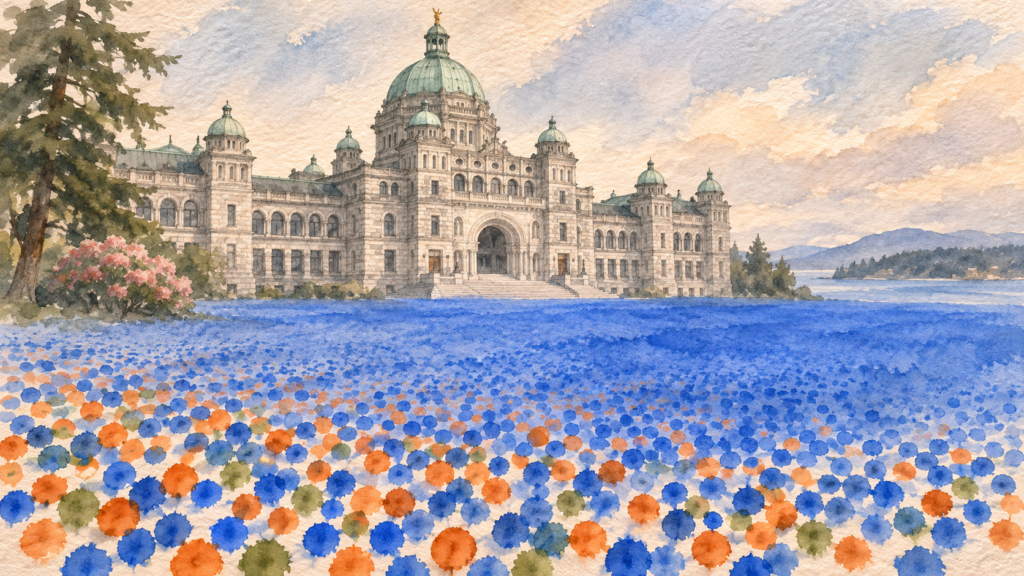
Pull up the results map in today’s coverage and British Columbia looks like it made up its mind. It’s a sea of blue, with patches of orange and a fleck or two of green. It works the way a TV screen works. From across the room, the picture looks solid. Get close enough and it breaks apart into thousands of tiny dots, each its own colour, and the image you thought you saw turns out to be mostly distance.
Get close to British Columbia and the same thing happens. Stop people on the street and ask how they voted, and you’ll hear Conservative, then NDP, then Conservative again, with some Green sprinkled in. Out of every ten voters, roughly five voted Conservative, four voted NDP and one voted Green. That’s a real lead, and a clear win by any fair measure, but it’s a divided province arguing with itself. Judge by the legislature, though, and you’d expect seven of those ten to answer Conservative before you finished the question. The Conservatives won 64 seats to the NDP’s 27. That’s more than twice as many seats, with only about 10 points more of the popular vote.
That’s the disconnect. The conversation on the street is close. The result on the map looks like a runaway. And with turnout at about 52 per cent, roughly one registered voter in four chose the party that now controls more than two-thirds of the legislature.
Anyone in Ontario should recognize the picture, because Ontarians have been living with the same arithmetic for years. In February 2025, Doug Ford’s Progressive Conservatives took 42.97 per cent of the vote and the second-place Liberals took 29.95 per cent. The PCs won 80 seats and the Liberals won 14. About 43 per cent more votes produced nearly six times as many seats. The NDP, third in the popular vote at 18.55 per cent, won 27 seats and became the Official Opposition. Turnout was 45.4 per cent, which means roughly one registered Ontarian in five voted for the government that holds nearly two-thirds of the seats at Queen’s Park.
Quebec added its own example last month. The Parti Québécois formed a government with about 28 per cent of the vote. The Coalition avenir Québec won roughly 40,000 more votes than Québec solidaire and came away with no seats at all, while Québec solidaire won nine.
Ottawa runs on the same rules and took a different route to the same place. In the 2025 federal election, the Bloc Québécois and the NDP each took 6.3 per cent of the vote. The Bloc won 22 seats and the NDP won seven. The Liberals won 169 seats with 43.7 per cent, three short of a majority. They reached one this spring, after five opposition MPs crossed the floor and the party swept three byelections, making Mark Carney’s the first federal government in Canadian history to move from minority to majority between elections. All of it was within the rules, and that’s exactly the point. In our system, the size of a government’s majority and the size of its support at the ballot box are two different numbers, and nothing requires them to be close.
None of this is a scandal. The winners won fairly, and they have every right to govern. But there’s a distinction worth holding onto. A majority of seats is a legal mandate to form a government. It isn’t evidence that a province, or the country, has been persuaded.
On Thursday in Victoria, as he and his MLAs were sworn in as members of the legislature, Doerkson gave them sound advice. He told them to serve their constituents first, to advocate fiercely for the people of the province and to be honest “even to a fault.” The Globe and Mail reported that he also told them to listen more than they speak. It’s good counsel. The test is whether it survives a government that no longer needs anyone else’s votes to pass a bill.
That’s where the structure matters more than the people in it. When the seat count is tight, a government has to listen whether it wants to or not, because it needs somebody across the aisle. When the count is lopsided, that pressure disappears. It gets easier to speak mainly to the people who already agree, and to mistake winning the chamber for settling the argument. Every party that’s held a big majority in this country has fallen into that at one time or another, and it’s rarely because its people were worse than the ones who came before. The system simply stopped requiring them to persuade anyone.
So in Victoria, at Queen’s Park and now in Ottawa, whatever listening a majority government does, it does by choice. That’s a lot to rest on the good intentions of whoever happens to be in charge.
Canada has a long habit of compressing a complicated country into two columns and calling the result a mandate, then wondering why so many people feel politically homeless in a system that’s working, on paper, exactly as designed. Doerkson may well govern as though the other half of British Columbia counts, and I hope he does. But when the only thing standing between less than half the vote and all of the power is the winner’s good judgment, the strain between votes, seats and the feeling of being represented isn’t going anywhere, in any province.
To be Canadian is a status. To be a Canadianist is a commitment.
Christopher M. Michaud is the publisher of The Canadianist. He is also the founder and leader of the United Canadian Centrists.