


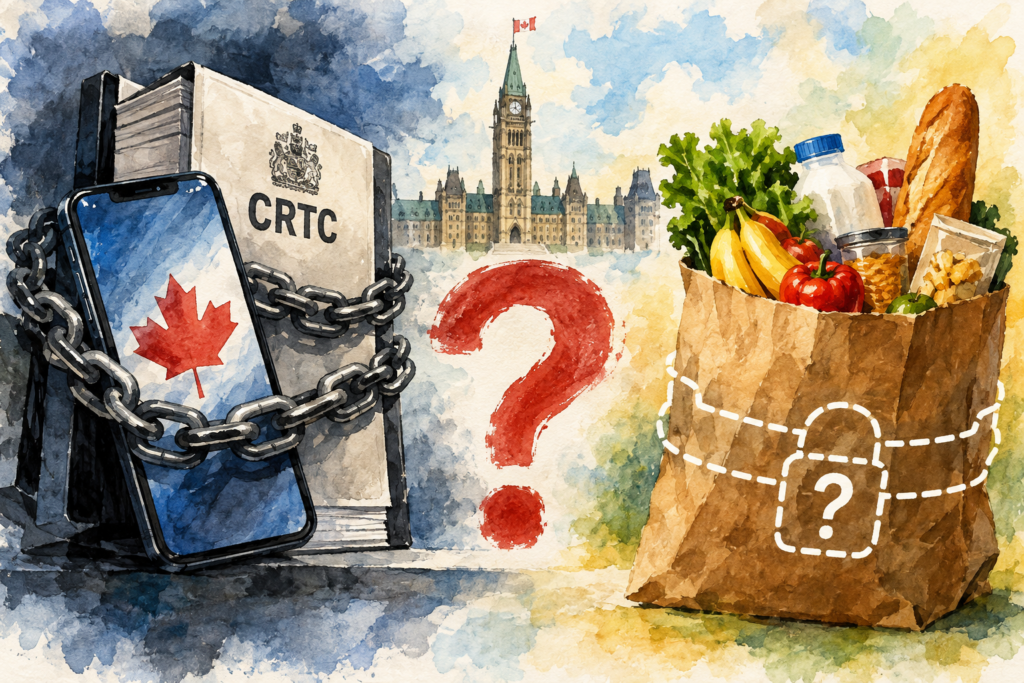
Canada doesn’t regulate every business, nor should it. Most businesses operate under the normal rules governing competition, consumer protection, employment, taxation and commerce. They decide what they sell and what they charge, and consumers decide whether they want to buy it.
There are industries, however, where Canada has decided that isn’t enough. Telecommunications is a good example.
Bell, Rogers and Telus are private companies. They compete with each other, set most of their own retail prices and make money doing it. They also operate within a federal regulatory framework because telecommunications has become an essential part of everyday life in Canada.
The CRTC regulates the telecommunications sector in the public interest. Its responsibilities include competition, wholesale access, consumer protections and certain service obligations. The Telecommunications Act itself recognizes that telecommunications performs an essential role in Canadian society and includes reliable and affordable service among the objectives of Canadian telecommunications policy.
None of this means the government runs Bell or decides what Rogers can charge you for every cellphone plan. Canada has simply decided that telecommunications is important enough that the industry requires dedicated oversight beyond the laws that apply to businesses generally.
I have a hard time understanding why we haven’t applied the same reasoning to food.
Most Canadians have no practical alternative to buying their food through the commercial food system. We aren’t growing enough vegetables in the backyard, raising livestock or producing our own dairy products. We buy food from grocery stores because that’s how modern Canadian society works.
Canada already regulates a great deal of what happens before that food reaches us. There are rules governing food safety, labelling, weights and measures and agricultural products. Grocery retailers are subject to competition and consumer laws. Canada also has a Grocery Sector Code of Conduct, fully implemented in January 2026, dealing primarily with relationships between retailers and suppliers.
What Canada doesn’t have is a national regulator responsible for the retail grocery market itself and the interests of the people who depend on it.
That becomes more difficult to explain when you look at what the grocery business has become.
The Competition Bureau describes Canada’s grocery sector as concentrated. Loblaw, Sobeys and Metro control a significant share of conventional grocery retail, while Walmart and Costco are also major players. The amount of actual choice available to a consumer can vary considerably depending on where that person lives.
The Competition Bureau has been examining competition in the grocery sector for years and is now looking more broadly at the food supply chain. That work is necessary, but competition policy isn’t a substitute for deciding whether an essential industry requires ongoing regulatory oversight.
Canada already makes that distinction in telecommunications. Having several cellphone companies competing for customers hasn’t eliminated the CRTC.
Technology is adding another reason to have this discussion.
Grocery retailers can now collect far more information about individual customers than they could a generation ago. Loyalty programs can produce detailed purchasing histories. Grocery apps provide personalized offers. Online shopping generates information about searches, purchases and browsing behaviour. Electronic pricing systems make it possible to change prices quickly and remotely.
The federal NDP has recently raised concerns about “surveillance pricing,” where information about an individual consumer could be used to determine the price or offer presented to that person. The party has proposed banning the use of personal information such as income, location, browsing history or previous purchases to determine individualized prices.
Whether surveillance pricing becomes common in Canadian grocery stores remains to be seen. There is already enough technology and customer data available to make the question worth addressing before the practice becomes established.
There are legitimate uses for personalized offers and loyalty programs. A supermarket sending someone a coupon for a product they regularly buy isn’t automatically a problem. Using information about that same customer to determine that they are likely willing to pay more for a product raises a very different consumer issue.
This is where I think the discussion needs to go beyond surveillance pricing.
Food is an essential market. Grocery companies should be able to compete, make money, invest, innovate and determine their own prices. Creating a regulatory framework doesn’t require government to decide what a loaf of bread should cost any more than telecommunications regulation requires the CRTC to decide the price of every cellphone plan.
A grocery regulator could instead establish rules around personalized and algorithmic pricing, the use of customer purchasing data, pricing transparency and disclosure. It could monitor practices in communities where consumers have limited alternatives and examine new pricing technologies as they enter the market. It could also collect and publish information about the grocery market on an ongoing basis instead of waiting until prices or business practices become serious enough to trigger another study.
There are legitimate arguments against creating another regulator. Regulation costs money. Poorly designed rules can increase costs for businesses and consumers, discourage competition and make it harder for smaller companies to enter the market. A new regulator that simply duplicates the Competition Bureau, the Canadian Food Inspection Agency or existing provincial responsibilities wouldn’t accomplish much.
Those are questions that would have to be worked through before creating anything.
What I don’t think makes much sense is refusing to have the discussion because grocery stores are private businesses. So are telecommunications companies.
Canada decided that telecommunications had become important enough in people’s daily lives to require a specific regulatory framework while allowing the companies involved to remain private and profitable.
Food is at least as important to everyday life, and I would argue considerably more so.
The Competition Bureau reported in September that grocery prices increased 22 per cent between 2022 and 2025, compared with 13 per cent for other consumer prices. Canadians have spent the last several years arguing about grocery prices, competition, profits, supply chains and affordability. Governments have commissioned studies, introduced affordability measures and supported an industry code of conduct.
What we haven’t really discussed is whether the regulatory structure surrounding the grocery industry still makes sense.
Canada doesn’t need to run grocery stores, and it doesn’t need to decide the price of every item on the shelf. It does need to decide whether an industry that almost every Canadian depends on several times a week should continue to operate without the kind of dedicated public-interest oversight we already accept in other essential sectors.
If we decided decades ago that telecommunications had reached that point, it’s reasonable to ask whether food reached it a long time ago and we simply never caught up.