


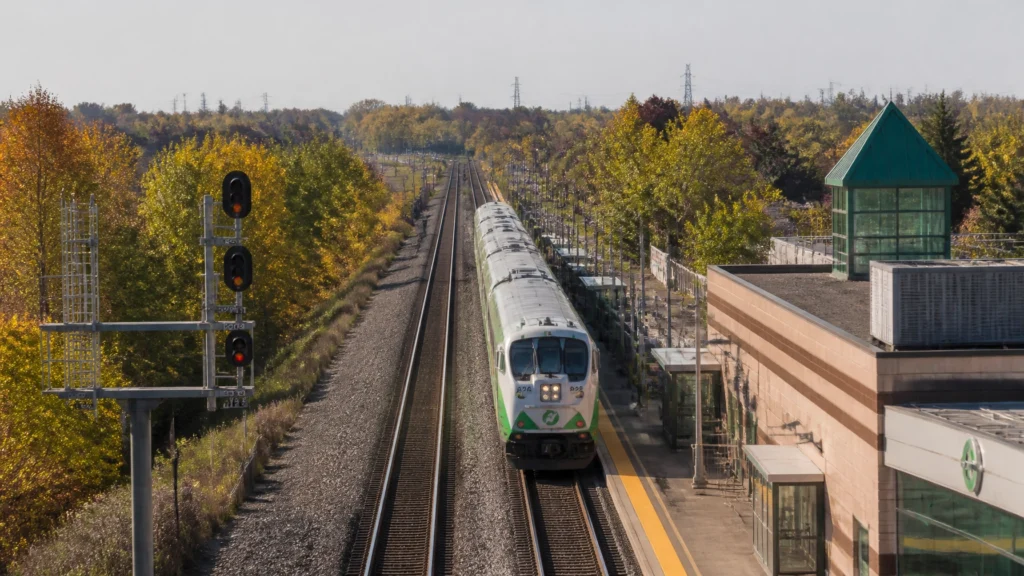
There is an old, cynical axiom in municipal politics that whenever a bureaucrat speaks of a vision, the local taxpayer should immediately check their pockets for missing change. For years, the gospel preached across York Region and the northern reaches of the Greater Toronto Area has been simple enough to fit on a billboard: build the trains, and the good life will follow. We were promised that steel rails and commuter locomotives would liberate us from gridlock, rescue our suburban working families from endless hours on the asphalt, and usher in an era of orderly, civilized growth. But as Markham and York Region councils enthusiastically back a sweeping master-planning proposal for the entire Stouffville GO corridor, one is forced to ask a rather impolite question. Is this ambitious transit expansion genuinely about moving people, or is it merely a Trojan horse designed to cram provincial housing density mandates down the throats of communities that never asked for them?
If you spend an afternoon wandering through the sleepy corners of Whitchurch-Stouffville, or observing the frantic paving operations around the edges of Markham, you can feel the gears of technocratic machinery grinding away in the background. The proposed Stouffville GO Corridor Master Plan is not content with merely upgrading a rail line or slapping a fresh coat of paint on a suburban platform. No, our regional overlords want a grand, intergovernmental steering committee to coordinate housing, employment, education facilities, cultural destinations, and recreation from Union Station all the way up to Lincolnville. They speak in hushed, reverent tones of transit-oriented development, complete destination communities, and twenty-four-hour urban nodes. It sounds terribly modern, sophisticated, and progressive, right up until you realize that local infrastructure readiness is being treated as an afterthought in a desperate race to satisfy arbitrary provincial headcounts.


To understand the sheer audacity of this enterprise, one must look at how the cards are stacked. For generations, the appeal of moving north: past the smog and congestion of downtown Toronto into places like Newmarket, Aurora, and the rolling fields of York Region: was the promise of breathing room. People traded proximity for peace, accepting longer commutes in exchange for neighborhoods where water mains didn't burst every winter and local schools weren't crammed three portables deep before September even began. Yet, under the guise of the province's relentless housing crusade, regional planning has been inverted. Minimum planned density targets of one hundred and fifty persons and jobs per hectare are now being slapped onto major transit station areas as if municipalities were Lego sets waiting for an overzealous toddler to rearrange them.
The architects of these master plans will tell you that doubling down on rail transit is simply common sense. After all, Metrolinx has poured billions into track upgrades, second-line installations, and grade separations along the Stouffville line to promise twenty-four-hour, all-day service. They point to Milliken, Agincourt, and Unionville as testaments to progress, complete with new pedestrian tunnels, elevators, and sleek canopies. But let us be entirely frank about what happens when you drop high-rise, mixed-use density targets onto suburban transit nodes without fixing the underlying plumbing first. The roads leading to these stations were laid out decades ago to handle modest suburban traffic flows, not thousands of high-density condominium dwellers spilling out onto arterial thoroughfares every morning.

When local councils rubber-stamp these sweeping corridor studies under the banner of regional cooperation, they are essentially outsourcing local democracy to unelected consultants and provincial steering committees. The timeline stretches out comfortably toward March twenty-twenty-seven, when municipal staff are expected to report back with findings and implementation frameworks. That is conveniently far enough down the road to insulate current politicians from immediate accountability, yet close enough to ensure that the bureaucratic momentum becomes irreversible. The strategy is classic Queen's Park: create a multi-layered governance structure so complex that the average citizen cannot figure out who is actually responsible when the local sewage plant reaches capacity or the local intersection gridlocks permanently.
What gets lost in the glossy slide decks and promotional brochures for transit-oriented communities is the unique identity of northern suburban life. We are told that everyone must live in stacked townhouses and fifteen-story glass towers within walking distance of a GO station, as if the suburban dream of a detached home with a backyard was some historical aberration that needs correcting. Mainstream media outlets and urban policy wonks look down their noses at anyone who dares question this densification gospel, labeling them as backward-looking obstructionists. But true critical thinking requires us to examine who actually benefits from these top-down mandates. Developers reap massive windfalls by flipping high-density parcels adjacent to transit lines, while municipal treasuries are left scrambling to pay for the endless cycle of soft and hard infrastructure upgrades required to keep the lights on.

If we are serious about building sustainable communities across York Region, our leaders need to stop acting as local branch offices for provincial housing ministries. Transit expansion should serve the communities it touches, rather than serving as an administrative lever to force unwanted intensification upon them. Until our municipal councils find the backbone to demand true infrastructure parity before signing off on mega-corridor master plans, we will continue to watch our local governance eroded in broad daylight. For more critical coverage of municipal affairs and provincial overreach in our backyard, explore our ongoing reporting on The Canadianist North of the City category. The noise we import from downtown boardrooms shouldn't drown out the reality of what life is actually like on the ground in our northern communities.
{“@type”:”Article”,”author”:{“name”:”NEWMARKET | NEWSDESK”,”@type”:”Organization”},”@context”:”https://schema.org”,”headline”:”The Stouffville GO Corridor Master Plan: Transit Expansion or a Growth Mandate Disguised as Infrastructure?”,”publisher”:{“url”:”https://thecanadianist.news”,”name”:”The Canadianist”,”@type”:”Organization”},”description”:”An investigative critique examining Markham and York Region councils backing a master-planning proposal for the Stouffville GO corridor, questioning whether transit expansion is masking top-down provincial density mandates.”,”mainEntityOfPage”:{“@id”:”https://thecanadianist.news/category/north-of-the-city/”,”@type”:”WebPage”}}