


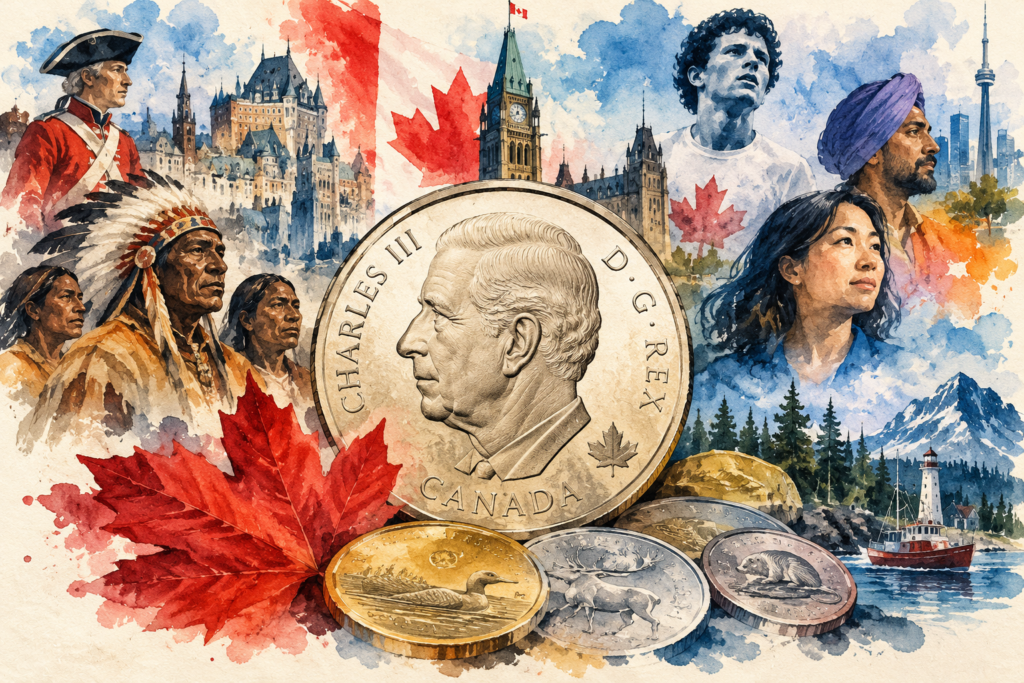
A recent post on LinkedIn and Facebook by my friend Gary Charles, questioning whether King Charles III should continue appearing on Canadian currency, reminded me of a conversation I had a few years ago with another friend, Steven Rosati.
Steven is a professional artist and a very talented performer whom I’ve hired on several occasions. He’s also from Pierrefonds, the same Montreal suburb where I grew up, and just next door to where Gary is from. A little bit of West Island trivia.
I remember Steven proudly telling me that he’d been selected to create the official portrait of King Charles III for Canada’s new coinage. His design had just been approved. Imagine knowing your artwork would eventually find its way into the pockets of millions of Canadians.
I’ve always been pleased for Steven. It’s a remarkable achievement for an artist, particularly one from my own hometown.
But Gary’s post got me thinking about something considerably larger than the portrait itself.
Why, in 2026, are we still putting the British monarch on Canadian money? And perhaps more importantly, what does that image mean to the Canadians who carry it?
Because depending on whom you ask, the answers can be profoundly different.
One Crown, Many Histories
Canada’s relationship with the monarchy is anything but uniform. The Crown’s been part of our political institutions for centuries, but its meaning changes considerably depending on whose history you’re telling.
In Ontario, particularly across the communities that grew out of Upper Canada, British traditions remain deeply embedded in our institutions and public life. The United Empire Loyalists who arrived following the American Revolution helped establish a society that deliberately maintained its allegiance to the Crown. Subsequent generations of British settlers reinforced that identity.
I’ve sometimes thought of southern Ontario as the New England that remained British. There’s a historical irony in that. While New England helped give birth to the American republic, communities north of the border preserved the political traditions the revolutionaries had rejected.
For many of those early settlers, the Crown represented refuge, continuity and the society they wanted to build.
Travel east into Quebec, however, and the same Crown carries an entirely different history.
French Canadians didn’t choose British rule. Their ancestors experienced the conquest of New France, followed by the transfer of French territory to Britain in 1763. The monarchy became the symbol of the power that had defeated them.
Quebec has since developed into a modern democratic society, and French Canadians have played an indispensable role in shaping Canada. None of that erases the historical memory of conquest.
Consider what it means for a people to see the symbols of their conquerors preserved in their country’s institutions, generation after generation. Imagine that history appearing on the money they use to buy groceries, pay their bills and conduct their everyday lives.
For some Quebecers, the monarch’s portrait is precisely that reminder.
The experience is hardly universal. Quebecers hold different views about the monarchy, just as Ontarians do. But the historical origins of those views can’t be ignored.
And Quebec is far from the only place where the Crown carries a difficult legacy.
The Crown and the People Who Were Already Here
For First Nations, Inuit and Métis peoples, the history of the Crown reaches into questions of sovereignty, land, treaties and the exercise of colonial authority.
The relationship is complicated because the Crown has represented both solemn obligations and the governments responsible for violating them.
Treaties entered into with the Crown remain fundamental to the legal and political relationships between Canada and many Indigenous nations. Those treaties established obligations that the Crown and Canadian governments are still bound to honour.
At the same time, colonial administrations operating under Crown authority imposed policies that displaced communities, restricted rights and attempted to dismantle Indigenous cultures.
There are Indigenous leaders who regard the Crown as an essential treaty partner, particularly when governments fail to honour their obligations. Others see the institution primarily through the history of colonial domination.
Those perspectives deserve to be understood on their own terms.
The monarchy can’t be discussed seriously in Canada without acknowledging that the country’s constitutional traditions were established alongside the dispossession of peoples who were already here.
The Histories We Brought With Us
Canada’s modern population introduces still more historical relationships with the British Crown.
Consider Canadians whose families came from India.
British colonial rule shaped the Indian subcontinent for generations before independence in 1947. For many families, the history of empire includes economic exploitation, political repression and the struggle for self-government.
Those memories didn’t disappear when people immigrated to Canada.
A Canadian whose grandparents lived under British rule in India may see the monarchy quite differently from a Canadian whose grandparents proudly celebrated their British heritage in Ontario.
The same complexity exists among Canadians from Hong Kong.
For more than a century and a half, Hong Kong was governed as a British colony, apart from the Japanese occupation during the Second World War. Some people who lived under British administration remember its institutions favourably, particularly in comparison with subsequent political developments. Others remember a colonial system in which the population had limited democratic control over its government.
Canadians from the Caribbean, Africa and other former British territories bring additional experiences of empire, independence and historical identity.
And all these histories now exist together in Canada.
A descendant of Loyalists, a francophone Quebecer, a member of a First Nation and a Canadian whose family came from Punjab may live in the same neighbourhood. They may shop at the same grocery store, pay the same taxes and use the same Canadian currency.
But the monarch’s portrait may mean something entirely different to each of them.
We can’t assume that one inherited symbol carries a common emotional meaning simply because we all share the same citizenship.
What the Crown Actually Does
There is, of course, a constitutional reality behind the symbolism.
Charles III is Canada’s head of state. He’s King of Canada in his own right, and our constitutional monarchy operates independently of the British government.
Canada doesn’t take political instructions from London. Our Parliament makes Canadian laws, our governments answer to Canadian voters, and our monetary policy is determined by Canadian institutions.
The Crown remains part of the constitutional framework through which executive authority is exercised, legislation receives royal assent and the Governor General performs the duties of the head of state.
For many Canadians, that arrangement provides continuity and a measure of institutional stability. The monarch’s separate from the elected politicians who temporarily hold government office.
There’s also a substantial constitutional obstacle to replacing the monarchy. Changes to the office of the monarch engage an amendment procedure requiring agreement from Parliament and all ten provincial legislatures.
We should understand those realities before proposing changes to the institution itself.
But we should also recognize that maintaining a constitutional monarchy doesn’t require us to place the monarch’s portrait on every coin.
Those are two different decisions.
Our Money, Our Identity
Look at the banknotes Canadians carry.
Our five-, ten-, fifty- and hundred-dollar bills have honoured figures drawn from Canada’s own history. Sir Wilfrid Laurier, Sir John A. Macdonald, William Lyon Mackenzie King and Sir Robert Borden have all appeared on our currency. Viola Desmond now appears on the ten-dollar note, and Terry Fox has been selected for the next five.
These choices tell us something about how Canada sees itself and whose contributions we consider worthy of national recognition.
The twenty-dollar bill has remained the royal exception, featuring Queen Elizabeth II, with Charles III selected to succeed her on the next design.
Our coins tell a similar story. One side carries familiar Canadian images: the beaver, the caribou, the Bluenose, the loon and the polar bear. The other carries the reigning monarch.
The imagery’s so familiar that most of us barely notice it.
Yet currency is among the most widely circulated expressions of national identity. It passes through our hands every day. It travels beyond our borders. It becomes part of how visitors and newcomers recognize a country.
And Canadian currency has no financial dependence on London. The British government doesn’t determine the value of our dollar, set our interest rates or control the Bank of Canada.
The monarch’s portrait is there because of tradition and symbolism.
Which brings us to the question Gary’s post raised in my mind.
If our currency’s Canadian, why shouldn’t the people we honour on it increasingly be Canadian as well?
Looking Inside Canada
I don’t believe Canada needs to discard its British heritage. That heritage’s part of our history, just as our French heritage, Indigenous foundations and the experiences of successive immigrant communities are part of it.
We should understand all of them, including the chapters that are uncomfortable.
But the Canada that exists today’s considerably larger than the colonial relationships from which it emerged.
We’ve produced extraordinary writers, artists, musicians, scientists, athletes, inventors, educators and community leaders. We’ve developed institutions, traditions and achievements that belong to us.
Some of the people responsible are household names. Others are largely forgotten outside their communities.
We could honour Canadians on our currency for generations without running out of worthy subjects.
And there’s no reason those subjects must all come from the distant past. History’s being made in Canada every day.
I’ve written before about Canadianism as an understanding of who we are as a people. It begins with recognizing that Canada has developed a character of its own, shaped by people whose histories are often very different but whose futures are connected.
We’ve spent much of our existence defining ourselves through our relationships with other countries. Britain and France shaped our beginnings. The United States has profoundly influenced our economic and cultural life.
Those relationships remain important. But they needn’t provide the centre of our national identity.
We’ve got enough history of our own now. Enough achievement. Enough cultural depth. Enough people whose lives and contributions deserve recognition.
Which brings me back to Steven Rosati.
I take genuine pleasure in knowing that an artist from Pierrefonds created a portrait that will be seen by millions of Canadians. His work deserves recognition, regardless of how we feel about the monarchy.
I’d be reluctant to see Steven’s work disappear from circulation. I’m proud of what he’s accomplished, and I think he’s a terrific artist. But perhaps the next time we’re commissioning a portrait for Canadian currency, we could hire Steven to paint someone else. We certainly have no shortage of Canadians worthy of the honour.
This doesn’t require a constitutional crisis, a referendum or the abolition of the monarchy.
It requires us to think about what our national symbols are meant to represent.
The Crown will always have a place in Canadian history. Its constitutional future’s a question Canadians can continue to debate.
But when it comes to the faces on our money, perhaps we should spend less time looking across the Atlantic and more time looking around us.
Canada’s got plenty of its own people worth remembering.