Listeners:
Top listeners:
-
 play_arrow
S1 E9 | Are We That Incompetent? Canada vs Saudi Arabia
-
 play_arrow
S1 E2 | Milk, Markets, and the Cost of Protection

Artemis Returns Humanity to the Moon After More Than 50 Years
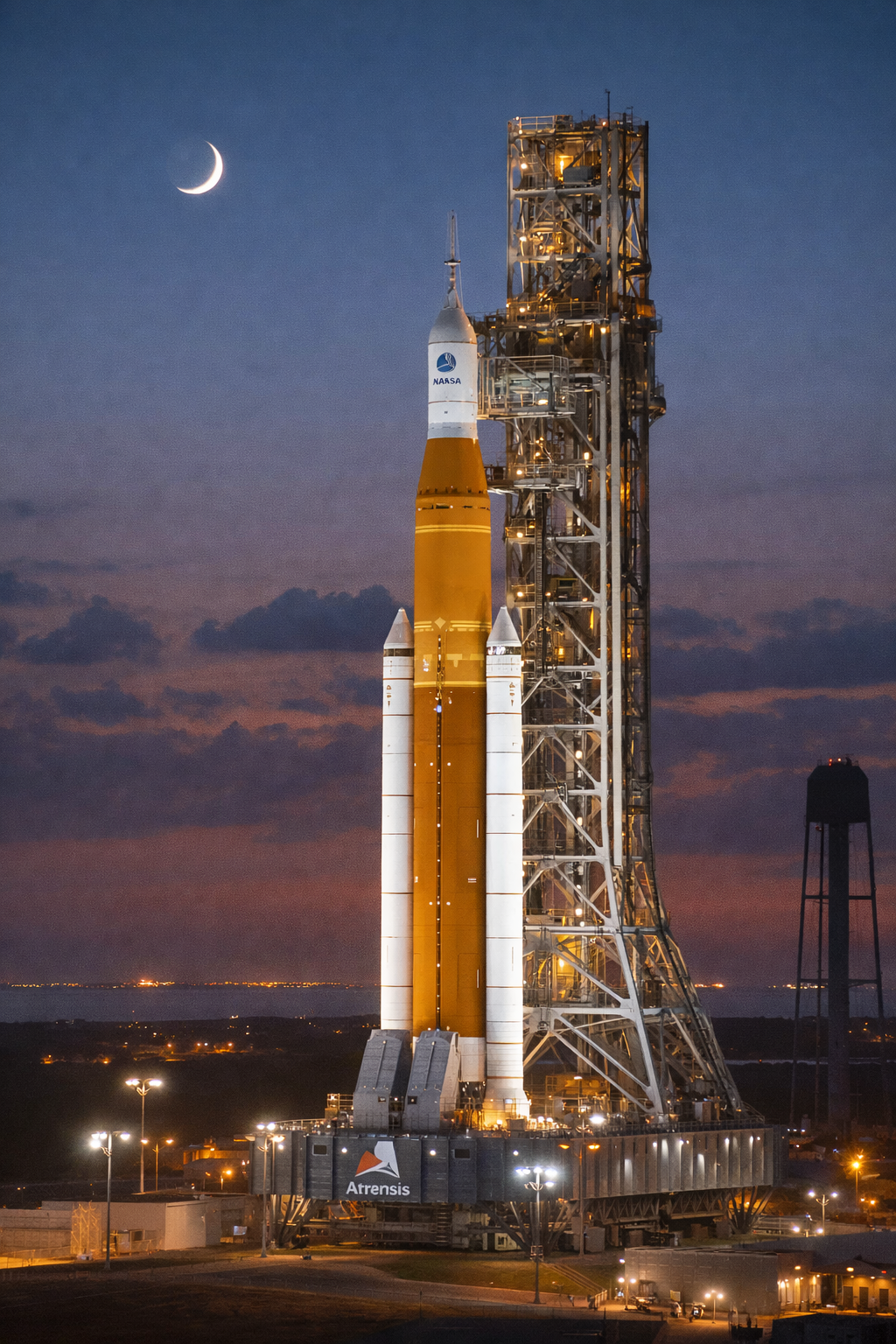
Artemis Returns Humanity to the Moon After More Than 50 Years, Paving the Way for a New Era of Space Exploration
After more than half a century since astronauts last ventured beyond Earth orbit, NASA’s Artemis program is preparing to usher in a bold new chapter in space exploration. The second mission under this initiative, Artemis II, is poised to launch as early as February 2026, marking the first time humans will journey around the Moon since the final Apollo mission in 1972.
Named after Artemis, the twin sister of Apollo in Greek mythology and goddess of the Moon, the program represents a strategic return to lunar space with far-reaching scientific, technological and exploratory goals. The overarching aim of Artemis is not only to revisit the Moon but also to make sustained human presence a reality, with long-term plans that include lunar bases, orbiting space stations and eventually missions to Mars and beyond.
At the heart of this effort is Artemis II, a planned 10-day crewed flight that will send four astronauts aboard NASA’s Space Launch System (SLS) rocket and the Orion spacecraft on a free-return trajectory around the Moon and back to Earth. Unlike the uncrewed Artemis I mission in 2022, this mission will carry humans deeper into space than any crew has traveled in more than five decades.
The crew scheduled for this historic flight includes NASA astronauts Reid Wiseman, Victor Glover and Christina Koch, joined by Jeremy Hansen of the Canadian Space Agency, marking the first time a non-American will join a lunar-orbit crew. During the mission, the team will travel out to lunar distance, swing around the Moon and return to Earth, testing life support, navigation and communication systems essential for future deep-space missions.
A key objective of Artemis II is to validate the performance of spacecraft systems in the harsh environment of deep space, ensuring that hardware and procedures are ready for more ambitious objectives, including the first lunar surface landing under the Artemis banner (Artemis III) currently targeted for mid-2027. That mission will include a lunar landing with scientific research and exploration near the Moon’s South Pole.
Technologically, the Artemis program represents a collaboration between multiple partners and leverages decades of advancement since the Apollo era. The SLS rocket, one of the most powerful ever built, and the Orion capsule are designed for long-duration missions. Artemis also includes contributions from international partners and private aerospace firms working on lunar landers, habitats and the Gateway, a small space station planned for lunar orbit that will support both lunar surface missions and future Mars expeditions.
Scientifically, the missions aim to unlock new understanding about the Moon’s geology, resources such as water ice, and conditions that could support longer human stays. Lessons learned on the Moon will help engineers design systems for life on Mars and sustainably explore deeper into the solar system.
For humanity, Artemis is more than a mission to the Moon. It signals a renewed commitment to exploration, international cooperation, scientific discovery and expanding the frontier of what humans can achieve beyond our home planet.


Post comments (0)