Listeners:
Top listeners:
-
 play_arrow
S1 E9 | Are We That Incompetent? Canada vs Saudi Arabia
-
 play_arrow
S1 E2 | Milk, Markets, and the Cost of Protection

Carney and Poilievre Clash Over Federal Fiscal Strategy
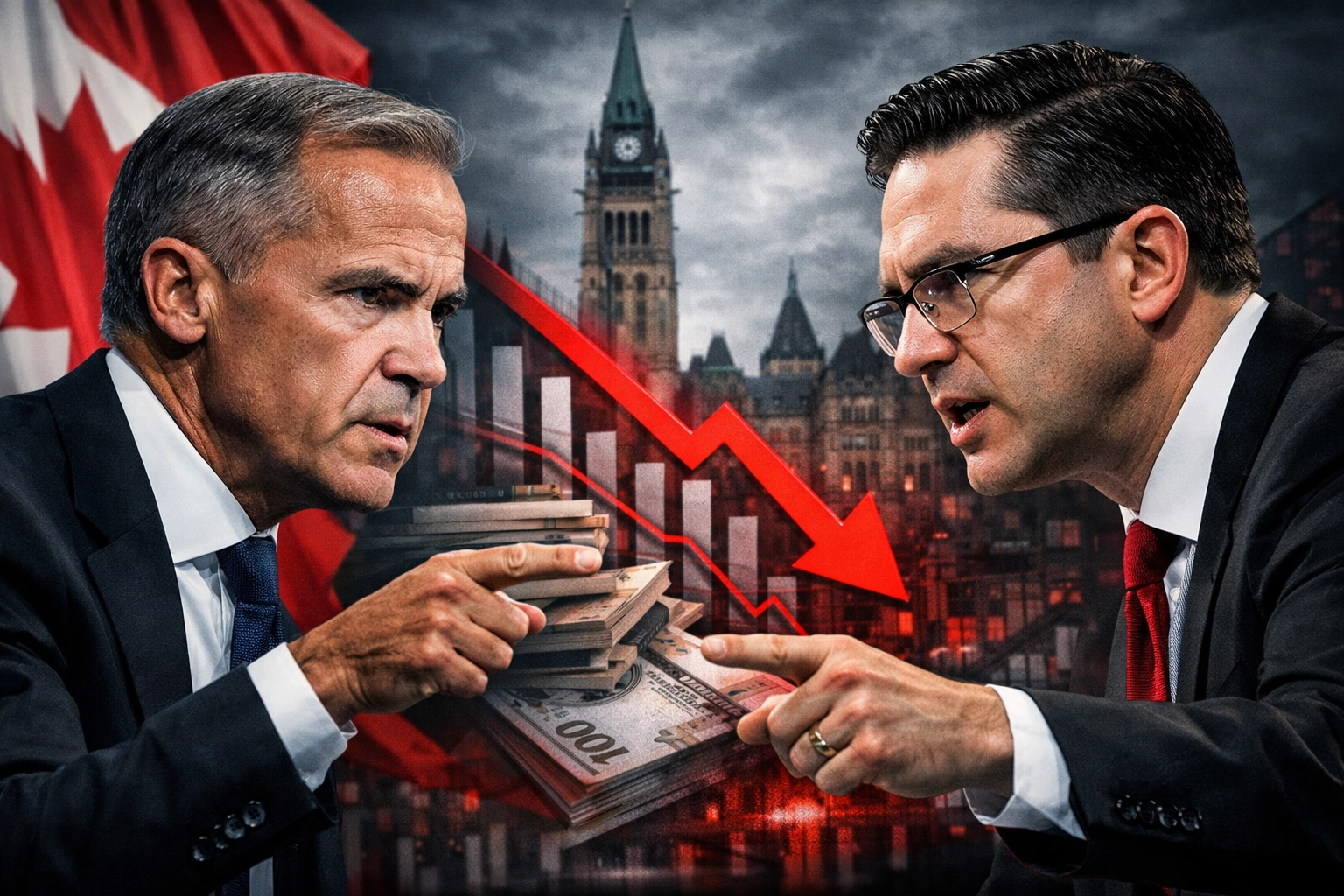
OTTAWA : Prime Minister Mark Carney and Opposition Leader Pierre Poilievre are presenting Canadians with sharply contrasting visions for the country’s economic future. The two leaders unveiled competing fiscal plans this week that differ on deficits, taxation, and government spending priorities.
The debate marks one of the clearest policy divides since Carney took office. At stake: how Canada manages its fiscal situation while addressing affordability concerns affecting millions of households.
The Deficit Divide
Numbers tell the story. Poilievre’s Conservatives pledge to cut the current federal deficit by 70% over four years. The plan promises to save Canada $125 billion compared to the Liberal government’s approach.
How? Through targeted spending reductions. The Conservative platform identifies cuts to bureaucracy, consultant contracts, foreign aid, and what Poilievre calls “handouts to insiders and special interests.” The savings would fund deficit reduction while maintaining essential services.
Carney’s government counters with a different calculation. The Liberals frame their approach as strategic investment rather than austerity. The plan includes $130 billion in new spending over the same period, focused on targeted programs and economic development.
Poilievre characterizes the Liberal plan as “doubling down on the Trudeau record.” Carney’s team argues their investments will generate long-term economic growth that offsets the initial spending.
Neither side disputes the baseline numbers. The disagreement centers on economic philosophy: rapid deficit reduction versus sustained investment.
Tax Cuts: Two Different Approaches
Personal income tax proposals reveal another stark contrast.
The Conservative plan proposes reducing the lowest marginal tax bracket by 2.25 percentage points: from 15% to 12.75%. According to party estimates, this saves the average worker $900 annually. Working families would see $1,800 in annual savings.
The Liberal counter-proposal offers a smaller reduction: 1% off the lowest bracket, bringing it from 15% to 14%. The difference between the two plans amounts to 1.25 percentage points, or hundreds of dollars per household depending on income level.
Both parties target the lowest tax bracket, aiming to provide relief to lower and middle-income Canadians. The scale differs significantly.

Capital Gains and Investment Incentives
Capital gains taxation has emerged as a major policy distinction between the parties.
Both plans cancel the proposed capital gains tax increase: a measure that had drawn criticism from business groups and investors. That’s where the similarity ends.
Poilievre introduces what Conservatives call the “Canada First Reinvestment Tax Cut.” Under this provision, capital gains taxes would be eliminated entirely when proceeds are reinvested within Canada. The incentive applies to both individuals and businesses.
The policy aims to keep investment capital circulating within the Canadian economy. Sell a business or property, reinvest those proceeds in Canadian ventures, and pay no capital gains tax on the transaction.
Carney’s government offers no comparable reinvestment incentive. The Liberal plan cancels the tax increase but maintains existing capital gains provisions without additional exemptions.
The Conservative proposal represents a significant departure from traditional capital gains policy. Whether it will stimulate domestic investment or primarily benefit high-net-worth individuals remains a point of debate between the parties.
Housing: Competing GST Strategies
Both leaders recognize housing affordability as a critical issue. Both propose eliminating GST on new home construction. The details diverge.
Carney’s plan removes GST on new homes valued up to $1 million, specifically for first-time buyers. The measure targets younger Canadians and families entering the housing market for the first time.
Poilievre extends the GST exemption to homes valued up to $1.3 million: a $300,000 higher threshold. The Conservative plan also removes the first-time buyer restriction, making the exemption available to any purchaser of a qualifying new home.

Beyond GST relief, the Conservative platform commits to building 2.3 million homes by cutting taxes on construction materials and expediting municipal approval processes. The plan emphasizes regulatory reform at local levels as a path to increased supply.
The Liberal government focuses its housing strategy on tax credits for critical minerals development: an indirect approach aimed at strengthening the economy broadly rather than targeting housing construction specifically.
The Affordability Debate
Food prices have become a flashpoint in the fiscal strategy clash.
Poilievre cites statistics showing food prices rising 48% faster in Canada than in the United States. He attributes this gap directly to government policies, particularly the industrial carbon tax applied to agricultural production.
The Conservative solution: eliminate carbon taxes on farm equipment, fertilizer, and industrial emissions related to food production. The argument frames carbon pricing as a direct driver of grocery inflation.
Carney’s government maintains its focus on middle-class tax cuts and industry supports as the path to affordability. Liberal messaging emphasizes investments in economic sectors that create jobs and raise incomes over time.
The carbon tax debate extends beyond food prices into broader questions about climate policy and economic competitiveness. Poilievre argues the tax increases costs across the economy. Carney’s position holds that targeted relief and strategic investment address affordability without abandoning climate commitments.
What the Numbers Mean
The fiscal plans present fundamentally different paths forward for Canadian government operations and household budgets.
Conservative projections show significant near-term deficit reduction through spending discipline. Liberal projections show sustained investment generating long-term economic returns.
Tax relief calculations differ by hundreds to thousands of dollars per household depending on income level, family structure, and investment holdings. The capital gains reinvestment incentive could represent tens of thousands in tax savings for business owners and real estate investors: or minimal impact for Canadians without significant investment assets.
Housing measures affect first-time buyers differently than existing homeowners or investors. GST savings on a $1 million home equal $50,000: a substantial down payment boost for qualified buyers.

The Stakes
These competing fiscal strategies will shape federal budget discussions for years. The plans reflect different answers to core questions about the role of government spending, the pace of deficit reduction, and the most effective tools for addressing affordability.
Carney frames his approach as building economic resilience through strategic investment. Poilievre positions his plan as providing immediate relief while restoring fiscal discipline.
Provincial governments are watching closely. Budget pressures from trade negotiations and healthcare costs mean federal fiscal policy directly impacts provincial planning. Business groups are analyzing the capital gains and construction tax provisions. Consumer advocates are calculating household impacts of the competing tax cuts.
The canadian government fiscal debate continues in Parliament, where both leaders will face questions about implementation timelines, revenue impacts, and economic projections underlying their plans.
For Canadian households navigating rising costs, the policy differences translate to tangible changes in take-home pay, housing affordability, and food prices. The competing visions represent distinct choices about how government can: or cannot: address economic pressures facing families nationwide.
Both leaders insist their approach serves Canada’s economic interests. Voters will ultimately decide which fiscal strategy aligns with their priorities and their assessment of what the country needs at this moment.


Post comments (0)