Listeners:
Top listeners:
-
 play_arrow
S1 E9 | Are We That Incompetent? Canada vs Saudi Arabia
-
 play_arrow
S1 E2 | Milk, Markets, and the Cost of Protection

Supply Management, Sovereignty, and the Search for Common Ground
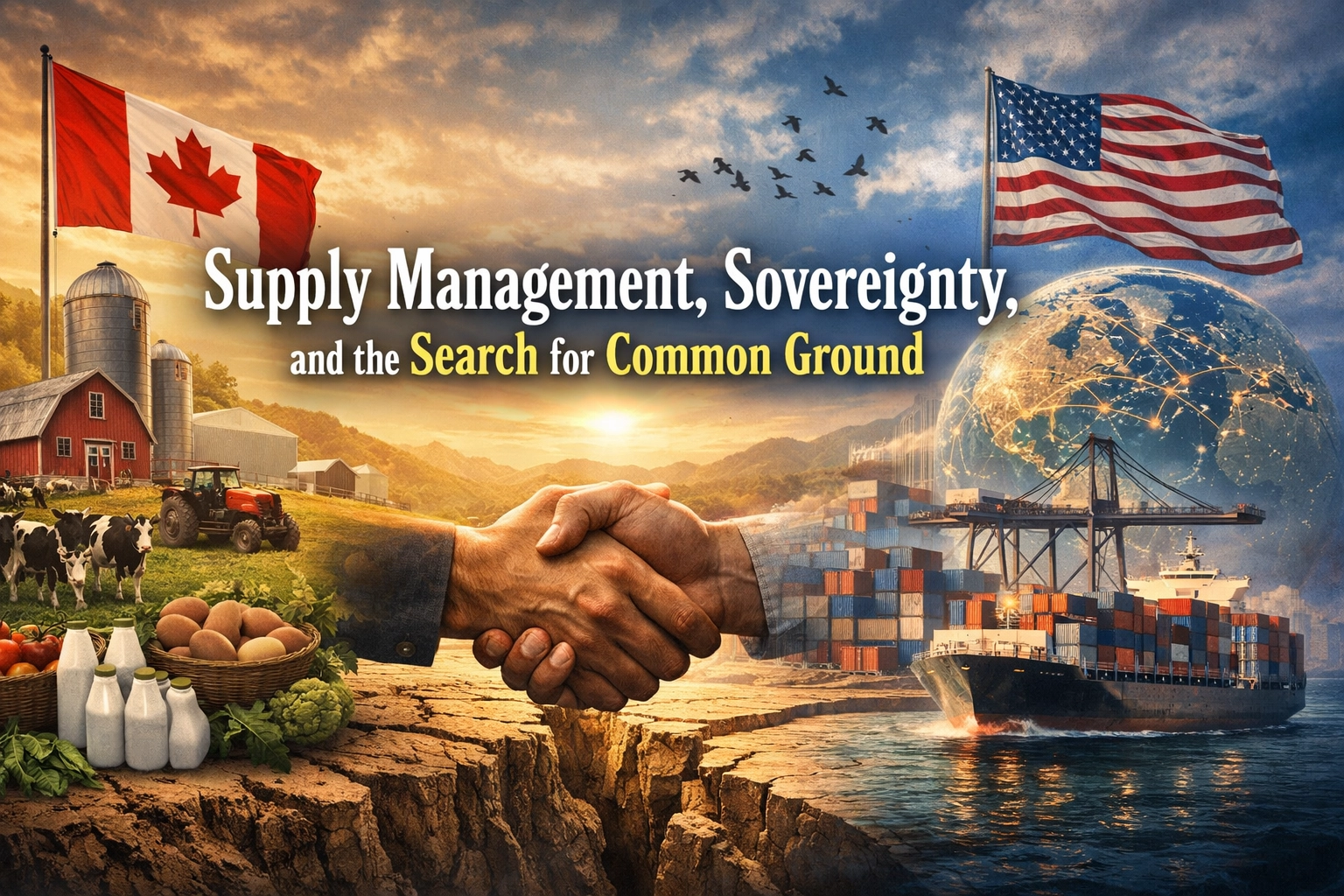
Canada’s supply management system almost never comes up in everyday conversation.
But it should.
Because it sits right at the centre of our trade relationship with the United States. It affects what you pay at the grocery store. It affects rural livelihoods. And it’s become a recurring friction point in negotiations with Washington.
So let’s slow this down and look at it clearly.
What is supply management?
Why do we have it?
When did it start?
What was it supposed to do?
What does it actually do?
And is there a centrist path forward that protects Canadian farmers while easing trade tensions?
Why It Exists
Supply management was introduced in the early 1970s.
At the time, Canadian dairy, poultry, and egg farmers were dealing with extreme price volatility. Some years there was overproduction. Other years there were shortages. Farmers were going bankrupt. Rural communities were unstable.
The federal government stepped in and created a system designed to bring predictability.
The model rests on three pillars:
• Production quotas that limit how much farmers can produce
• Price setting that ensures farmers receive stable returns based on cost of production
• Import controls that place high tariffs on foreign dairy, poultry, and eggs
In simple terms, the system controls supply to stabilize income.
And in many ways, it’s worked.
Canadian dairy farmers, for example, don’t rely heavily on government subsidy cheques the way many American farmers do. Instead of taxpayers funding bailouts, Canadian consumers pay slightly higher prices at the grocery store. The cost’s built into the system.
That was the trade-off.
Stability in exchange for higher consumer prices.

The Criticism
The criticism is straightforward.
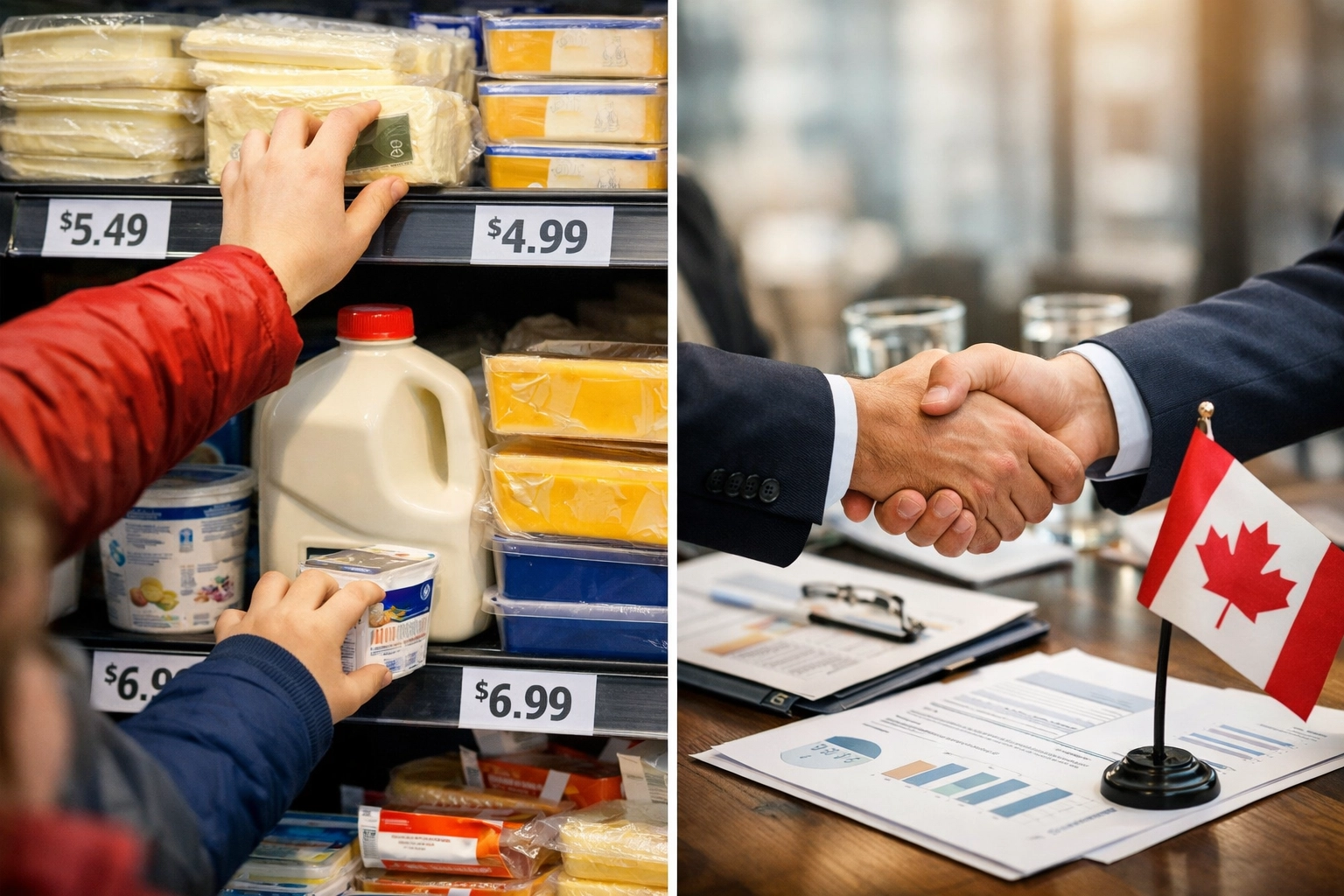
Canadian consumers often pay more for milk, cheese, butter, and chicken than Americans do. Critics argue that the system limits competition, discourages innovation, and makes food less affordable, especially for lower-income families.
And then there’s the international angle.
The United States has long argued that Canada’s high dairy tariffs, in some cases exceeding 200 percent, block American farmers from accessing the Canadian market. During NAFTA renegotiations and later under USMCA, supply management became a major sticking point.
From Washington’s perspective, it looks like protectionism.
From Ottawa’s perspective, it looks like sovereignty.
And this is where nuance matters.
Who It Actually Affects
Let’s zoom in.
At the policy level, we talk about tariffs and trade frameworks. But on the ground, this system affects real people.
A dairy farmer in rural Ontario, Quebec, or Alberta has purchased quota, sometimes worth millions of dollars. That quota represents security. It guarantees that if they produce within their allotment, they’ll receive a stable price.
If supply management were dismantled overnight, quota values would collapse. Farm incomes would fall sharply. Many family farms could fail. Rural communities would feel that shock immediately. Equipment suppliers, veterinarians, feed companies, local lenders, everyone connected to that ecosystem would feel it.
This isn’t abstract policy.
It’s livelihoods.
At the same time, Canadian families feel the impact at the grocery store. A few extra dollars each week adds up. For some households, that matters deeply.
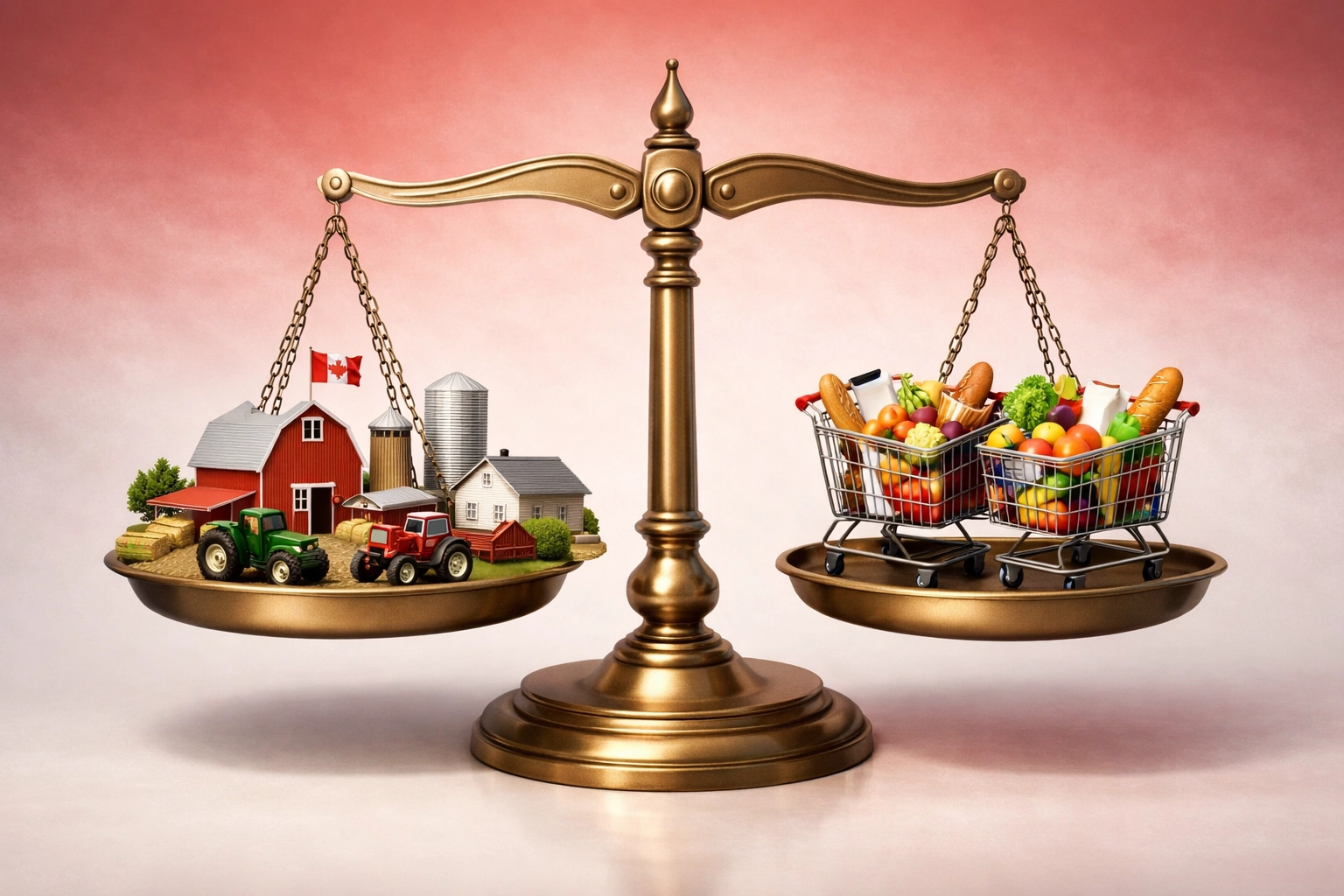
So we’ve got a classic Canadian dilemma:
Stability versus affordability.
Protection versus competition.
Sovereignty versus trade harmony.

Is There a Centrist Path?
This is where the shouting usually starts.
But it shouldn’t.
Because this isn’t about being pro-farmer or pro-consumer. It’s about designing policy that recognizes both realities.
A centrist approach doesn’t mean tearing the system down. And it doesn’t mean pretending it’s untouchable.
Compromise could look like gradual increases in import access instead of sudden shocks. It could mean structured compensation if negotiated trade changes reduce quota value. It could mean serious innovation incentives so Canadian producers become more competitive over time. It could mean greater pricing transparency so consumers understand exactly what they’re paying for.
Most importantly, it means honesty.
If we defend supply management, we should clearly explain why. If we reform it, we should clearly outline who’s protected and how.
Trade with the United States isn’t optional. It’s foundational to our economy. At the same time, rural Canada isn’t expendable.
A serious government doesn’t pit one against the other.
It prepares.
Then it negotiates from strength, thus protecting its people while acknowledging the economic reality.
The Bigger Question
Supply management was created in a different era. Globalization wasn’t as intense. Trade politics weren’t as charged.
The world’s changed.
That doesn’t automatically mean the system’s wrong. But it does mean it deserves honest examination, without ideology and without reflex.
The goal isn’t to make Americans happy at Canada’s expense.
And it isn’t to ignore legitimate trade concerns out of reflexive nationalism.
The goal’s stability, fairness, and long-term prosperity for Canadians.
All Canadians.
From the dairy farmer up before sunrise, to the single parent budgeting at the checkout line.
That’s the kind of issue that demands a Canadianist approach. Not left. Not right. Not slogans. Just practical problem-solving.
So here’s the question worth debating seriously:
If reform’s coming, how do we design it so rural communities aren’t sacrificed?
And if we keep the system largely intact, how do we justify the cost to consumers and our trading partners?
That’s the conversation.
I’m Christopher M. Michaud. I’m a Canadianist. And if this resonates with you, I invite you to continue the conversation at thecanadianist.news.

Post comments (0)