


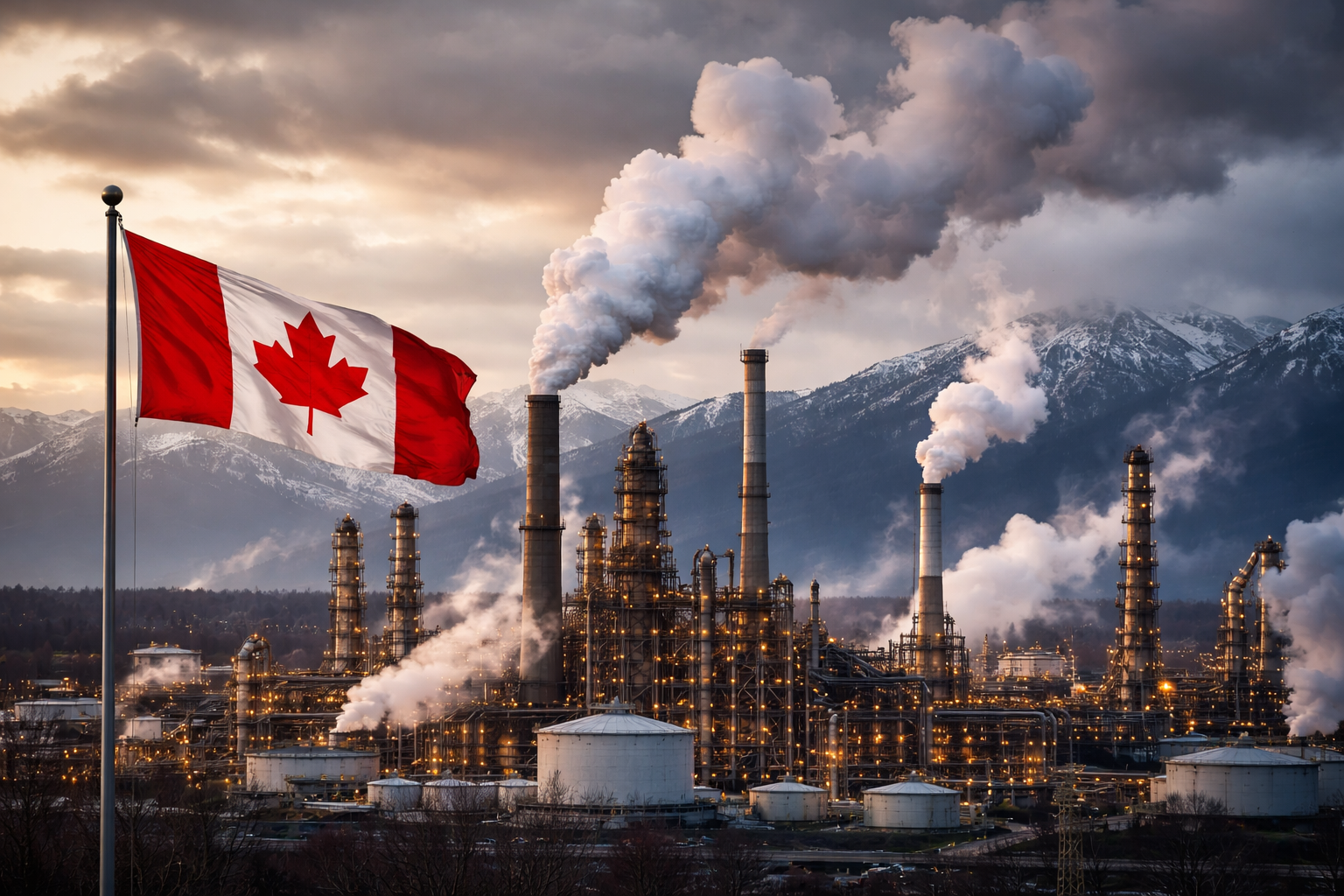
Canada is no longer on track to meet any of its major climate commitments, according to a new national review that warns the country’s emissions strategy is weakening at a critical moment.
The assessment finds Canada is likely to miss its 2026 milestone, its 2030 Paris Agreement target, and its long-term 2050 net-zero objective. The findings point to recent policy changes, economic pressures, and shifting political priorities that have slowed progress just as global expectations for emissions reductions are intensifying.
The warning lands at a moment when climate policy in Canada is increasingly entangled with affordability, energy security, and industrial competitiveness. It also raises a fundamental question about whether the country can balance environmental commitments with the realities of a resource-driven economy.
A widening gap between ambition and reality
Canada’s climate framework remains among the most ambitious in the industrialized world on paper. Federal plans call for emissions reductions of 40 to 45 percent below 2005 levels by 2030, followed by net-zero emissions by mid-century.
But projections now suggest Canada may achieve only a portion of the reductions required by the end of this decade. Analysts say the country’s trajectory has softened as governments recalibrate policy amid economic uncertainty, trade pressures, and domestic political shifts.
Recent changes have included the scaling back or removal of some carbon pricing measures affecting consumers, adjustments to industrial carbon rules, and the winding down of certain incentives tied to electrification and building retrofits. Provinces have also moved unevenly, with some tightening industrial policies and others loosening them.
The result is not a single policy reversal but a gradual loss of momentum.
Energy realities shaping the debate
Canada’s emissions challenge is closely tied to its economic structure. Oil and gas production remains a major employer and a cornerstone of export revenue, particularly in Western Canada. Supporting energy output during volatile global markets has become a priority for governments concerned about jobs and economic stability.
That balancing act has complicated climate planning.
Electricity generation and some heavy industries have made measurable gains in emissions reduction, largely through cleaner power grids and technological upgrades. But emissions tied to transportation, buildings, and oil and gas production have proven harder to bring down, and in some cases have risen.
Canada’s geography adds further complexity. A vast territory, long travel distances, and a cold climate increase energy demand and slow the pace of electrification compared with more densely populated countries.
Political tensions and leadership questions
The report’s conclusions arrive amid broader political tensions over climate direction. Recent resignations from advisory roles and shifts within environmental policy circles reflect growing disagreement about how quickly Canada should move and how the costs should be shared.
For some policymakers, climate action must proceed alongside industrial competitiveness and affordability. For others, the current trajectory signals a loss of urgency at precisely the wrong time.
The divide highlights a recurring challenge in Canadian climate policy, maintaining consistent direction across election cycles, economic downturns, and regional priorities.
Structural hurdles to net zero
Canada faces structural obstacles that go beyond policy design. Transitioning heavy industry, modernizing transportation networks, and retrofitting millions of buildings require sustained investment measured in decades, not election terms.
At the same time, climate impacts are already intensifying. Wildfires, flooding, and extreme weather events are increasing the financial and social cost of inaction, creating pressure for stronger mitigation while also demanding resources for adaptation.
Experts argue that meeting long-term targets will depend on stability more than speed. Businesses, provinces, and investors need predictable frameworks to commit to large-scale change.
A narrowing window
Despite the stark findings, the review does not suggest Canada’s goals are unattainable. It points instead to the possibility of regaining momentum through stronger industrial carbon pricing, accelerated clean-technology deployment, and clearer coordination between federal and provincial governments.
Technological advances in carbon capture, electrification, and renewable energy could still shift the trajectory if implemented at scale. But the timeline is tightening.
Every year of slower progress increases the difficulty of achieving future targets.
A defining national choice
The debate now confronting Canada is not only about emissions. It is about the country’s economic identity and political direction in a world transitioning toward lower-carbon systems.
Climate policy is no longer a standalone file. It intersects with trade, infrastructure, housing, and national competitiveness. Decisions made in the next few years will shape investment, employment, and regional development for decades.
For supporters of stronger action, the report is a warning that Canada risks falling permanently behind. For skeptics, it underscores the need for a pragmatic transition that protects economic stability.
What is clear is that Canada has entered a decisive phase.
The country still has the capacity to meet its commitments, but doing so will require renewed focus, consistent policy, and a willingness to reconcile environmental ambition with economic reality. The question now is whether political will can keep pace with the scale of the challenge.


Post comments (0)