Listeners:
Top listeners:
-
 play_arrow
S1 E9 | Are We That Incompetent? Canada vs Saudi Arabia
-
 play_arrow
S1 E2 | Milk, Markets, and the Cost of Protection

Janice Charette Begins CUSMA Negotiations Amid Provincial Budget Concerns
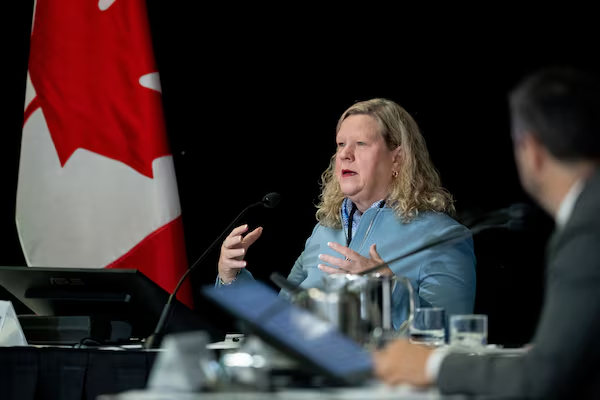
Prime Minister Mark Carney announced the appointment of Janice Charette as Canada’s Chief Trade Negotiator on February 16, 2026. Charette will lead the Canadian government’s team in the upcoming review of the Canada-United-States-Mexico Agreement (CUSMA), set to begin later this year.
The appointment comes as provinces across Canada prepare for negotiations that could impact budgets and economic planning. Charette brings four decades of public policy and diplomatic experience to the role.
Charette’s Background and Qualifications
Janice Charette served as Clerk of the Privy Council and Secretary to the Cabinet during two separate periods. She held the position from 2014 to 2016 and again from 2022 until her retirement in 2023. Between these appointments, Charette served as Canada’s High Commissioner to the United Kingdom from 2016 to 2021.
In December 2025, Charette was named an Officer of the Order of Canada, recognizing her contributions to Canadian public service. Her appointment as chief negotiator marks a return to federal responsibilities after her retirement from the Privy Council Office.
The Canadian government cited Charette’s extensive experience in international relations and policy development as key factors in the selection. Her background includes working directly with multiple prime ministers and navigating complex bilateral relationships.
The CUSMA Review Timeline
The Canada-United-States-Mexico Agreement is scheduled for review in 2026 under terms established when the agreement was signed. The review process allows all three nations to assess the agreement’s performance and propose potential modifications.
CUSMA, which replaced the North American Free Trade Agreement (NAFTA) in 2020, governs trade relationships between Canada, the United States, and Mexico. The agreement covers sectors including automotive manufacturing, agriculture, digital trade, and labour standards.

Canada’s negotiating team will prepare materials and positions ahead of formal talks with American and Mexican counterparts. The review’s exact start date has not been announced, though officials indicate discussions will commence sometime in 2026.
The Canadian government has not disclosed the full composition of the negotiating team beyond Charette’s leadership role. Typically, such teams include representatives from Global Affairs Canada, Innovation, Science and Economic Development Canada, and other federal departments.
Provincial Response and Economic Concerns
Ontario Premier Doug Ford commented on the appointment on February 17, 2026. Ford emphasized the need for swift negotiations, stating that “uncertainty around the world…it’s not good for anyone’s economy.”
Provincial governments across Canada have expressed interest in the CUSMA review process. Trade with the United States represents a significant portion of economic activity in most provinces, particularly Ontario, Quebec, and Alberta.

Provincial budget planning often depends on stable trade relationships and predictable tariff structures. Changes to CUSMA could affect industries ranging from automotive manufacturing in Ontario to energy exports from Alberta and forestry operations in British Columbia.
The timing of the review coincides with budget preparation cycles in several provinces. Finance ministers have indicated they are monitoring the negotiations closely to assess potential fiscal impacts.
Federal Government’s Approach
Prime Minister Mark Carney’s government has stated that protecting Canadian interests while maintaining strong continental relationships remains the priority. The Canadian government has not released specific negotiating objectives or areas of focus for the CUSMA review.
Global Affairs Canada will coordinate with provincial and territorial governments throughout the negotiation process. Past trade negotiations have included consultation mechanisms to gather input from sub-national governments.

The federal approach typically balances competing regional interests, from Prairie agriculture to Maritime fisheries to Central Canadian manufacturing. Charette’s experience navigating federal-provincial dynamics during her time in the Privy Council Office is expected to inform this coordination.
Industry stakeholders have requested early consultation opportunities. Business groups, labour organizations, and sector-specific associations have begun preparing position papers and recommendations for the negotiating team.
International Context
The CUSMA review occurs against a backdrop of evolving North American economic relationships. Trade flows between Canada and the United States exceeded $900 billion in 2025, making the bilateral relationship one of the world’s largest trading partnerships.
Mexico’s role in trilateral trade has grown since CUSMA’s implementation. Mexican manufacturing, particularly in automotive and electronics sectors, has integrated further into North American supply chains.
Recent global economic uncertainty has heightened attention to trade agreement stability. Both the United States and Mexico have indicated they will participate in the review process as scheduled under the agreement.
The review does not automatically lead to renegotiation. All three countries must agree to any modifications to the agreement. The process may result in minor adjustments, significant changes, or maintenance of current terms.
Next Steps for Canada’s Negotiating Team
Charette’s immediate priorities include assembling support staff and developing Canada’s positions on key issues. The negotiating team will conduct consultations with stakeholders across sectors and regions.
The Canadian government will table briefing materials in Parliament as the review process advances. Opposition parties have requested updates on negotiating strategy and provincial input mechanisms.
Provincial premiers are expected to meet with federal officials in the coming months to discuss regional priorities. Past trade negotiations have included formal consultation structures bringing together federal and provincial representatives.
The timeline for completing the review remains undefined. CUSMA negotiations in 2017-2018 took approximately 14 months, though review processes typically differ from initial negotiations.
Charette has not made public statements since her appointment announcement. The Privy Council Office confirmed she has begun transition meetings and briefings.
Canadian news coverage of the appointment has focused on Charette’s qualifications and the potential economic implications of the review. Business publications have highlighted sectors most likely to feature in negotiations.
The appointment represents one of Prime Minister Carney’s first major policy decisions regarding international economic relations. Carney’s government has emphasized economic stability and strengthening Canada’s trading relationships.
Further details on Canada’s negotiating positions and the review schedule are expected in the coming weeks. The Canadian government has committed to transparency throughout the process while protecting confidential negotiating information.
Stay informed on developing Canadian government news and national headlines at The Canadianist News.


Post comments (0)