Listeners:
Top listeners:
-
 play_arrow
S1 E9 | Are We That Incompetent? Canada vs Saudi Arabia
-
 play_arrow
S1 E2 | Milk, Markets, and the Cost of Protection

The 12-Point Gap: Carney Surges as Poilievre Faces a House Divided
Look at the numbers.
Read the writing on the wall.
Watch what’s happening in Ottawa.
We’re witnessing a shift in Canadian politics that tells us something important about where this country is headed. The latest Liaison Strategies survey dropped this week, and the results are striking: Prime Minister Mark Carney’s Liberals sit at 45% support nationwide, while Pierre Poilievre’s Conservatives trail at 33%. That’s a 12-point gap: the kind of margin that changes conversations, shifts strategies, and forces political parties to look in the mirror.
This isn’t just about one poll. It’s about momentum, direction, and what Canadians are telling us they want right now.
The Numbers Tell a Story
Political polls are snapshots, not prophecies. We all know that. But when you see a consistent trend emerging across regions and demographics, it’s worth paying attention to what’s driving it.
The Liaison Strategies data shows Carney’s Liberals consolidating support in Ontario, Quebec, and Atlantic Canada: the traditional battlegrounds where federal elections are won and lost. Ontario, with its 121 seats, remains the pivotal province, and the Liberals have rebuilt trust there after a rocky few years. Quebec continues to be a complex landscape where the Liberal brand resonates with federalist voters looking for stability and economic pragmatism.
The Conservatives, meanwhile, maintain their fortress in the West. Alberta and Saskatchewan remain deep blue, and British Columbia shows competitive numbers in suburban ridings. But here’s the challenge: you can’t form government by winning the West alone. You need Ontario. You need Quebec. You need at least a foothold in Atlantic Canada.
Regional politics matter in a country this vast and diverse. What plays well in Calgary doesn’t necessarily resonate in Halifax. What works in rural Saskatchewan might fall flat in downtown Toronto. Successful federal leadership requires building bridges across these divides: not just shouting louder to your base.
The Floor-Crossing That Shook Parliament Hill
Politics moves fast. Sometimes it moves faster than anyone expects.
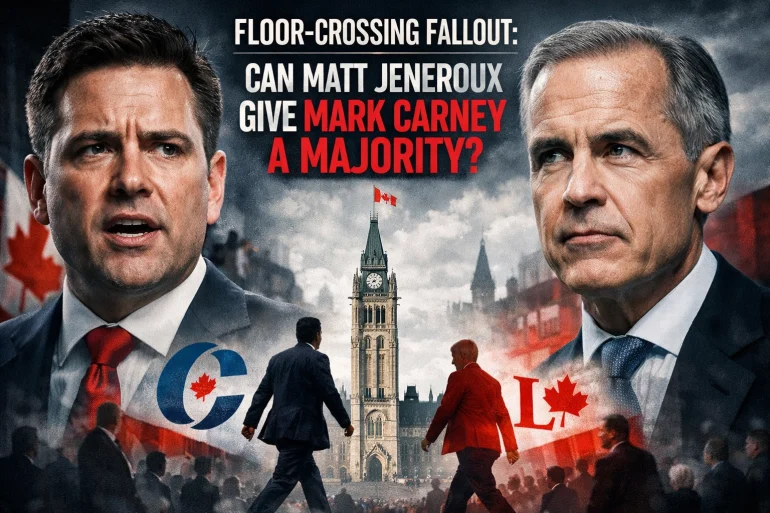
Last week, Conservative MP Matt Jeneroux made the decision to cross the floor and join the Liberal caucus. The Edmonton MP cited concerns about the direction of the Conservative Party and his belief that the Liberals better represent his values of pragmatic, centrist governance. It was a calculated move, and it sent shockwaves through both parties.
Floor-crossings are never just about one person. They’re symptoms of deeper tensions: disagreements about strategy, philosophy, and where a party is headed. When an MP walks across that aisle, it raises questions that don’t have easy answers. Is this an isolated case, or are others feeling the same internal pressure? Is the party leadership responding to concerns from within, or doubling down on its current path?
For Poilievre, Jeneroux’s departure adds to an already challenging year. The Conservative leader has been working to unite various factions within his party: social conservatives, fiscal hawks, libertarian-leaning members, and Red Tories who feel increasingly sidelined. That’s not an easy coalition to hold together, especially when the governing party is gaining ground in public opinion.

Leadership is tested not just in victory, but in moments of adversity. How Poilievre responds to these internal challenges will define his tenure and his party’s future trajectory.
What This Means for Canadian Unity
Here’s what matters more than any individual poll number: the direction our country is heading and whether our political leaders are focused on bringing Canadians together or driving us apart.
Canada works best when we’re building consensus, finding common ground, and recognizing that people in Vancouver and people in St. John’s both want the same fundamental things: good jobs, safe communities, quality healthcare, and a government that listens. Regional differences are real, but they don’t have to be divisive.
The challenge for any opposition party is offering an alternative vision that appeals across provincial boundaries and cultural divides. It’s not enough to criticize the government in power: Canadians want to know what you’d do differently and why it would be better for them and their families.
The Liberals’ current lead suggests they’re successfully positioning themselves as the party of national unity and practical governance. Whether that perception holds depends on delivery: actually following through on promises, managing the economy effectively, and maintaining credibility on the issues Canadians care about most.
The Path Forward
So where does Canadian politics go from here?
For the Liberals, maintaining this lead requires avoiding complacency. Twelve points in February doesn’t guarantee anything in the next election. Governments that take their support for granted tend to lose it quickly. The focus needs to stay on delivering results: economic growth, healthcare improvements, climate action that doesn’t leave workers behind.
For the Conservatives, the path back to competitiveness runs through the middle. That doesn’t mean abandoning principles or core values. It means recognizing that most Canadians aren’t looking for radical change: they’re looking for competent, responsive leadership that makes their lives better. The party that figures out how to speak to suburban Ontario parents, Quebec entrepreneurs, and Maritime workers all at once will be the party that forms government.
The NDP and other opposition parties also play a role in shaping this landscape. In a minority parliament situation: which Canada may well see again: smaller parties wield outsized influence on policy and political stability.
What We’re Watching
Politics doesn’t stand still. The numbers we’re seeing today will shift as events unfold, policies are tested, and leaders rise or fall to the moment.
We’ll be watching how both major parties respond to this polling data. Will the Conservatives pivot their messaging? Will more caucus members express concerns about direction and strategy? Will the Liberals capitalize on this momentum or become overconfident?
We’ll also be tracking the regional dynamics: whether the Liberal surge holds in Ontario through the spring, whether Conservative support softens or hardens in the West, and whether Quebec’s political landscape continues to evolve.
Most importantly, we’ll be listening to what Canadians themselves are saying: not just in polls, but in town halls, on social media, in conversations happening in communities across this country.
The Bottom Line
A 12-point lead is significant. It reflects public sentiment at a specific moment in time. It suggests one party is connecting with voters while another faces challenges. But it’s not destiny.
Canadian politics has seen dramatic reversals before. Parties that looked unbeatable have fallen. Leaders written off as finished have come back stronger. The only constant is change.
What matters now is how political leaders respond to this moment. Do they double down on division, or do they work toward unity? Do they offer Canadians real solutions, or just partisan talking points? Do they lead with conviction and humility, or with anger and grievance?
We deserve leaders who bring out the best in this country: who recognize that our diversity is a strength, our regional differences are manageable, and our shared values are more important than our disagreements.
That’s the Canada worth fighting for. That’s the political culture we need to build.
Stay informed. Stay engaged. Stay Canadian.
For more political coverage and analysis, visit The Canadianist News.

Post comments (0)