


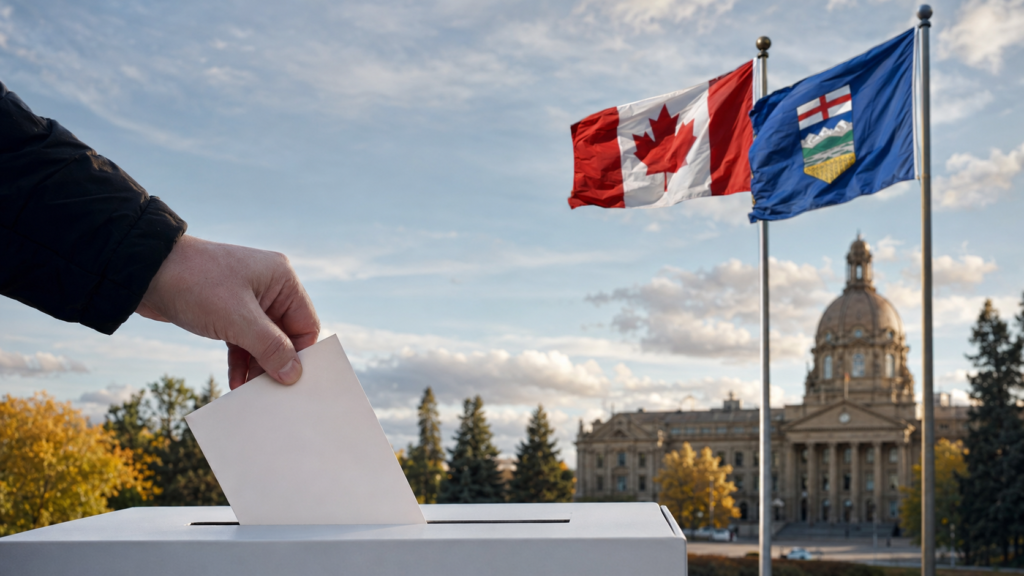
Support for Alberta separating from Canada has fallen sharply since the beginning of the year, but the province’s October referendum remains a politically sensitive test for federal and provincial leaders.
The most recent Ipsos polling, released in early June, found that 18 percent of Albertans would vote to leave Canada if a binding referendum on separation were held. That represents a 10-point decline from the 28 percent recorded in January. Another 72 percent said they would vote to remain in Canada, while nine percent were undecided, wouldn’t vote or declined to answer. Ipsos
The October 19 vote won’t itself be a binding referendum on independence. Albertans will instead be asked whether the provincial government should begin the constitutional process required to hold a binding separation referendum in the future. Ipsos found 19 percent supported taking that step, compared with 72 percent who preferred a motion affirming that Alberta should remain part of Canada.
Support also varies considerably across the province. Only 14 percent of Calgary respondents favoured beginning the process toward a future separation vote, compared with 18 percent in Edmonton and 27 percent elsewhere in Alberta. Among United Conservative Party supporters, 40 percent backed moving toward a binding referendum, while 50 percent supported remaining in Canada.
The October vote emerged after Alberta’s Court of King’s Bench quashed the original separatist petition in May, ruling that the province failed to fulfil its duty to consult First Nations before allowing the signature campaign to proceed. Premier Danielle Smith subsequently announced that the government would hold a non-binding referendum based on a separate pro-Canada petition. The provincial government has appealed the court decision concerning the original initiative. Reuters
Federal Conservative Leader Pierre Poilievre is now moving more directly into the debate. He has appointed Parkland MP Dane Lloyd as the party’s “Referendum Lead for Alberta” and launched a summer campaign intended to persuade Albertans to remain in Canada.
Poilievre’s approach reflects the difficulty facing federal Conservatives. The party must acknowledge the grievances driving separatist sentiment without appearing to encourage the movement itself. In announcing Lloyd’s appointment, Poilievre said the party’s task was to hear Albertans rather than scold them, framing national unity as something to be strengthened through political and economic change.
The polling suggests separation is unlikely to win broad support under current conditions. The political risk, however, hasn’t disappeared. A sizeable minority of UCP voters remains willing to advance the process, giving separatists influence beyond their province-wide numbers.
The referendum campaign will also overlap with Ottawa’s commitment to pursue national-interest designation for Alberta’s proposed West Coast oil pipeline by October 1. Progress on that project could weaken separatist arguments that Alberta’s economic interests are ignored within Confederation. Delays or disputes would give those arguments new material only weeks before Albertans vote. Prime Minister’s Office