


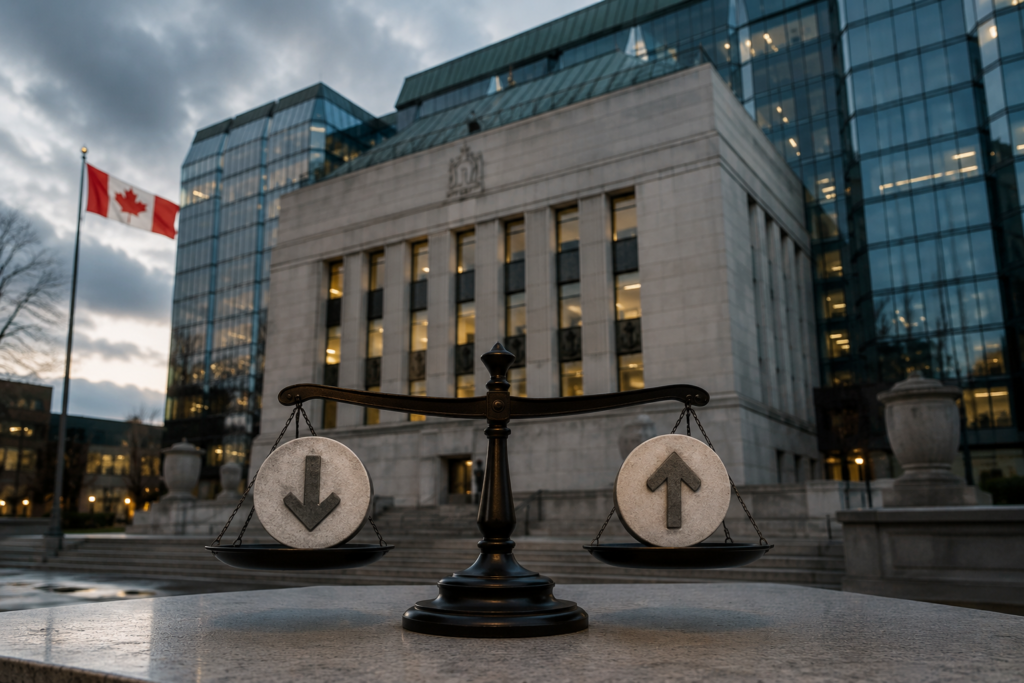
The Bank of Canada remains on hold at 2.25%, with the next rate decision not until June 10 — but a closely watched annual assessment of system-wide financial risk lands next week and could set the tone for summer monetary policy.
At its last meeting on April 29, the Bank of Canada held its interest rate at 2.25%, noting that a rate hike may be needed if energy-related inflation becomes a persistent obstacle. The Bank’s public communications since that decision have reinforced a posture of patience: the Bank of Canada’s Summary of Deliberations reinforced uncertainty around the policy outlook, with Governing Council judging there is scope to remain patient and hold rates steady as the economy evolves broadly as expected. True North MortgageTD
The forward curve, along with recent communications from the Bank of Canada, both suggest that the policy rate is expected to remain broadly stable through 2026, with the Bank indicating a preference for maintaining rate continuity as it balances competing pressures. The central bank is weighing geopolitical energy inflation — a temporary supply shock — against a domestic economy that remains soft and a labour market that has not fully recovered. WOWA

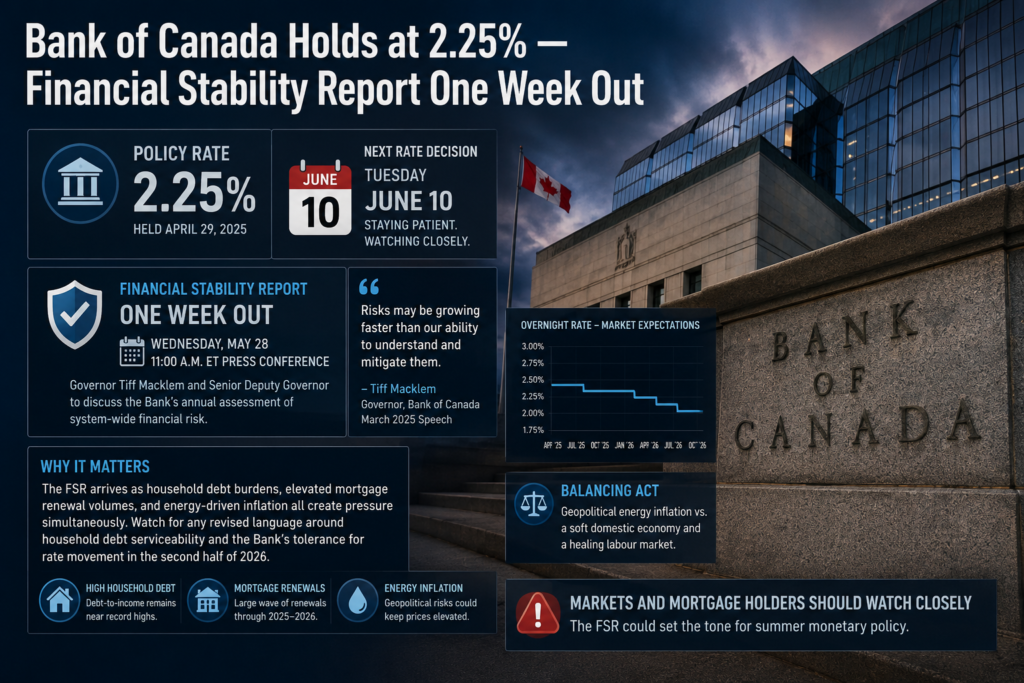
One week from today, on May 28, the Bank will release its annual Financial Stability Report — an assessment of potential risks to the stability of Canada’s financial system — with the Governor and Senior Deputy Governor holding a press conference at 11:00 a.m. ET to discuss the findings. Governor Tiff Macklem flagged in a March speech that risks may be growing faster than the ability to understand and mitigate them, and that economic uncertainty is already high — the country cannot afford to add financial instability to the mix. That speech specifically highlighted the growing role of hedge funds and private credit in global debt markets as new systemic vulnerabilities. Bank of CanadaBank of Canada
Why it matters: The FSR will be the most comprehensive official accounting of stress risks in the Canadian financial system since last year — arriving at a moment when household debt burdens, elevated mortgage renewal volumes, and energy-driven inflation are all creating pressure simultaneously. Markets and mortgage holders should watch for any revised language around household debt serviceability and the Bank’s tolerance for rate movement in the second half of 2026.