


The Canadianist News
OTTAWA — As Canada continues to wrestle with an increasingly uncertain trade relationship with the United States, one of the country’s largest potential economic opportunities may have little to do with Washington.
It is trade with ourselves.
More than $500 billion in goods and services already moves across provincial and territorial borders every year, accounting for nearly one-fifth of Canada’s gross domestic product. Yet Canadian businesses and workers continue to face a patchwork of regulations, licensing requirements and administrative rules that can make crossing a provincial boundary considerably more complicated than the absence of tariffs might suggest.
The potential cost is enormous.
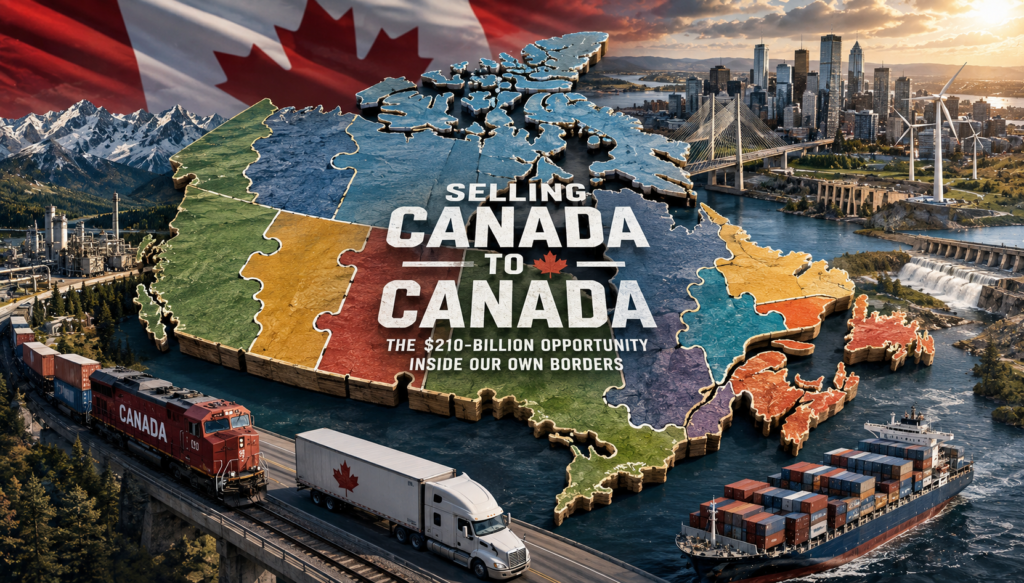
The International Monetary Fund estimates that Canada’s non-geographic internal trade barriers are equivalent, on average, to a tariff of roughly 9%. Its modelling suggests eliminating those barriers could increase Canada’s real GDP by nearly 7% over the long term, equivalent to approximately $210 billion in today’s economy.
The gains would come largely from improved productivity, allowing workers, businesses and capital to operate more efficiently across provincial boundaries. Smaller provinces and northern territories could see some of the largest proportional benefits.
The numbers have taken on greater significance as Canada’s economic relationship with the United States has deteriorated.
For generations, Canada’s economy has developed largely along north-south lines. Supply chains, transportation infrastructure and businesses were built around easy access to the world’s largest economy immediately to the south.
That relationship remains enormously valuable. The United States is Canada’s largest trading partner, and the two economies remain deeply integrated.
The current trade dispute, however, has exposed the vulnerability that comes with depending so heavily on one customer.
Canada also enters the debate from an unusually strong resource position.
The country possesses enormous supplies of energy, freshwater, oil and natural gas, uranium, potash, critical minerals, lumber and hydroelectricity. It has nuclear power, advanced manufacturing, technology industries, an educated workforce, access to three oceans and one of the largest national territories in the world.
The question increasingly facing policymakers is whether Canada can make better use of those advantages inside its own borders.
Ottawa Has Removed Its Barriers. The Harder Part Comes Next.
The federal government has already eliminated all 53 of its exceptions under the Canadian Free Trade Agreement. The Free Trade and Labour Mobility in Canada Act, which came into force January 1, also allows comparable provincial and territorial requirements to satisfy certain federal requirements.
Those changes do not eliminate provincial regulations.
That distinction is critical.
Canada is a federation, and many of the remaining barriers involve areas legitimately regulated by provincial and territorial governments.
A truck travelling between provinces can face different technical standards. Construction workers can encounter different certification and occupational health and safety requirements. Building products approved in one jurisdiction may face different processes elsewhere. Businesses operating nationally can face different licensing and paperwork requirements.
Alcohol remains one of the most visible examples. Ottawa and the provinces have continued working toward a system allowing Canadian producers to sell directly to consumers across provincial borders.
Professional and skilled-labour mobility presents another challenge.
A Canadian qualified to perform a particular job in one province does not automatically become entitled to practise a provincially regulated profession everywhere in the country. Governments are working on faster recognition of qualifications while preserving legitimate provincial regulatory authority.
That means eliminating internal barriers cannot simply amount to Ottawa imposing one national rulebook.
Quebec will protect Quebec’s jurisdiction. Alberta will protect Alberta’s. Ontario, British Columbia and the other provinces and territories have their own regulatory responsibilities and economic interests.
Some differences exist for legitimate reasons, including health and safety, geography, regional industries and public protection. Quebec also has linguistic and cultural considerations that cannot simply be classified as economic barriers and discarded.
Others may represent little more than decades of accumulated duplication.
Determining which is which requires cooperation among Ottawa, 10 provinces and three territories.
There has been movement.
Governments are currently working on interprovincial trucking rules, faster labour-mobility applications, recognition of construction safety training, common approaches to building materials and prefabricated housing, trades credential recognition and direct-to-consumer alcohol sales.
The objective is not to eliminate provincial jurisdiction.
It is to make provincial jurisdiction work better together.
Canada’s Other Customer Is Canada
The push for greater internal trade does not require Canada to retreat from international commerce.
Canada will continue to need the American market. Expanding trade with Europe, Asia, India and other international partners can reduce the country’s exposure to any single trading relationship.
But diversification does not necessarily have to begin overseas.
Canada itself is a wealthy market of more than 40 million people sitting on many of the resources, industries and skills the rest of the world wants to buy.
A Canadian business looking for its next customer should be able to look across the country as easily as it looks south.
A qualified worker should be able to move between provinces without unnecessarily repeating qualifications they have already earned.
Goods legally produced and sold in one Canadian jurisdiction should not routinely encounter an entirely new regulatory obstacle course simply because they cross an internal border.
Canada does not need to become “Fortress Canada,” nor would economic isolation make sense for a trading nation.
The lesson from the current dispute with Washington is considerably simpler.
Canada cannot control the decisions made by an American president. It can control how vulnerable the Canadian economy becomes when Washington changes the terms of the relationship.
That means building east-west transportation, energy and transmission infrastructure, reducing unnecessary internal barriers and giving Canadian businesses greater access to Canadian customers.
Canada has spent generations becoming very good at selling Canada to the world.
There may be $210 billion worth of reasons to get much better at selling Canada to Canada.