


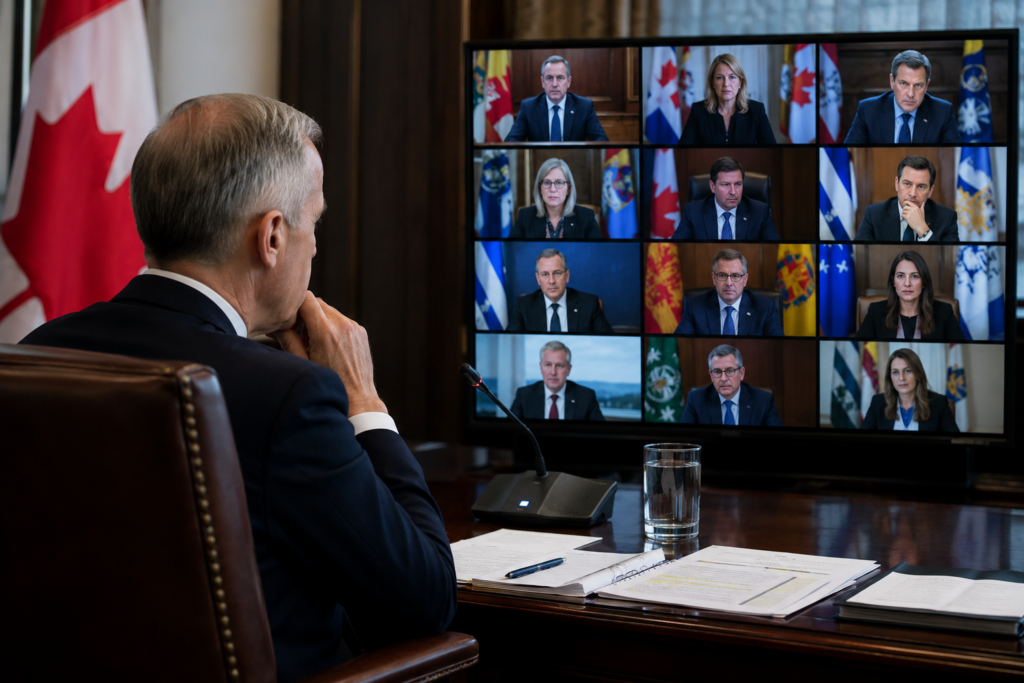
Prime Minister Carney met virtually with provincial and territorial premiers on July 21, hastily adding the session to the calendar after the tariff announcement. The meeting took place as premiers were already gathered in Charlottetown for the annual Council of the Federation summit. According to the PMO’s readout, Carney updated leaders on the U.S. actions, pointed to more than 20 new economic and security partnerships signed by his government as evidence of Canada’s diversification strategy, and reiterated Ottawa’s commitment to “work relentlessly” in support of Canadian workers, farmers, businesses and families.
Alberta Premier Danielle Smith told reporters in Charlottetown that “we all want to see an intensity ramp up” in negotiations, while Quebec Premier Christine Fréchette said Ottawa’s focus must remain on renewing CUSMA, the pact that has so far shielded Canada from the bulk of U.S. tariff actions. B.C. Premier David Eby was more combative, stating there is “not a chance in hell” his province will lift its ban on U.S. alcohol sales — one of the specific grievances cited by the White House in justifying the new tariffs.
Why it matters: The episode illustrates both the cohesion and the fault lines in the federal-provincial response to Washington. Premiers are broadly aligned in demanding an intensified federal push on CUSMA, but provinces retain full autonomy over the very policies (liquor procurement, in B.C.’s case) that the U.S. has flagged as tariff triggers — meaning Ottawa cannot unilaterally remove the irritants even if it wanted to. This dynamic will test the intergovernmental unity Carney has cultivated through the Council of the Federation relationship since taking office, particularly if the trade dispute drags into the fall sitting and premiers face pressure to choose between provincial prerogatives and national economic interest.