


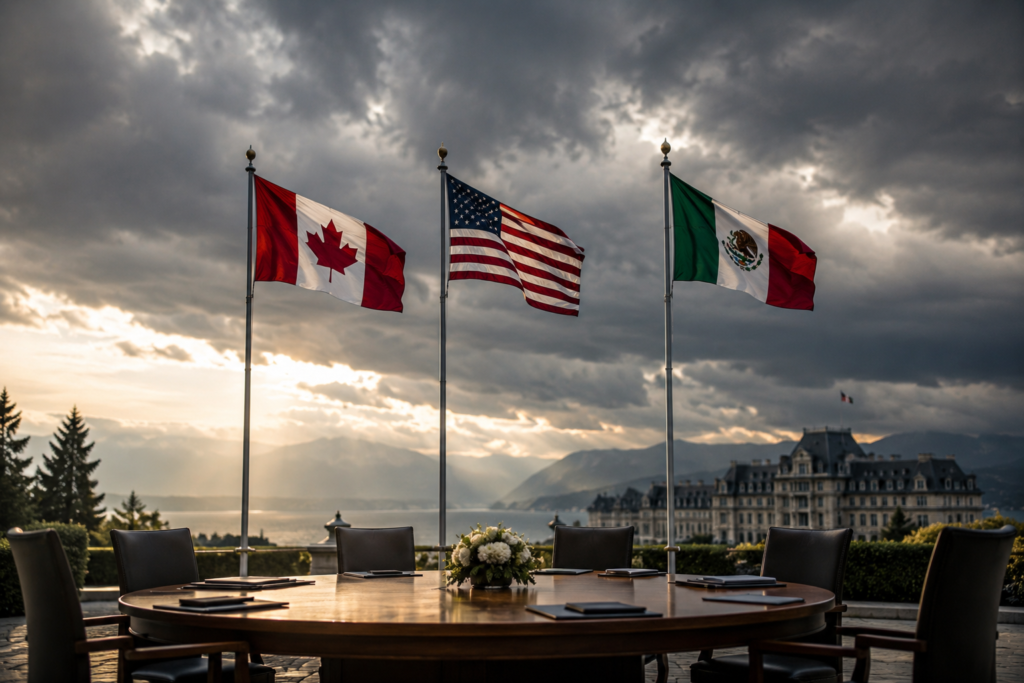
The July 1 CUSMA review milestone is now 12 days away, and it is effectively certain the agreement will not be formally renewed before that date. U.S. President Donald Trump — speaking to reporters at the G7 summit in Évian-les-Bains, France on June 17 — went further than previous statements, saying he would rather “leave it unsigned” or “have it terminated,” and characterizing the deal as largely irrelevant. He sent mixed signals within the same exchange, suggesting he might ultimately sign off on renewal, consistent with his established pattern of maximalist positioning ahead of negotiations.
Prime Minister Carney — returning from the G7 — told reporters in Vancouver on Thursday that Trump’s CUSMA skepticism was “no secret,” and that bilateral progress on specific irritants, including forest products, remained possible regardless of the agreement’s formal status. Carney characterized his conversations with Trump at the G7 as detailed and technical in nature, though no formal bilateral meeting was held between the two — Trump reserved scheduled one-on-ones at Évian for French President Macron and Indian Prime Minister Modi. Trade Minister Dominic LeBlanc met separately with U.S. Trade Representative Jamieson Greer on the G7 sidelines. A failure to renew before July 1 triggers a series of annual joint reviews rather than immediate expiry — CUSMA remains in force unless a party gives six months’ formal withdrawal notice.
Why it matters: Trump’s comments at G7 inject fresh uncertainty into the North American trading relationship at a moment when Canada is already navigating a technical recession partly attributed to trade disruption. A formal non-renewal does not collapse the agreement, but it resets the political framework to one of rolling annual reviews — a permanently precarious posture for Canadian exporters who depend on the agreement’s tariff protections. Analysis from trade law practitioners and industry groups suggests the U.S. strategy favours a bilateral restructuring that offers more favourable terms to Mexico on auto content and agriculture, leaving Canada in a comparatively disadvantaged negotiating position. The next round of talks is scheduled for the week of July 20 in Mexico City.