


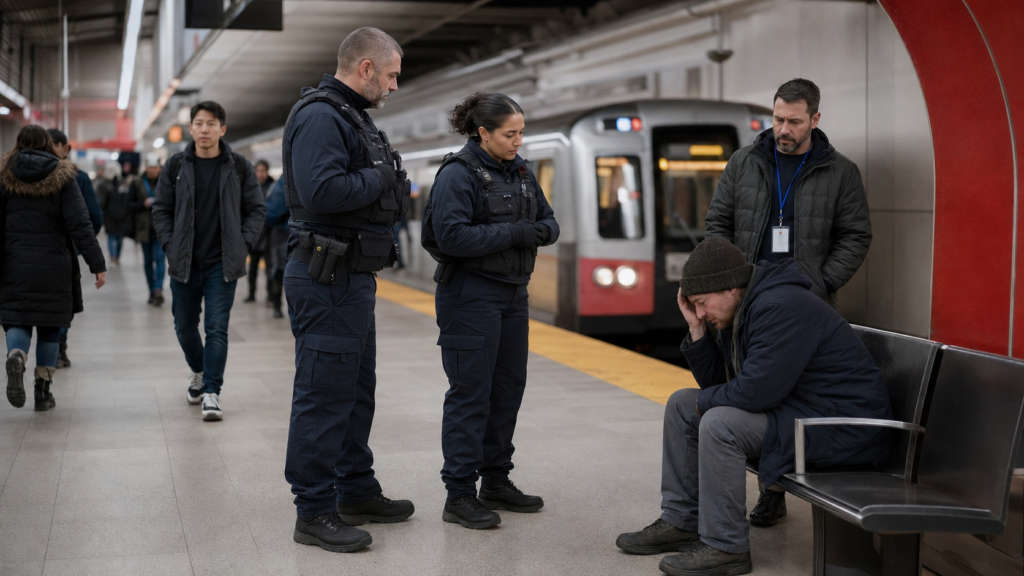
Ontario has expanded the authority of TTC special constables to confront illicit drug use across Toronto’s transit system, giving them powers previously reserved for police officers under the province’s public-consumption law.
The change took legal effect July 1 through a provincial regulation designating special constables employed by local transit systems as officers under the Restricting Public Consumption of Illegal Substances Act. The designation also covers special constables working for Metrolinx and municipal transit services elsewhere in Ontario. Ontario Regulation 151/26
The law allows an officer with reasonable grounds to believe someone is consuming an illegal substance in public to order that person to stop or leave the area. If the person refuses, the officer may demand identification, seize substances found in plain view and make an arrest without a warrant.
A conviction can carry a fine of up to $10,000, six months in prison or both. The maximum penalty applies to offences under the act, including refusing to follow an officer’s direction or provide identification. It isn’t an automatic penalty for being observed using drugs. Legislative Assembly of Ontario
The authority is now established in law, but TTC special constables aren’t expected to begin using it immediately. TTC spokesperson Stuart Green said the agency must complete training and establish procedures covering use of force, evidence storage and the handling of seized narcotics. Those preparations pushed implementation beyond the province’s original July target.
Premier Doug Ford has argued that visible drug use makes riders feel unsafe and that transit officers need the ability to intervene without waiting for Toronto police. The Ontario Special Constables Association supports the expanded authority, saying it should allow officers to deal more efficiently with drug-related incidents. CityNews
Transit and civil-liberties advocates see a different risk. They argue that the “reasonable grounds” threshold gives officers broad discretion and could lead to racial profiling, arbitrary detention and the criminalization of poverty, homelessness, addiction and disability. The Canadian Civil Liberties Association urged Ontario to invest in health-focused intervention instead of expanding police-equivalent powers. CCLA
TTCriders has pointed to the Toronto Community Crisis Service as an alternative. The city-funded pilot embeds trained crisis workers in downtown Line 1 stations and provides round-the-clock, non-police responses to mental-health and substance-use calls. Toronto budgeted up to $1.8 million for the program in 2026. City of Toronto
The province has legally changed how safety can be enforced inside a city-owned transit system, while leaving the TTC responsible for the training and operational costs. With Toronto’s municipal election approaching, the contrast is ready-made: Bradford can campaign on stronger enforcement, while Chow can defend a crisis-response model centred on intervention and support.