


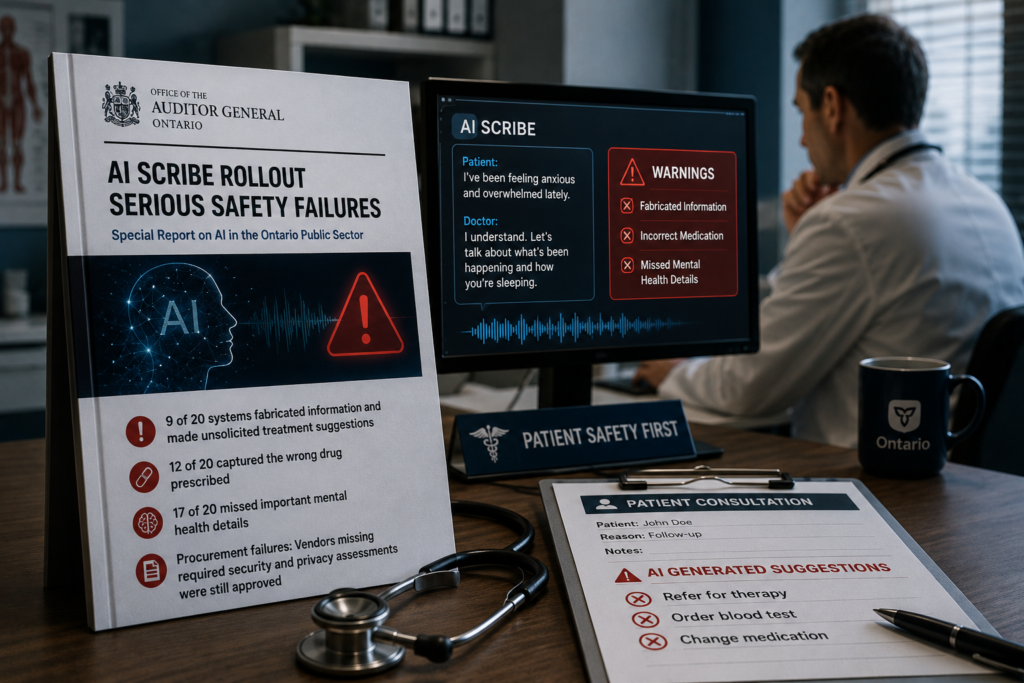
Ontario’s Auditor General Shelley Spence has released findings from a wide-ranging review of AI usage across the provincial public service, with the health sector component drawing significant attention. A special report found that nine of 20 AI scribe systems approved for use in Ontario doctors’ offices fabricated information and made unsolicited suggestions to patients’ treatment plans — such as referrals for therapy or orders for blood tests — even though no such steps were discussed during simulated doctor-patient conversations used in testing. Further, 12 of 20 systems captured a different drug than what was actually prescribed, and 17 of 20 missed important details about patients’ mental health issues even when those issues were mentioned explicitly in the simulated recordings.
The Auditor General also criticized the procurement process itself, designed by Supply Ontario in consultation with OntarioMD, Ontario Health, and the Ministry of Health. Eleven of 20 approved vendors failed to submit required third-party reports or ISO 27001 certification, and five vendors didn’t submit mandatory threat risk assessments or privacy impact assessments — yet all were approved regardless.
The findings arrive at a particularly sensitive moment. Ontario’s Information and Privacy Commissioner has released general AI guidance for provincial entities, while British Columbia’s privacy commissioner released separate health-sector guidelines in January 2026, reflecting a broader recognition of the risks AI scribes pose around privacy, accuracy, and potential bias. Quebec’s health authority, Santé Québec, has also launched a provincial pilot project approving four platforms for use by health-care professionals, with others undergoing certification.
The AG’s findings materially complicate the federal and provincial push to deploy AI scribes as a solution to physician burnout and administrative backlog. Canada Health Infoway is currently funding AI scribes for 10,000 clinicians nationally, and OntarioMD has reported that physicians using the tools cut paperwork time by 70 to 90 per cent. The efficacy case for AI scribes is strong; the safety and governance case, as Ontario’s auditor has now documented, remains seriously underdeveloped. Macleans.ca