


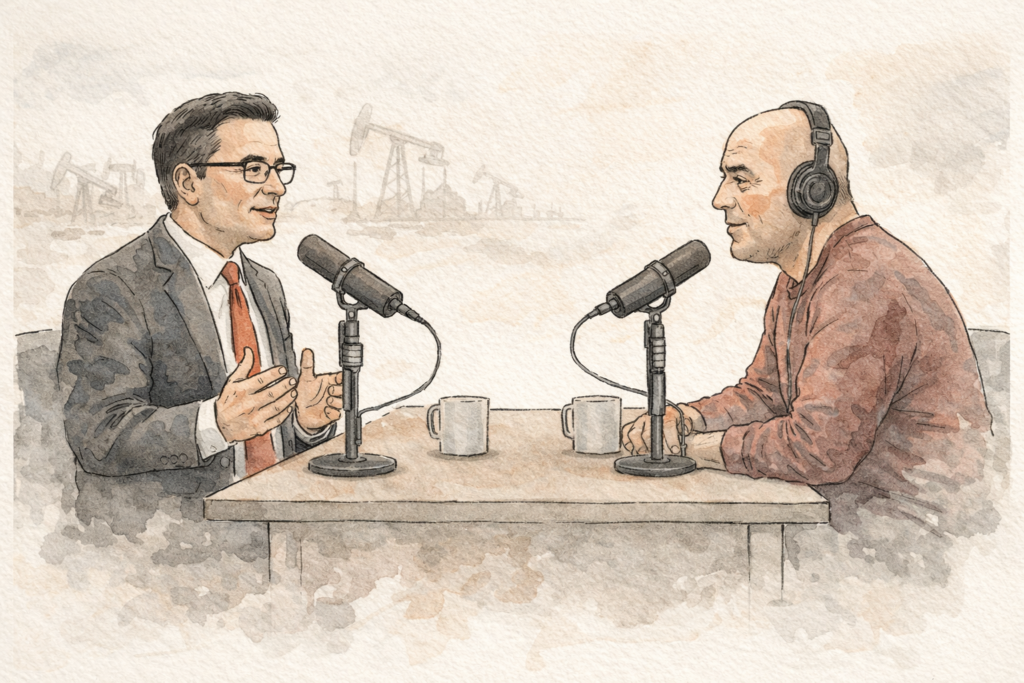
A long-form interview reveals a disciplined message, a narrow lens, and a focus on leadership over national consensus.
The Rogan Interview: What Pierre Poilievre Says, and What He Doesn’t
There’s something useful about a long-form interview. You get past the clips, past the slogans, and you hear how someone actually thinks when they’re given the time to explain themselves.
Pierre Poilievre sat down for nearly two and a half hours on Joe Rogan’s podcast. That alone is worth noting. Most politicians don’t put themselves in that kind of setting. For that, he deserves some credit.
But once you listen to it closely, what comes through isn’t just what he says. It’s how he frames himself, who he’s speaking to, and what he leaves out.
1. “Prime Minister in Waiting”
At one point, he says it outright. He’s the Leader of the Opposition, which is true, but then adds that he’s a “prime minister in waiting.”
That’s not a real title. It sounds official, but it isn’t. The Leader of the Opposition is a defined role in Canada’s system. “Prime minister in waiting” is not. It’s a way of presenting himself as the next government before voters have actually made that decision.
That kind of framing matters, especially on a platform with a large international audience, where many listeners won’t be familiar with how Canada’s political system actually works.
2. Oil Sands and Indigenous Communities
He talks about oil sands development, including extraction methods that happen underground, and suggests the impact is minimal, even something you wouldn’t notice under your feet.
There’s a piece of truth there. Methods like SAGD are less visible than open-pit mining. They don’t leave the same kind of surface footprint.
But that’s only part of the story.
These projects still require significant water use. They still generate emissions. There are ongoing concerns about groundwater, air quality, and long-term environmental effects. None of that is “invisible” in any meaningful sense.
And when it comes to Indigenous communities around Fort McMurray, the idea that everyone is simply on board doesn’t hold up. Some communities have built strong economic partnerships with the industry and benefit from it. Others have raised serious concerns about land, water, and health. In many cases, both of those realities exist at the same time.
Presenting it as clean and universally supported simplifies something that isn’t simple.
3. Who He’s Speaking To
What stands out more than anything isn’t just what he says, it’s who he’s speaking to.
The Rogan interview isn’t an outlier. It reflects a broader pattern in how he communicates. The message is consistent, disciplined, and easy to follow, but it’s aimed at people who already agree with him.
You don’t hear much in the way of outreach to people who don’t. There’s no real attempt to bring in skeptics or bridge divides. It’s a clear direction, delivered to a receptive audience.
That works politically. But it also limits how far the message travels beyond that base.
4. The Canada He Presents
He says he’s there to make the case for Canada and for Canadian workers.
But the version of Canada that comes through is narrow.
The conversation leans heavily on Alberta, oil, and agriculture. Those are real parts of the country, but they’re not the whole picture. There’s very little about the cities where most Canadians live. Nothing substantial about the pressures in Ontario. Almost nothing that reflects the broader economy people are dealing with day to day.
If you’re presenting Canada to a large international audience, that matters. Because for many people listening, that is their picture of the country.
5. A Case for Canada, or a Case for Himself
By the time you step back from it, the pattern is clear.
He says he’s there to make the case for Canada. But what you’re really hearing is a case for himself.
It’s not just the policies, it’s the framing. He refers to himself as a “prime minister in waiting.” He speaks as though he’s already stepping into the role. The version of Canada he presents fits neatly within that narrative.
There’s nothing unusual about a politician promoting their own leadership. That’s part of the job. But let’s be honest about what this is. This isn’t a broad case for the country. It’s a long-form pitch for why he should be the one running it.

6. The One Point He Gets Right
To be fair, there is one area where he’s on solid ground.
Canada does have a problem when it comes to getting major projects built. The layers of approval, overlapping jurisdictions, and long timelines have made it harder than it should be to move things forward.
That doesn’t mean those processes don’t serve a purpose. Environmental standards matter. Indigenous consultation matters. Those aren’t boxes you can just ignore.
But the broader point stands. The system is slow, and that’s something most people, regardless of where they sit politically, can agree on.
Conclusion
If Pierre Poilievre wants to live up to his own framing of being a “prime minister in waiting,” then at some point he has to start doing what prime ministers actually have to do, which is build a broader consensus.
That means speaking not just to the people who already agree with him, but to the ones who don’t. The voters in the cities. The people dealing with the pressures in Ontario. The Canadians who don’t see the country the same way.
What comes through here is a message that is tight and effective, but narrow. It holds the base. It reinforces it. What it doesn’t do is expand beyond it.
And that matters. Because governing a country isn’t the same as leading a movement. At some point, you have to bring people in who didn’t start with you.
Right now, there’s little evidence of that effort. And if that doesn’t change, it risks becoming the ceiling, not the foundation.