


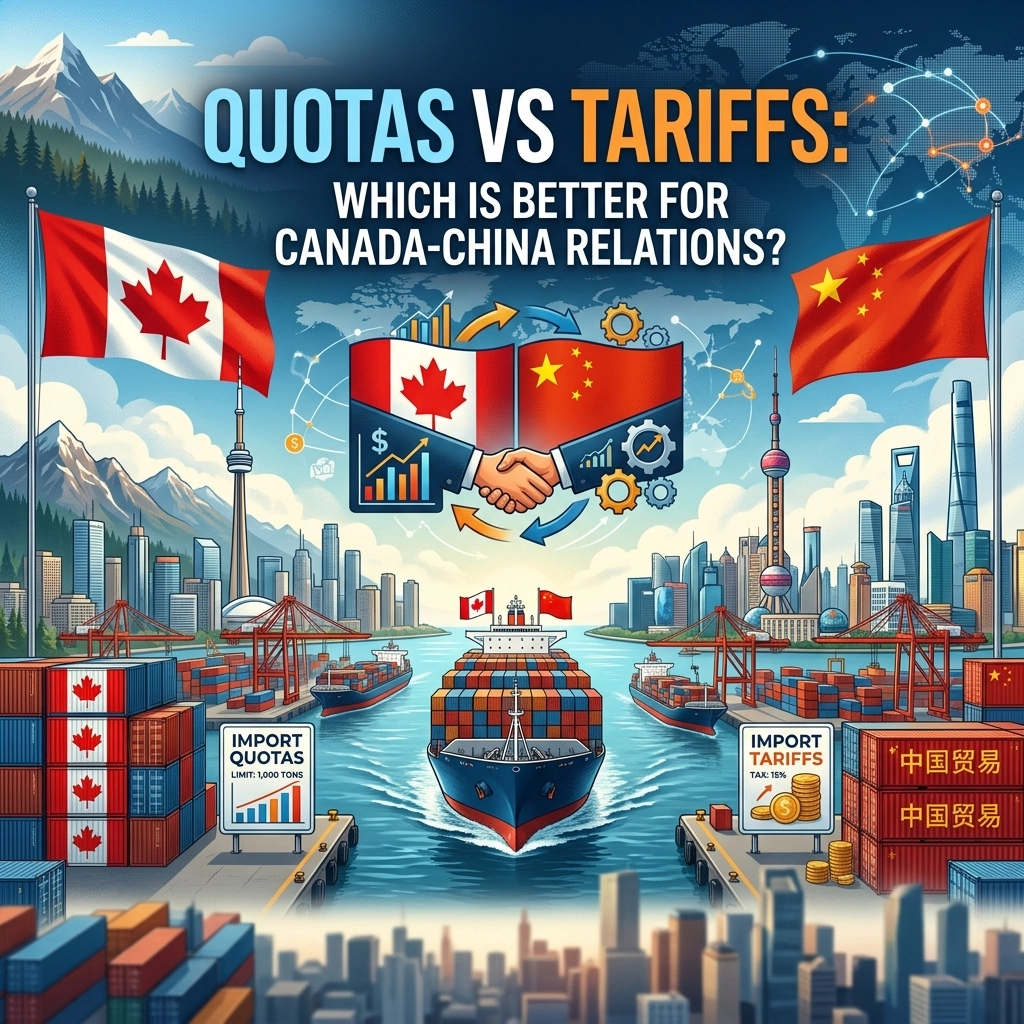
The landscape of Canadian trade policy is currently undergoing its most significant shift in a generation. For years, the federal approach to managing economic relations with China fluctuated between hopeful engagement and reactive protectionism. However, the recent January 2026 trade framework marks a definitive departure from the era of blanket 100% tariffs on Chinese electric vehicles. As we navigate this new environment, we must evaluate whether the current pivot toward a quota-based system serves our national interest more effectively than the blunt instrument of high duties. The choice between these two mechanisms is not merely a technical accounting exercise; it is a fundamental statement on Canadian sovereignty and our ability to maintain economic stability in a multipolar world.
At the heart of the current friction is the tension between protecting domestic industry and ensuring affordable access to the technologies required for a green transition. In 2024, the implementation of a 100% tariff on Chinese-made EVs was a clear signal of alignment with our southern neighbors, yet it carried significant domestic costs. It effectively locked out affordable options for Canadian consumers and invited immediate, painful retaliation against our agricultural sectors. By shifting toward the 2026 agreement: which establishes a 49,000-vehicle annual quota at a significantly lower 6.1% tariff rate: we are testing a more nuanced approach to managed trade. This transition requires us to look closely at how these instruments function and which one provides the strategic leverage we need to protect our long-term industrial policy.
The Blunt Instrument of Blanket Tariffs
Tariffs are historically the first tool pulled from the protectionist toolkit. They are easy to legislate, provide immediate revenue to the treasury, and offer a clear, albeit aggressive, signal to trading partners. However, in the context of Canada-China relations, high-percentage tariffs have proven to be a blunt instrument that often produces unintended consequences. When we applied 100% duties to Chinese EVs, the primary objective was to prevent a "flood" of subsidized goods from hollowing out the North American auto sector. While this provided a temporary shield for domestic manufacturers, it also signaled a lack of creativity in our diplomatic and economic strategy.
The primary drawback of high tariffs is their inherent invitation for retaliation. We observed this clearly when China responded by escalating duties on Canadian canola and other agricultural staples. For a middle power like Canada, engaging in a "tariff war" with a global manufacturing titan is a game of diminishing returns. The resulting trade distortion narrowed our bilateral growth to a mere 2% in the latter half of 2025. Furthermore, tariffs act as a regressive tax on domestic consumers, driving up prices and limiting choice without necessarily fostering the innovation required for domestic industries to become globally competitive.


The Surgical Nature of Quotas
In contrast to the broad impact of tariffs, quotas offer a form of "surgical protection." The January 2026 agreement demonstrates the value of this approach. By capping imports at 49,000 units, the Canadian government provides a predictable market ceiling that protects domestic manufacturers from being overwhelmed. This volume-based control is coupled with a modest 6.1% tariff, which generates revenue without making the product prohibitively expensive for the average Canadian. This hybrid model allows for a controlled entry that can be adjusted as our own production capacity matures.
The strategic advantage of a quota is the "breathing room" it provides. The current framework includes a five-year ramp-up period, aiming for 70,000 vehicles by 2030. This gives the Canadian auto industry: and its workforce: a clear timeline to adapt and compete. Moreover, the 2026 deal includes a stipulation that 50% of these imports must be priced below $35,000. This is a crucial detail that a simple tariff cannot achieve; it forces the competition toward the affordability gap that domestic producers have yet to fill. By managing volume rather than just inflating price, we maintain a level of market vitality that high tariffs typically extinguish.


Reciprocity and the Agricultural Factor
We cannot analyze trade instruments in a vacuum; we must consider the entire basket of Canadian exports. The shift from high tariffs to a quota-based system has already yielded dividends in sectors far removed from automotive manufacturing. Following the relaxation of the 100% EV tariff, China responded by reducing canola seed duties from 84% back to 15% and removing anti-discrimination barriers on lobster, crab, and peas. This reciprocal relief is essential for the economic health of the Prairies and the Atlantic provinces.
The restoration of these agricultural channels suggests that quotas are viewed by our trading partners as a more "constructive" form of protectionism than punitive tariffs. It allows for a face-saving exit from trade escalations while still maintaining the core protections required by Canadian industry. This balance is vital for a country that relies so heavily on export-led growth. We must view our trade policy as an integrated whole, ensuring that protection for one sector does not come at the expense of another's market access. You can find further analysis on these sectoral shifts in our economy section.


Toward a Smart Protection Framework
Moving forward, Canada should adopt what we call a "Smart Protection" framework. This approach moves beyond the binary choice of free trade versus protectionism. Instead, it prioritizes the resilience of the Canadian supply chain and strategic industrial policy. A Smart Protection framework uses quotas as a transitional tool rather than a permanent barrier. The goal should be to foster an environment where Canadian firms can integrate into global value chains while retaining the sovereignty to protect critical sectors.
This framework involves three core pillars. First, it requires the use of quotas to manage the pace of market disruption in emerging sectors like clean tech and critical minerals. Second, it mandates that any trade concessions: such as lowering tariffs: be tied to domestic investment requirements or knowledge transfer. Third, it demands a high degree of agility; trade instruments must be reviewed and adjusted annually based on the performance of domestic industries. We must ensure that our trade policy is proactive rather than reactive, positioning Canada as a leader in the new global economy. For a deeper look into the future of the automotive sector, consider reading our report on the North American auto dream.

Strategic Sovereignty and Economic Stability
The debate between quotas and tariffs is ultimately about how Canada projects its power and protects its citizens. Blanket tariffs are often a sign of a government that has run out of ideas, relying on high walls to hide a lack of industrial strategy. Quotas, when managed correctly, represent a more sophisticated understanding of global markets. They acknowledge that we cannot: and should not: entirely decouple from the world’s second-largest economy, but that we must engage on our own terms.
As we look toward 2030, the success of the January 2026 agreement will serve as a litmus test for this managed approach. If we can successfully grow our domestic EV capacity while maintaining stable prices and open agricultural markets, the quota-plus-low-tariff model will likely become the standard for Canadian trade relations across the board. We must remain vigilant, however, ensuring that these quotas do not lead to artificial scarcity or corruption in the allocation of import licenses.
We invite you to stay informed on these developing trade dynamics. Visit thecanadianist.news for ongoing coverage of Canada’s role in the global economy.
- View our full Economy archives.
- Read our latest Featured analysis.
- Support our work by exploring The Case for Canadianism.