


Listen. Watch. Read. Discuss.
We are standing at a crossroads that defines the modern Canadian experience. It isn't just about the numbers on a spreadsheet or the fluctuations of the TSX. It is about the foundation of our homes and the stability of our future. We are in the middle of a financial evolution: one that requires us to look clearly at the reality of our wallets.
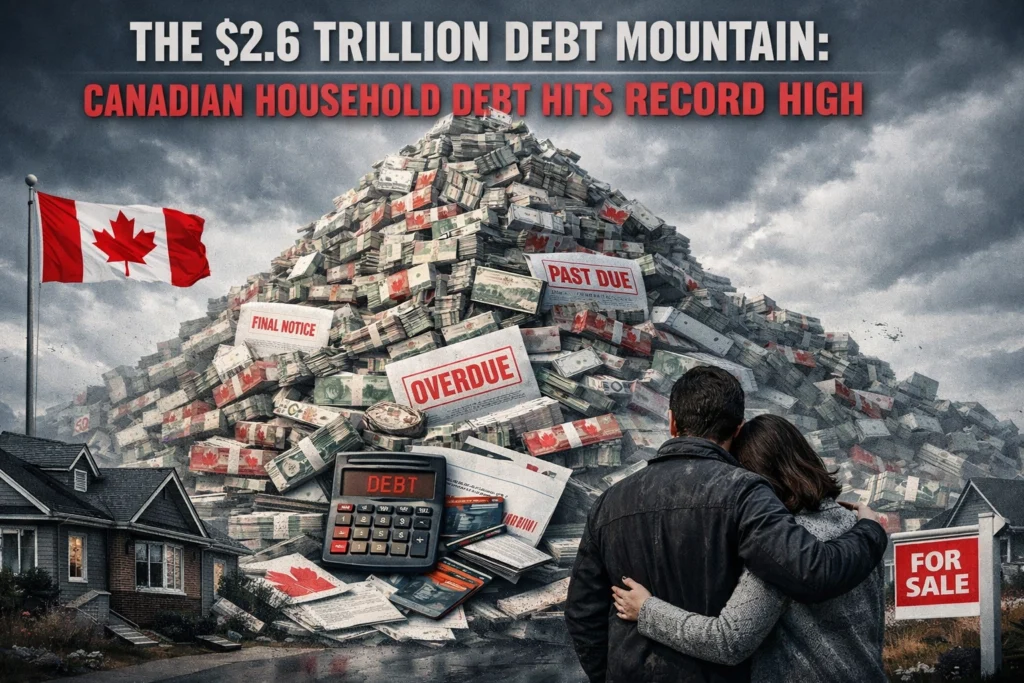
The news from yesterday isn't just a headline; it is a wake-up call for every kitchen table from Victoria to St. John’s. Canadian household debt has officially reached a record-shattering $2.6 trillion. That is a number so large it feels abstract, but for the millions of Canadians checking their banking apps this morning, the weight of it is very real.
We are a nation built on the promise of upward mobility, yet we find ourselves anchored by a mountain of credit. It is time we talk about how we got here, what it means for our neighbors, and how we move forward together.
The Scale of the Summit
When we talk about $2.6 trillion, we are talking about a 4% year-over-year increase. In a year where many hoped for a cooling period, the debt heat stayed on. This isn't just "lifestyle spending" or a few too many dinners out. This is a structural shift in how Canadians survive and thrive.
The primary driver? Mortgages. As housing prices have remained stubborn and interest rates have performed their own high-wire act, the cost of simply having a roof over our heads has become the dominant line item in the national ledger. We are a country of homeowners and aspiring homeowners, but that dream is increasingly being financed by a level of leverage that would make previous generations wince.

While many Canadians: roughly two-thirds: maintain strong credit scores and stay "prime," the cracks are forming at the edges. We cannot ignore the subprime borrowers and those in lower-income brackets who are being squeezed the hardest. For these families, debt isn't a tool for growth; it’s a survival mechanism. When the cost of living outpaces the growth of the paycheck, the credit card becomes the bridge. But bridges built on high-interest debt eventually require a toll that many cannot afford to pay.
The $1.77 Dilemma
Let’s look at the math, because the math tells the story of our daily lives. As of the latest data, Canadians owe roughly $1.77 in credit market debt for every $1 of household disposable income.
Think about that for a moment. For every dollar you actually have to spend after the government takes its share, there is nearly two dollars of debt waiting in the wings. This ratio: 176.7%: is one of the highest in the developed world. It means that as a collective, we are living a life that our current income cannot fully support.
We have surpassed our neighbors to the south in this regard. Since 2011, Canada’s household debt-to-income ratio has consistently outpaced that of the United States. While the Americans deleveraged after the 2008 crisis, Canadians doubled down on real estate. We bet on our homes, and while that bet has paid off in equity for some, it has created a precarious height from which to fall.
The Rise of "Zombie Debt"
Perhaps the most concerning trend uncovered in the recent data is the emergence of what economists are calling "zombie debt." This isn't debt used to buy a new car or renovate a kitchen. This is debt that exists simply to service other debt.
We are seeing a growing number of households who are struggling just to pay the interest on their existing loans. When 30% to 50% of a family's monthly income is dedicated solely to debt repayment, there is very little room left for the things that actually grow an economy: innovation, entrepreneurship, and local spending. In 2020, that figure was closer to 20%. The doubling of that burden in just a few years is a shock to the system that we are all feeling.

When we talk about being "balanced" as a news organization, we have to look at the silver linings, too. The household debt service ratio did see a slight dip from its peak of 15.2% in early 2025 down to 14.6%. It’s a small breath of air, but a welcome one. It shows that some Canadians are finding ways to tighten their belts, even if the belt is already in the last notch.
A National Challenge, A Shared Solution
As we look at these figures, it is easy to feel overwhelmed. But as a community, we have a choice. We can view this $2.6 trillion mountain as an insurmountable obstacle, or we can see it as a mandate for practical, common-sense governance and personal financial literacy.
We need a national strategy that focuses on productivity and housing supply. We cannot borrow our way to prosperity indefinitely. We need to create an environment where Canadians can earn more, save more, and rely on credit less. This means looking at our trade policies and ensuring our industries are competitive on a global stage.
It also means supporting our local economies. Whether you are in Toronto, Montreal, or the Maritimes, the story is the same: the cost of living is the number one issue at the ballot box and the dinner table.
The Path Forward
We are a resilient people. We have navigated high-interest environments before, and we will do it again. But this time, we must do it with our eyes wide open.
The $2.6 trillion debt mountain is a signal that the old ways of "borrow and hope" are reaching their limit. We need a return to fiscal responsibility, not just at the government level in Ottawa, but as a national culture. We need to celebrate the savers and support the strivers.
Leadership isn't about telling people what they want to hear; it’s about presenting the facts and building a coalition to address them. We need to unify around the idea that a stable, debt-manageable Canada is a stronger Canada for everyone. We need to ensure that the "Canadian Dream" doesn't become a "Canadian Debt Trap."
We’re in the middle of everything. Every mortgage payment, every credit card statement, and every grocery bill is a part of this story. We are all participants in this economy, and we all have a stake in its stability.
Stay informed. Stay engaged. And most importantly, stay hopeful. We have the resources, the talent, and the will to scale this mountain and find the solid ground on the other side.
For more updates on how the national economy is shifting and what it means for your region, you can explore our sitemap or check out our latest Quebec reports.
The Canadianist News: Balanced. Bold. Truly Canadian.
Listen. Watch. Read. Discuss. We are moving forward, together.