


The two-stage deal
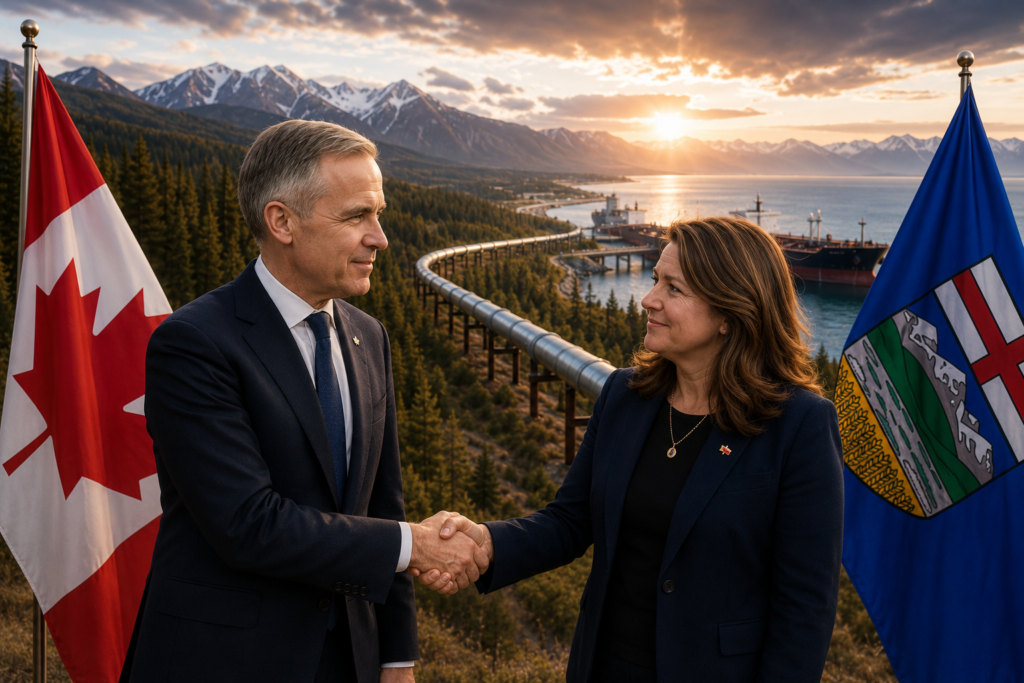
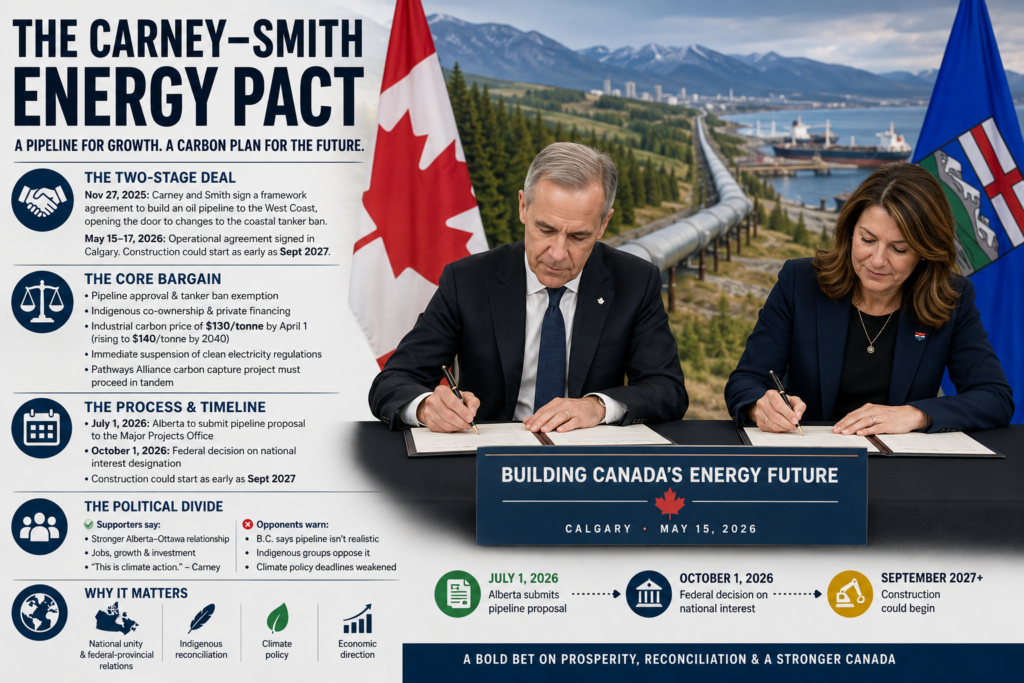
This unfolded in two phases. The framework came first: on November 27, 2025, Carney and Smith signed a memorandum of understanding in Calgary committing both governments to work toward building an oil pipeline to the West Coast, opening the door to changes to the coastal tanker ban, with Ottawa agreeing to enable the export of oil through a deepsea port to Asian markets and “if necessary” adjust the tanker ban to make that happen. barchartbarchart
The implementation phase followed on May 15, 2026, when the two leaders signed the operational agreement in Calgary that could see construction on an oil pipeline to the West Coast start as early as September 2027. The final version Guilbeault cited was signed May 17. The May agreement builds on the November memorandum and includes a plan to increase Alberta’s industrial carbon price, though at a slower pace than previously projected. CBC NewsCBC News
The core bargain
The deal is a trade: a pipeline for a softened carbon framework. Alberta will implement an industrial carbon price of $130 per tonne by April 1, bringing it above the federal benchmark, while Ottawa immediately suspends the clean electricity regulations in the province. Carbon pricing rises but more slowly — the effective industrial carbon-emission price is set to reach $130 per tonne by 2040, with the headline price reaching $140 per tonne by 2040, up from the current $95. The original framework also paired the pipeline with the proposed Pathways Alliance carbon capture project — Canadian Natural Resources, Cenovus, ConocoPhillips Canada, Imperial and Suncor — with officials stating the two must be built in tandem. globalnews + 2
Crucially, the November MOU specified the pipeline must have Indigenous co-ownership, be financed by a private company rather than tax dollars, and exempts the proposed route from the tanker ban off B.C.’s coast while committing to suspend a federal oil and gas emissions cap — a significant reversal from the policies of Carney’s predecessor, Justin Trudeau. bbci
The process and timeline ahead
The path is staged with hard deadlines. Alberta will submit a proposal for a new oil pipeline to Carney’s Major Projects Office by July 1, and the federal government says it will “pursue” designating the pipeline as a project of national interest by October 1. Intergovernmental Affairs Minister Dominic LeBlanc has stressed that pipeline construction is “contingent” on going ahead with the Pathways carbon capture project — the two would go ahead together. CBC NewsCBC News

The political fault lines
The reaction split sharply along regional and constituency lines. Smith framed it as a “new relationship” between Alberta and a prime minister who cares about the province’s prosperity, and the Calgary Chamber of Commerce gave Carney — a Liberal prime minister in oil country — a standing ovation. Carney, for his part, defended the deal in climate terms, declaring at a press availability: “This is climate action.” CBC NewsNational Observer
The opposition is significant and comes from two directions. B.C. Premier David Eby said the new pipeline isn’t realistic and that the suggestion alone risks compromising real major resource projects underway by alienating First Nations communities. And Indigenous opposition is direct: the Haisla Nation, Coastal First Nations and the B.C. Union of Indian Chiefs were among the Indigenous groups to say a new pipeline isn’t on the table. CBC NewsCBC News
Why it matters
This agreement is arguably the defining domestic-policy gamble of Carney’s government, and it touches nearly every coverage area at once:
- National unity / federal-provincial relations: It represents a deliberate reset with Alberta after a decade of friction, but at the cost of new tension with British Columbia.
- Indigenous reconciliation: The Indigenous co-ownership requirement is both the deal’s enabling condition and its largest unresolved risk — coastal First Nations opposition could halt the project regardless of federal designation.
- Climate policy: It marks a clear departure from the Trudeau-era framework, trading a faster carbon-price trajectory and the emissions cap for pipeline approval — the direct cause of Guilbeault’s exit and the caucus unease he flagged.
- Economic direction: It anchors Carney’s “energy superpower” pitch and his $1-trillion investment narrative, the same case he made in New York this week.
The next pressure points are concrete: Alberta’s July 1 submission, the federal October 1 national-interest decision, and the ongoing — and far from resolved — consultations with B.C. and coastal First Nations.