


Canada has always been a country that changes as people arrive.
For more than a century and a half the story has unfolded that way. Someone leaves somewhere else, steps into a new life here, and slowly finds their place inside the larger rhythm of the country.
These days I spend part of my time driving rideshare across the city. I enjoy it more than I expected to.
There are moments when the streets go quiet and the car becomes a kind of travelling office. I keep my tablet beside me, my phone within reach. Sometimes I write. Sometimes I read. Sometimes I answer messages while the city moves around me.
Then the request comes through.
The phone rings, the ride appears on the screen, and like Pavlov’s dog hearing the bell, I’m suddenly back to work.
Someone new is about to step into the car.
It was late afternoon when this one came in.
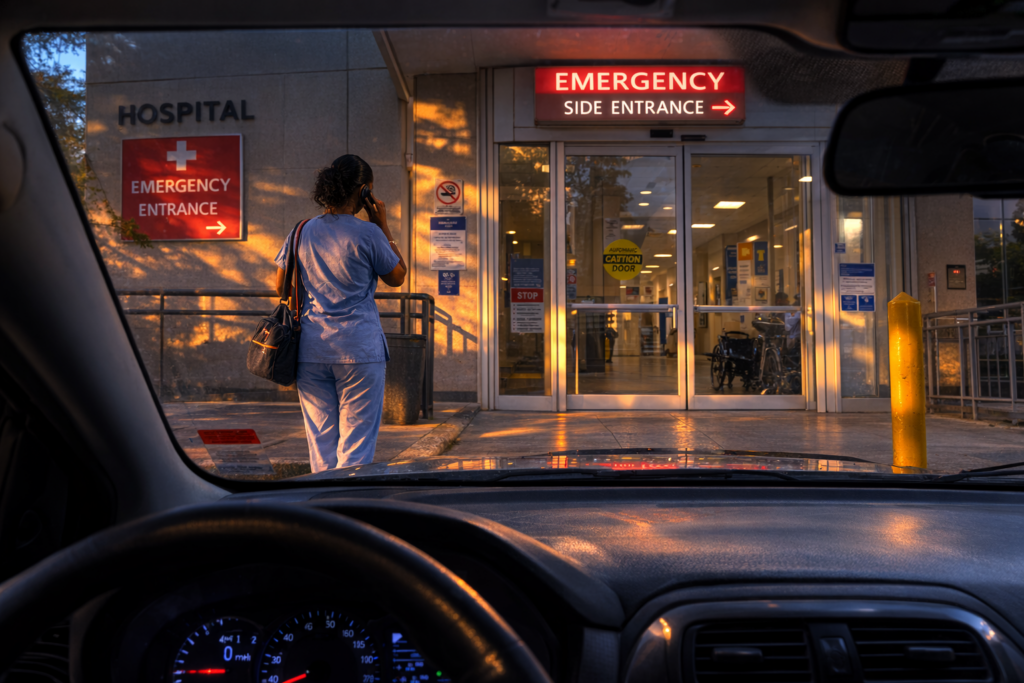
The kind of hour when hospitals begin to thin out as shifts change and people start thinking about home. I pulled up near the side entrance by the emergency department, the place where rides usually collect the people who have just finished long days inside.
She was already waiting.
Light blue uniform, the sort you see in hospitals everywhere. Not quite scrubs, but close enough that you know immediately what kind of work she does. She carried a bag in one hand and a small bundle of clothes in the other.
When she opened the door and climbed in, she apologized for the unusual request.
Her husband had locked his keys inside his car at the auto parts manufacturer where he worked. He was stuck outside waiting. She had the spare set with her, along with a change of clothes he needed, and she was heading over to rescue him.
We eased back into traffic and began crossing the city.
Somewhere along the way she mentioned she had come to Canada from Guyana twenty-five years ago.
Back home she had already trained as a nurse. When she arrived here she expected the work to continue more or less where it had left off.
But it didn’t quite happen that way.
Her credentials didn’t transfer the way she thought they would. The system placed her in a different category, one step lower than the role she had held before.
So she adjusted.
She became a registered practical nurse instead.
Still working long shifts. Still caring for patients. Just under a slightly different title than the one she had once carried.
Immigration has a way of doing that. People bend their expectations a little, shift their footing, and carry on.


About halfway through the drive her phone buzzed.
A message from her husband.
How much longer?
She smiled, typed back a quick reply, and explained that he was standing outside the plant waiting for her to arrive with the keys. A few minutes later the phone buzzed again. And then once more as we got closer.
He was clearly eager to get back into his car.
Each time she answered quickly and then slipped back into the conversation as if the interruptions were simply part of the rhythm of the afternoon.
At some point the conversation turned to her daughter.
She’s in school now, working toward a career of her own, and that was when the frustration in her voice became clearer.
She started talking about the changes to student loans.
When many of these students signed up for their programs, they had done the math based on a certain understanding of how the financial aid system worked. A large portion of the support came through grants, with the rest coming from loans that could be managed later once they entered the workforce.
Then the formula changed.
More loans. Fewer grants.
The numbers suddenly looked very different for students who were already halfway through their programs.
She told me about what happened at her wife’s school when the announcement came. Within days several students simply stopped coming. Not because they didn’t want the careers they were studying for, but because the debt they were suddenly expected to carry had become too large.
They had already committed years of their lives.
Now they were walking away.
The more she talked about it, the stranger the situation began to sound.
Everywhere you look, Canada is asking for healthcare workers.
Hospitals need nurses. Long-term care homes need staff. Governments talk constantly about the shortage and the need to train more people to fill those roles.
We advertise for them. We recruit internationally. We tell students that healthcare is one of the most secure careers they can choose.
And yet here she was describing something that seemed to move in the opposite direction.
Students signing up for programs only to see the financial rules change while they were already in the middle of their studies. Grants shrinking, loans growing, the cost of finishing suddenly looking much heavier than it did when they began.
For the students already in those programs, it creates a crisis.
But it also sends a message beyond them.
Word travels quickly in the communities where people are deciding whether to come to Canada to study or work. When the rules shift halfway through the game, it doesn’t just affect the people sitting in the classroom that year. It makes the next group wonder how stable the system really is.
And if you are asking people to come from around the world to train for careers that Canada says it desperately needs, uncertainty like that has a way of making people think twice.
She didn’t say it exactly that way.
But listening to her describe what she was seeing around her, it was hard not to notice the contradiction.
Her phone buzzed again just then.
Another message from her husband.
We were almost there.
The industrial district was beginning to appear ahead of us, wide parking lots and long low buildings stretching along the road. The auto parts manufacturer where he worked sat just up ahead.
He was already standing outside when we pulled in.
The moment we stopped, he walked toward the car.
She stepped out, handed him the keys, and the two of them laughed about the whole situation like it had simply been a small complication in the middle of an ordinary day.
A quick hug.
Then they turned and walked together toward their car.
I watched them get in before pulling back into traffic.
Another ride.
Another voice.
Another small piece of the country revealing itself in the space of a few miles.
And sometimes the stories that stay with you the longest are not the ones about people arriving in Canada.
They are the ones about people who have been here long enough to quietly wonder what comes next.