


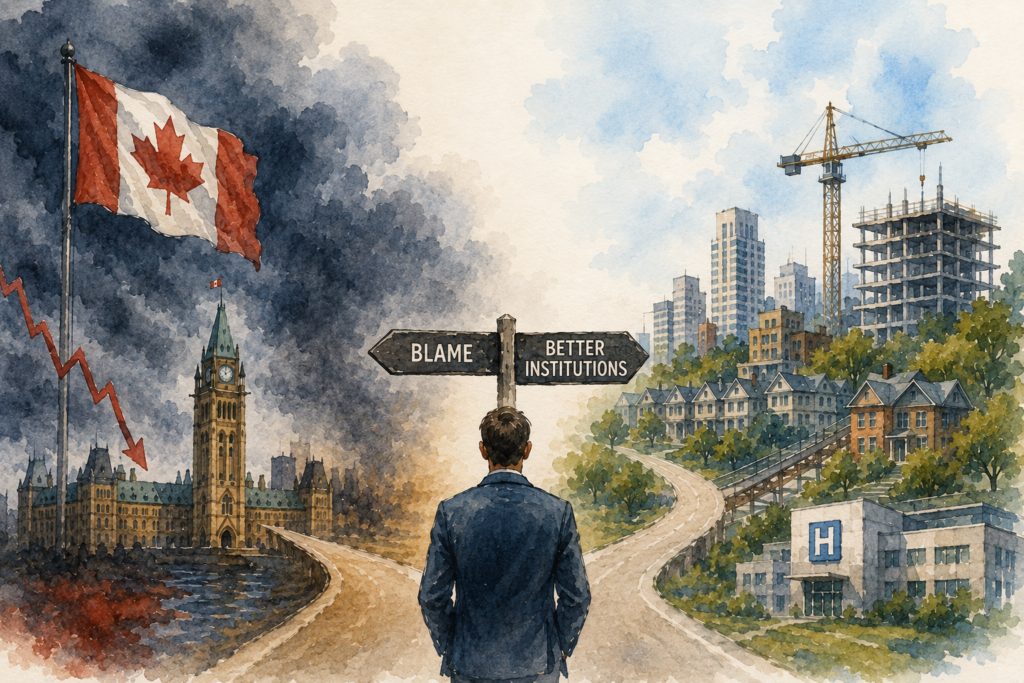
Canada has officially entered a technical recession.
That headline has generated exactly the reaction one might expect. Conservatives have pointed to it as evidence of failed Liberal economic management. Liberal supporters have highlighted global uncertainty, trade disruptions, and broader international economic conditions. Economists are debating whether the downturn is severe enough to resemble what most Canadians think of when they hear the word recession.
Before going any further, it is worth explaining what a technical recession actually is.
A technical recession occurs when an economy contracts for two consecutive quarters. In other words, economic activity becomes smaller for six months in a row. It is a statistical definition used by economists to create a consistent benchmark. It does not automatically mean widespread layoffs, collapsing businesses, or economic panic. It simply means the economy has met a specific threshold that economists use to measure economic performance.
That distinction matters because the word “recession” carries emotional weight. Most Canadians associate it with significant hardship. A technical recession may become that, but it does not necessarily mean it has reached that stage.
The political debate surrounding Canada’s latest economic numbers is understandable. Governments are accountable for economic outcomes, and opposition parties are expected to challenge those outcomes. The Trudeau government was in power for nearly a decade, during which many of the trends now causing concern became more pronounced. Weak productivity growth, declining business investment, housing shortages, affordability pressures, and growing strain on public services did not emerge overnight.


At the same time, Prime Minister Mark Carney has now been in office long enough that he cannot be viewed solely as the inheritor of past circumstances. Every government eventually owns the conditions it governs.
The question, however, is whether we are focusing on the right issue.
What is striking about Canada’s technical recession is not that it happened. What is striking is how little of it feels surprising.
Canadians have been hearing warnings about productivity for years. Business groups, economists, policy analysts, and even government reports have repeatedly highlighted concerns about Canada’s ability to generate long-term economic growth. Concerns about housing supply have been discussed for years. Healthcare capacity pressures have been evident for years. Questions about infrastructure, affordability, and investment have all been part of the national conversation for a long time.
None of these developments arrived without warning.
That raises a more important question than who deserves the blame.
If so many of these warning signs were visible, why was it so difficult for Canada to change course?
This is where the conversation moves beyond economics and into governance.
Canada’s political culture often encourages citizens to view every challenge through a partisan lens. Liberals blame Conservatives. Conservatives blame Liberals. Each side presents evidence supporting its preferred explanation, and the debate continues.
Yet many of Canada’s biggest challenges have persisted across multiple governments, multiple leaders, and multiple election cycles.
Housing shortages did not begin with a single budget.
Productivity challenges did not emerge because of one policy decision.
Healthcare pressures did not appear after one election.
These issues developed gradually and remained visible for years.
The larger question is whether Canada’s political institutions are structured in a way that allows for timely course correction when warning signs emerge.
Under Canada’s electoral system, a party can secure roughly forty percent of the popular vote and still obtain a strong parliamentary majority. Forty percent of the vote can translate into sixty percent or more of the seats. Every major party benefits from this reality when it forms government.
The question is whether Canada benefits.
When governments possess substantial parliamentary majorities despite receiving support from a minority of voters, are enough perspectives represented in the decision-making process? Are warning signs challenged early enough? Are governments encouraged to adjust course before problems become entrenched?
Reasonable people can disagree on the answers.
What cannot be disputed is that many of today’s challenges were visible long before the current recession headline appeared.
That is why the recession itself may not be the most important story.
The more important story may be Canada’s difficulty in responding to problems that are already widely understood.
Economic downturns happen. Governments change. Political fortunes rise and fall.
Institutions endure.
If Canadians are increasingly dissatisfied with outcomes related to housing, healthcare, affordability, productivity, and economic growth, then perhaps the conversation should not begin and end with which party occupies government benches.
Perhaps the conversation should also examine whether the institutions through which Canada governs itself are evolving quickly enough to meet the challenges of a changing country.
The recession may be the headline.
The real story lies underneath it.