


Toronto voters will choose a mayor on October 26, 2026, in an election featuring 53 certified candidates and an incumbent seeking her first full four-year term.
Mayor Olivia Chow, elected in the June 2023 byelection following John Tory’s resignation, is running again after just over three years in office. Her most prominent challengers include Beaches-East York councillor Brad Bradford and former federal Conservative cabinet minister and diplomat Chris Alexander.
Chow won the 2023 byelection with 269,372 votes, finishing roughly 34,000 votes ahead of former councillor Ana Bailão. She took office on July 12, 2023.
Bradford is making his second run for mayor. A former city planner, he has represented Ward 19, Beaches-East York, since 2018. He finished eighth in the 2023 mayoral byelection with 9,254 votes. His 2026 campaign has focused on affordability, housing construction, public safety, congestion and municipal services, arguing that Toronto residents are paying more without seeing corresponding improvements in how the city functions.
Chris Alexander entered the race in July. He previously served as the Conservative MP for Ajax-Pickering, minister of citizenship and immigration, a Canadian diplomat and ambassador to Afghanistan. His campaign has identified economic growth, transportation, housing, neighbourhood services and municipal performance as major priorities.
Polling conducted in August suggests Chow remains the frontrunner, with Bradford her strongest challenger.
A Pallas Data survey conducted August 19 to 21 placed Chow at 38 per cent, Bradford at 30 per cent and Alexander at six per cent, with 24 per cent undecided. Among decided and leaning voters, Chow was near 50 per cent, Bradford near 39 per cent and Alexander near eight per cent.
A Liaison Strategies poll conducted August 14 to 16 produced a similar result, showing Chow at 49 per cent, Bradford at 38 per cent and Alexander at 11 per cent among decided and leaning voters.
Those numbers do not necessarily indicate an easy election for the incumbent.
Pallas also found 46 per cent of respondents believed Toronto was headed in the wrong direction, compared with 37 per cent who believed it was headed in the right direction. Forty-eight per cent were dissatisfied with Chow’s performance, while 37 per cent were satisfied.
The Issue: Can Toronto Still Deliver the Basics of a Growing City?
Housing may be the largest individual issue in the election, but the broader question facing Toronto is whether municipal government can successfully manage the growth already happening around it.
Housing, congestion, TTC reliability, homelessness, public safety, construction delays, municipal finances and basic service delivery increasingly overlap.
Toronto is not debating whether it will grow. It is already a city of more than three million people, with significant population growth and billions of dollars in planned housing and infrastructure investment.
The question is whether the city can absorb that growth without making daily life increasingly expensive, congested or unreliable.
Housing provides one of the clearest examples.
Toronto’s provincially assigned housing target is 285,000 new homes by 2031.
By the second quarter of 2026, Toronto City Council had approved housing equivalent to 73.7 per cent of its annual target. Actual housing starts, however, represented only 21.5 per cent of the target, while completed units represented 22.7 per cent.
The gap between approving housing and actually building it is likely to become one of the most important policy questions of the campaign.
Chow can point to progress during her time in office.
More than 6,200 rent-controlled, affordable and rent-geared-to-income homes approved through HousingTO were under construction as of March 31, 2026.
The city has also expanded the types of housing permitted in Toronto neighbourhoods, frozen TTC fares for three years and expanded library hours.
One of the most consequential achievements of Chow’s term was the Ontario-Toronto New Deal, under which the province assumed responsibility for the Gardiner Expressway and Don Valley Parkway and provided additional operating and capital support.
Toronto’s 2026 operating budget is approximately $18.9 billion, accompanied by a $63.1-billion ten-year capital plan.
The combined residential property-tax and City Building Fund increase for 2026 was 2.2 per cent.
Those numbers make the election partly a debate about political priorities and partly a referendum on municipal management.
Chow’s argument is likely to be that her administration inherited a financially strained city, stabilized its relationship with Queen’s Park and Ottawa, protected municipal services and expanded housing and transit investment.
Bradford’s argument is that residents are still paying too much for a city that is not delivering basic services quickly or reliably enough. His campaign is emphasizing faster housing construction, reduced congestion, tighter spending priorities and measurable municipal performance.
Alexander is approaching the same dissatisfaction from outside municipal government, arguing that Toronto is economically and administratively underperforming and requires stronger management and closer collaboration with business, universities, hospitals, Queen’s Park and Ottawa.
Those are campaign arguments and should be judged against each candidate’s record and proposals as the election develops.
Who’s Running
The certified candidates for mayor are:
Imad Abdulkadir
Bahira Abdulsalam
Chris Alexander
Jamie Atkinson
Brad Bradford
Darrell Brown
Brian Buffey
Braeden Chow
Olivia Chow
Logan Choy
Kevin Clarke
Paul Collins
Alex Cruze
Roberto Curto
Laura Dean
Habiba Desai
Cory Deville
Wincess Dorville
Laura Ellis
Martin Fraser
Alton Frederick
Faizan Haider
Thomas Hall
Jack Hartley
Heather He
Peter Handjis
Georgios Kalkounis
Mohamad Kaaki
Isidoros Kyrlangitses
Michael Lamoureux
Rick Lee
Reagan Levermany
Eddie Mayanja
Sarah McVie
Francis Mercieca
Joseph Osuji
Odessa Paloma Parker
Gus Prokos
Faisal Razi
Amy Rosen
Lyall Sanders
Naomi Sayers
Robert Shusterman
Sandeep Srivastava
Weizhen Tang
Joshua Thompson
Kuo Yu Tong
Jeffery Tunney
Jack Weenen
Henoke Yohannes
Leila Yohannes
Mostafa Zandkarimi
Edward Gong
The City of Toronto says 361 candidates have been certified across the mayoral, council and school-board races.
The Canadianist will continue to review the full mayoral field and expand candidate profiles where political experience, campaign organization, policy development or demonstrated public support warrants additional coverage.
Election Information
Toronto’s municipal election takes place Monday, October 26, 2026.
Polls will be open from 10 a.m. until 8 p.m.
Advance voting runs from Tuesday, October 6 through Sunday, October 11, with voting locations open from 10 a.m. until 7 p.m.
Beginning September 1, eligible voters can use the City of Toronto’s MyVote service to confirm or update voter information, locate voting places, see candidates and request a mail-in ballot.
Voter information can be updated through MyVote until 7 p.m. on October 11.
What Toronto Is Choosing
Toronto’s mayoral election is not simply a contest over housing, transit or taxes individually.
The larger question is whether the city government can keep pace with the scale of Toronto itself.
The next mayor will inherit a city attempting to build hundreds of thousands of homes, maintain aging infrastructure, improve transit reliability, address homelessness, manage congestion and finance services for more than three million residents.
The election will ultimately test competing arguments over whether Toronto needs continuity, a change in municipal management or a broader reset in how City Hall approaches growth.
Companion Story
Toronto approves housing. Why isn’t Toronto building housing?
Toronto’s housing numbers create an obvious follow-up story.
Council approvals are running well ahead of actual construction starts and completions.
The Canadianist can examine what is creating the gap, including interest rates, construction costs, development charges, financing, permitting, market conditions and the degree to which City Hall can actually influence whether approved projects get built.
Hero Image
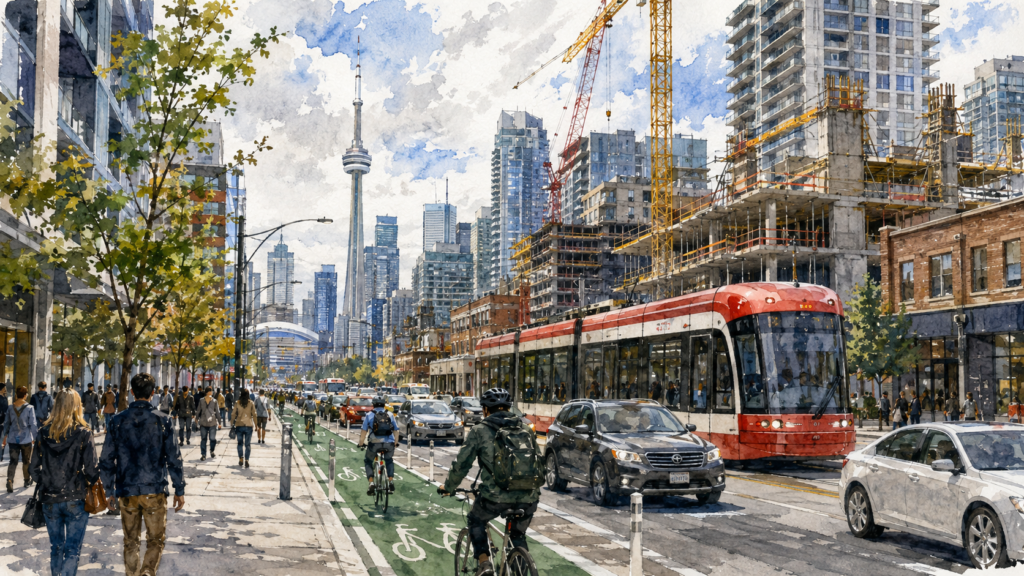
A strong Toronto hero image should show the city’s growth and its pressures in the same frame.
A realistic editorial watercolor could depict a major Toronto avenue such as Eglinton, Yonge or Bloor, with condominium construction, cranes, TTC vehicles, traffic, pedestrians and cycling infrastructure visible together.
No text, no ballot boxes and no candidate collage.