


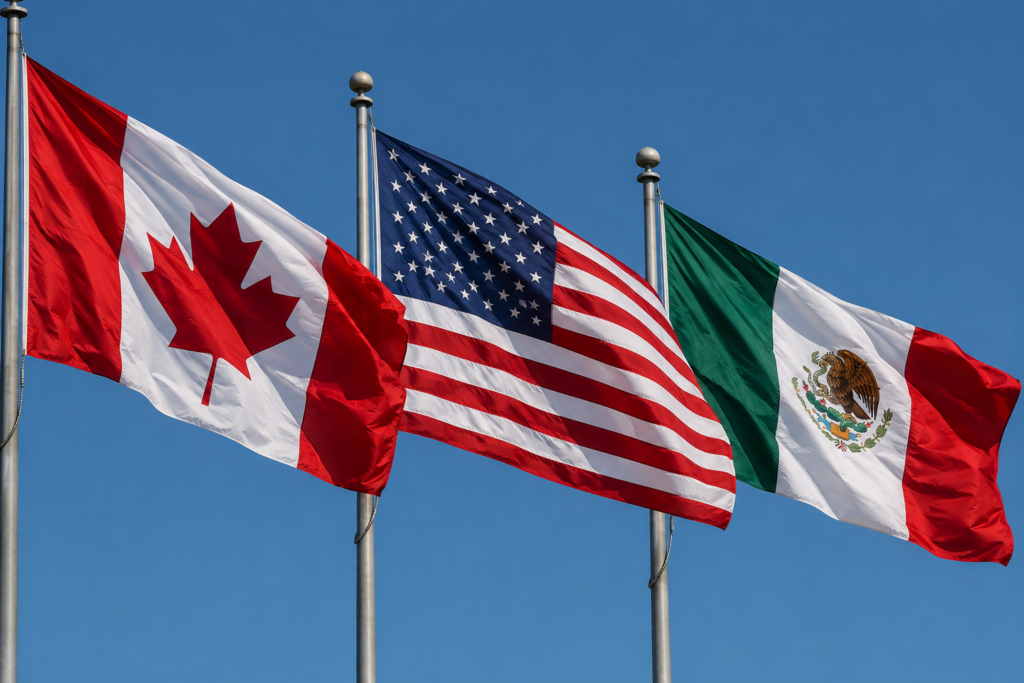
The United States has formally declined to renew the Canada-United States-Mexico Agreement (CUSMA) for another 16-year term, setting North America’s most important trade agreement on a path of annual reviews instead of long-term certainty.
The decision, announced Wednesday following the mandatory six-year review built into the agreement, does not terminate CUSMA. Trade rules remain in force exactly as they did yesterday, and the agreement continues to govern trade between Canada, the United States and Mexico until at least 2036 unless one of the three countries withdraws or a new agreement is reached.
What has changed is the level of certainty.
Under Article 34.7 of CUSMA, all three countries were required to confirm by July 1 that they wished to extend the agreement for another 16 years, carrying it through 2042. Canada and Mexico indicated they supported an extension. The United States declined to do so. As a result, the agreement now enters a period of annual joint reviews that could continue until its scheduled expiry in 2036. At any point during those yearly reviews, all three countries can still agree to extend the deal.
U.S. Trade Representative Jamieson Greer said Washington chose not to renew the agreement in its current form because the administration believes it has failed to address American trade deficits and other longstanding concerns. Officials have also pointed to issues including automotive rules of origin, market access and Chinese supply chain participation as priorities for future negotiations.
For Canada, the immediate economic impact is limited.
Canadian exporters do not suddenly lose preferential access to the American market, nor do existing tariff schedules automatically change. Manufacturers, farmers and businesses continue operating under the current CUSMA framework.
The larger concern is investment.
Businesses making multi-billion-dollar decisions about factories, supply chains and manufacturing expansion typically look years into the future. An agreement subject to annual political review creates significantly more uncertainty than one guaranteed for another 16 years. Economists have long warned that uncertainty alone can delay investment, hiring and capital spending, even if the underlying trade rules remain unchanged.
The decision also reflects a broader shift in the Trump administration’s approach to trade.
President Donald Trump originally negotiated and signed the agreement in 2020 as the replacement for NAFTA, describing it at the time as a major achievement. Since returning to office, however, he has repeatedly argued that the agreement has not delivered the balance of trade or manufacturing gains he expected, particularly with Canada and Mexico. Rather than extending the existing deal, the administration has chosen to use the annual review process as leverage to seek additional concessions.
Canadian officials have consistently maintained that July 1 was never a hard deadline for the agreement’s survival. Trade Minister Dominic LeBlanc has previously described the review as a checkpoint rather than a cliff, noting that CUSMA was designed specifically to continue operating while negotiations proceed if consensus could not be reached.
Attention now shifts to the negotiating table.
Washington has indicated that talks with Mexico will continue later this month, while discussions with Canada are expected to remain active as the three governments work through a growing list of trade disputes. Those negotiations are likely to touch everything from automotive manufacturing and critical minerals to agricultural market access and digital trade rules.
For Canadians, today’s announcement is best understood as the beginning of a new phase rather than the end of North American free trade.
CUSMA remains in force. Goods continue crossing borders under the same rules as before. But unless the three countries eventually reach a new consensus, North America’s largest trading relationship will now operate under the shadow of yearly political negotiations instead of the long-term stability businesses had hoped to secure.