


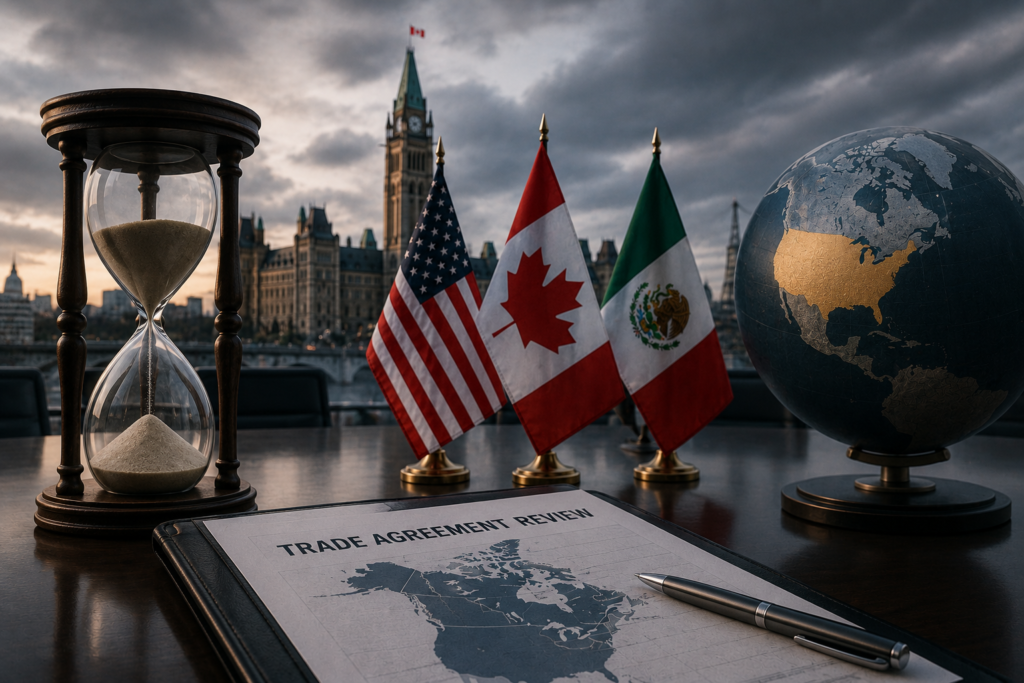
Canada’s most consequential trade negotiation in a generation enters its final weeks, with a mandatory July 1 review of the USMCA approaching and no formal agreement yet in place — an outcome that could lock the country into a prolonged cycle of annual trade uncertainty.
Under Article 34.7 of the USMCA, all three parties must review the agreement beginning July 1, 2026 — six years after it entered into force. After each review, the U.S., Mexico, and Canada must decide whether to extend the agreement for another 16 years. If they cannot agree, annual reviews continue for up to 10 years, until 2036, at which point the USMCA would expire if no renewal is reached. Beutelgoodman
A clean, early extension by July 1 now appears unlikely. The review launched only on March 18, bilaterally rather than trilaterally, narrowly scoped to increasing U.S.-Mexico production and limiting non-market inputs into North American supply chains, with no text on the table beyond the existing agreement and less than four months before the statutory decision date. Prime Minister Carney has acknowledged there is little evidence that Canada will secure a trade deal with the United States that does not impose some tariffs, with elimination or further reduction in tariffs likely left to additional concessions Canada provides. Center for Strategic and International StudiesCenter for Strategic and International Studies
Canada’s chief USMCA negotiator Janice Charette has attempted to manage expectations, signalling that the July 1 deadline should not be viewed as a breaking point for North American trade relations, emphasizing that the date serves as an important checkpoint but does not mean the agreement will collapse if negotiations remain unresolved. The most structurally significant recent development is the U.S. Supreme Court’s ruling earlier in 2026: the Court’s 6-3 decision striking down IEEPA tariffs is the most structurally significant development of 2026. The administration responded by pivoting to Section 122 of the Trade Act of 1974 to maintain tariff pressure. Canada’s counter-tariffs on steel, aluminum, and automobiles remain in effect as intensive negotiations continue, in recognition that the U.S. maintains tariffs on these sectors without providing an exemption for CUSMA-compliant goods. EconoTimes + 2
Why it matters: The USMCA governs roughly three-quarters of Canada’s goods exports. Roughly 76 per cent of Canada’s worldwide exports of goods were destined to the U.S. in 2024. A drift into annual review cycles — rather than a clean 16-year extension — would create sustained investment uncertainty for every sector of the Canadian economy tied to cross-border trade, from autos to agriculture to energy. The next four to six weeks are arguably the most economically consequential negotiating window Canada has faced since NAFTA itself was negotiated in the early 1990s.