


By Christopher M. Michaud
Canada likes to congratulate itself for not being the United States.
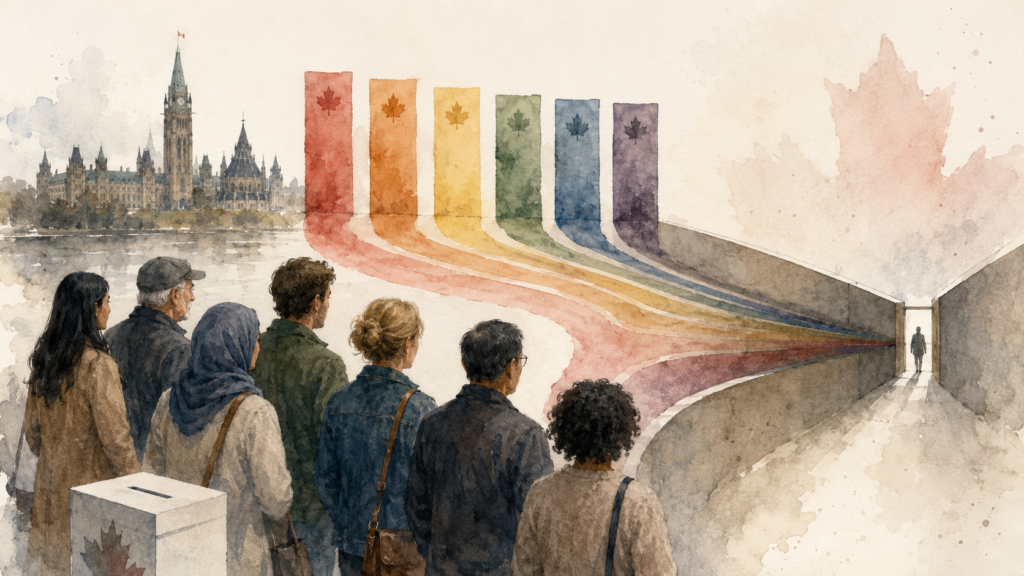
We don’t have a two-party system. We have the Liberals, Conservatives, New Democrats, Greens, Bloc Québécois, the People’s Party, and now the United Canadian Centrist Party.
On paper, that’s an impressive menu.
In practice, many Canadians walk away feeling like there wasn’t much choice at all.
That’s the illusion.
When Americans criticize their political system, they usually point to the Republican-Democrat duopoly. Two brands dominate everything. If you don’t fit neatly into one of them, you’re left wondering where you belong.
Canada appears different.
But only because we’ve confused the number of parties with the amount of political choice.
Think about the conversations Canadians have during every federal election.
Very few begin with, “Which party best reflects your values?”
Instead, they begin with questions like, “Can they win?” “Will you split the vote?” “Do you really want to help the other side?”
Those aren’t questions about democracy.
They’re questions about strategy.
Somewhere along the way, we stopped asking Canadians who they wanted to represent them and started asking them to predict what everyone else was going to do.
That’s a remarkable shift.
A democracy should reward honesty. Instead, ours often rewards calculation.
Millions of Canadians cast ballots they don’t feel particularly good about because they’ve been convinced that voting for the party they actually prefer is somehow irresponsible.
That’s not political engagement.
It’s political compromise before the votes have even been counted.
Ironically, having more parties can make this problem harder to recognize.
Because there are multiple logos on the ballot, Canadians assume we enjoy broad political competition. Yet election after election, the national conversation narrows toward a small number of “viable” choices, while everyone else is treated as a spoiler, a protest vote, or an interesting idea for another day.
If you’re politically homeless, the ballot doesn’t feel any bigger simply because there are more names on it.
You still don’t feel represented.
That’s one reason new political movements continue to emerge.
The United Canadian Centrist Party didn’t appear because Canadians needed another logo on the ballot. It exists because a growing number of Canadians no longer see themselves reflected in the existing political choices. They’re fiscally responsible but socially moderate. They believe in immigration but want it managed. They support free enterprise while recognizing the need for responsible government. They don’t wake up every morning looking for another culture war.
Yet too often they’re told they have to pick a side.
Why?
Most Canadians don’t live at the political extremes.
They raise families. They run businesses. They commute to work. They worry about paying the mortgage, finding a family doctor, and whether their kids will have the same opportunities they had.
Their lives are nuanced.
Our politics increasingly isn’t.
The real question isn’t whether Canada has enough political parties.
It’s whether Canadians have enough meaningful political choice.
Those aren’t the same thing.
When millions of people feel compelled to vote strategically instead of sincerely, when elections become exercises in preventing outcomes rather than pursuing better ones, and when citizens begin choosing the least objectionable option instead of the one that best reflects their beliefs, something deeper is happening.
The political marketplace has become compressed.
That’s not healthy for Liberals.
It’s not healthy for Conservatives.
It’s not healthy for the New Democrats, the Greens, the Bloc, the People’s Party, or the United Canadian Centrist Party.
It’s not even healthy for democracy itself. A healthy democracy shouldn’t ask citizens to hold their noses; it should ask them what they believe.
Until we build a political system where Canadians feel free to answer that question honestly, we’ll continue mistaking the number of parties on the ballot for the amount of choice we actually have.