

The Canadianist | Blog
Political Restraint and the Canada We Choose to Be

When personal convictions enter public institutions, the responsibility to Canadians must come first.
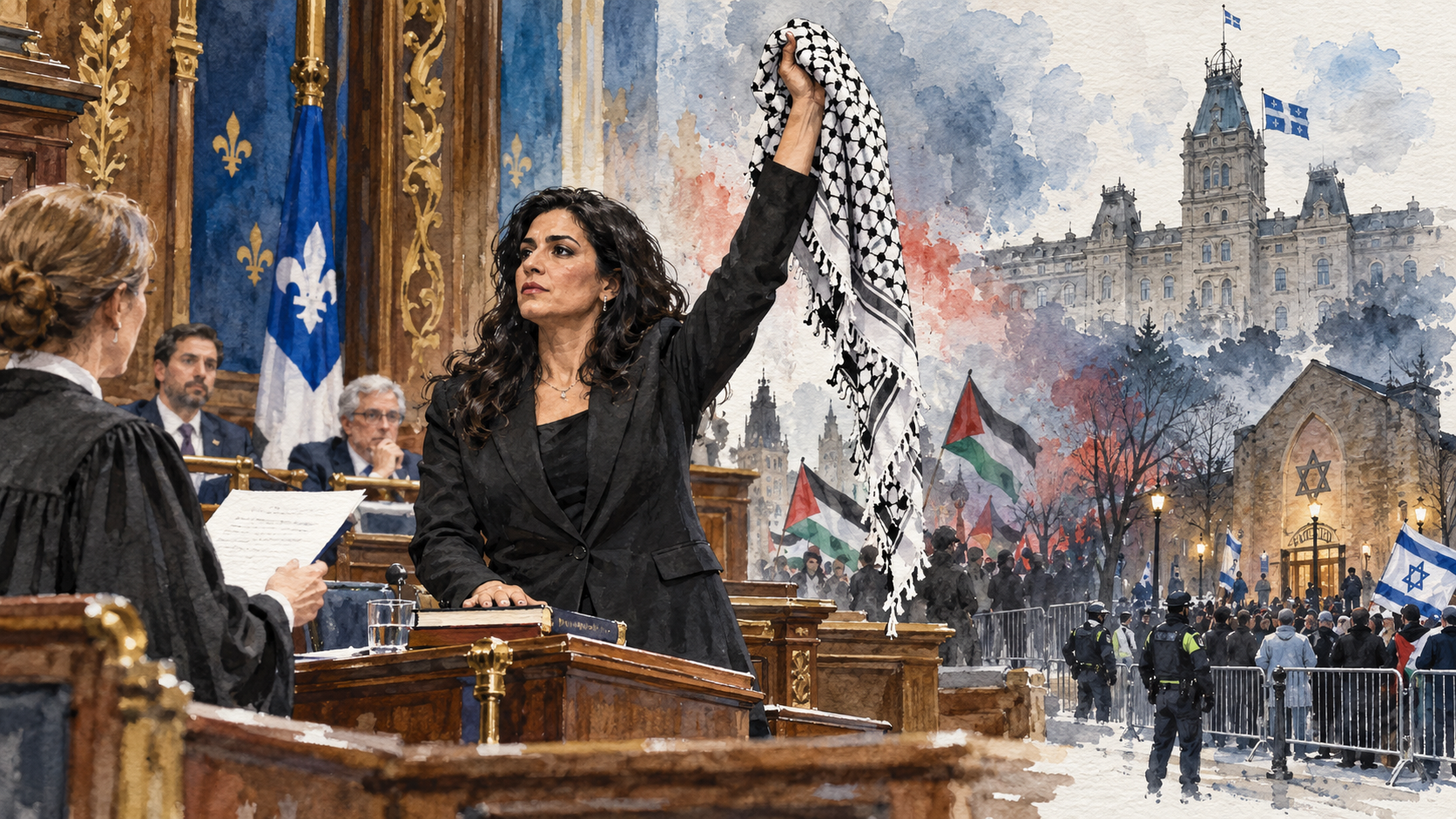
On October 20, Ruba Ghazal, the parliamentary leader and co-spokesperson of Québec solidaire, stood inside Quebec’s National Assembly during the swearing-in ceremony for her party’s elected members. At one point, she took a Palestinian keffiyeh from former party spokesperson Manon Massé and raised it above her head. It was a brief gesture, but a deliberate and unmistakably political one. The photographs circulated quickly, and so did the controversy.
Ghazal subsequently explained that the gesture was an expression of her Palestinian heritage and her gratitude toward Quebec, where her family had found refuge decades earlier. She described it as a message of love for the society that welcomed her. I don’t question her right to celebrate her heritage, express solidarity with Palestinians or hold strong opinions about the conflict in the Middle East. I question her judgment in choosing that particular moment to make her statement.
She was participating in a ceremony devoted to her responsibilities as an elected representative of the people of Quebec. Nobody had asked her about Palestine. Nobody had invited her to explain her family history or demonstrate her political allegiances. She chose, on her own initiative, to introduce an international political cause into an occasion that belonged to the Quebec electorate. Whether she had planned the gesture or acted spontaneously makes little difference to how it was received. She momentarily redirected attention from the responsibility she was accepting to a political cause of personal significance.
The Responsibility of an Oath
Quebec’s elected representatives swear loyalty to the people of Quebec and undertake to perform their duties honestly and justly. It’s a formal acknowledgment of the obligations that accompany democratic office. Quebecers are also Canadians, and their provincial institutions exist within the broader constitutional framework of this country. The National Assembly is a place where competing political convictions are debated, legislation is examined and elected representatives pursue the interests of the people they serve. Those representatives are entitled to their opinions, and their convictions will inevitably influence their work. But a swearing-in ceremony serves a different purpose. It marks the acceptance of a public responsibility that extends beyond personal preferences, ancestry and political affiliations.
My Italian Heritage Doesn’t Change My Responsibility
My mother’s family is Italian. That heritage is part of who I am, and I’m proud of it. But if I were standing inside Quebec’s National Assembly taking an oath to serve Quebecers, the last thing I’d consider appropriate would be to raise an Italian flag. I suspect many Italian Quebecers would be the first to ask me what the hell I was doing. You’re a Quebecer. You’re there to represent Quebecers. Save the Italian flag for another occasion. And they’d have a point. I’d have precisely the same objection to an Israeli flag, an American flag or any other foreign national symbol being used to make a political statement during that ceremony.
Of course, a keffiyeh is not a national flag. It’s a traditional garment with a history that extends beyond contemporary politics, but it has also become one of the most recognizable symbols of Palestinian nationalism and solidarity. Ghazal is an experienced politician who understands those associations. Quebecers are divided on Palestine. Some support Palestinian statehood and identify strongly with that cause. Others identify with Israel. Many have complicated views about both peoples, while others would prefer that international conflicts not dominate provincial politics. The existence of those disagreements should have given her reason to consider how the gesture would be received.
Her explanation emphasizes what the keffiyeh means to her. Public leadership, however, requires understanding that a symbol may mean something very different to the people watching. Those who applauded her gesture are not the only people she represents. Solidarity with people who share one’s convictions is only part of the responsibility of elected office. The more demanding obligation is to maintain respect for those who disagree, particularly during occasions meant to affirm a shared civic commitment.
Québec solidaire and the Meaning of Solidarity
There is a particular irony in the fact that the party Ghazal helps lead is called Québec solidaire. Solidarity is written into its name. The party’s founding principles describe a pluralistic, inclusive Quebec committed to the common good. They also embrace international solidarity, so expressions of support for Palestinians are not inherently inconsistent with its political philosophy. But a party that places solidarity at the centre of its identity should also recognize that the responsibility to bring people together extends beyond those who already support its positions. What about Quebecers who see the conflict differently? What about those concerned by antisemitism, political intimidation and the increasingly confrontational nature of public demonstrations? What about Quebecers who simply expect their elected representatives to concentrate on governing Quebec?
I’m not particularly interested in turning this into an examination of Québec solidaire’s internal politics. The broader concern applies to every political party in Canada. But Ghazal is a party leader, and her conduct carries significance beyond her individual reputation. Political leaders establish expectations and influence the priorities of the organizations they lead. Their public judgment is part of what voters must consider when deciding whether to entrust them with greater authority. If a leader chooses to use a solemn parliamentary occasion for a personal political statement, voters are entitled to ask how that leader understands the responsibilities of the institution and whether those same priorities might influence decisions involving much greater consequences. One gesture cannot establish how someone would govern, but the decisions politicians make in public are part of the record on which their judgment is assessed.
The Conflict Has Already Entered Canadian Life
My concern isn’t confined to the National Assembly. I’ve watched the Israel-Palestine conflict become a recurring source of confrontation in Canadian communities. At Sheppard and Bathurst in Toronto, an intersection I pass regularly, opposing demonstrators have gathered repeatedly, separated by police officers and metal barricades. I’ve seen people standing across the street from one another, hurling insults over a conflict taking place thousands of kilometres away. The police presence has at times resembled an operation in itself, with barriers, officers and command facilities deployed to manage tensions between groups that have become familiar adversaries. I’ve driven past it weekend after weekend, and I’m thoroughly tired of watching Canadians treat one another this way.
Toronto Police have identified the intersection as a location requiring heightened security. Investigations arising from demonstrations there have resulted in criminal charges, including allegations involving the public promotion of hatred. Those allegations must be dealt with through the justice system, and the conduct of particular individuals should never be attributed automatically to everyone participating in a demonstration. But the broader public-order problem is evident. There is a difference between peaceful protest and conduct that intimidates others, threatens public safety or repeatedly turns residential neighbourhoods into confrontation sites. The right to demonstrate is fundamental to Canadian democracy, but the residents of those neighbourhoods have rights as well. They should be able to live their lives, attend places of worship, operate businesses and move through their communities without repeatedly finding themselves in the middle of confrontations they did not create.
When two groups stand across a street shouting insults at one another, I have to wonder what anyone believes is being accomplished. Are Israelis and Palestinians any closer to peace? Have these confrontations brought Canadians together or improved life for the people living nearby? We should be able to ask those questions without being accused of opposing the right to protest. Canada cannot solve every conflict in the world, but we are responsible for how we conduct ourselves toward one another here.
What Antisemitism Looks Like in Everyday Life
There is another reality that cannot be ignored. Drive through Toronto’s Jewish neighbourhoods and look at the security arrangements outside synagogues, Jewish schools and community centres. Security personnel, controlled entrances and heightened police presence are familiar sights. I’ve seen them with my own eyes. These are institutions where Canadians go to worship, educate their children and participate in community life. They should be places where people feel secure, yet concerns about antisemitism have made substantial security measures a prominent feature of the environment surrounding many of them.
These concerns are supported by more than personal observation. In March 2026, three Toronto-area synagogues were targeted by gunfire within approximately one week. No one was injured in those incidents, but they understandably generated serious concern in the affected communities. Toronto Police figures also document the disproportionate targeting of Jewish residents in reported hate crimes. In 2024, Toronto recorded 443 reported hate crimes, with anti-Jewish incidents accounting for approximately 40 per cent of the total. The overall number declined to 231 in 2025, but Jewish residents remained the most frequently targeted group. By May 2026, police were reporting an increase in hate crimes compared with the same period the previous year. These figures don’t demonstrate an uninterrupted increase in every category, but they establish that antisemitism remains a persistent public-safety problem.
I have a friend named William, an Israeli Canadian who grew up in Israel. He eventually decided to leave Canada. I remember him telling me, “Chris, I’ve seen it firsthand. I grew up in the Middle East. I know what’s coming.” Those were his fears, informed by his own experiences, and I’m not presenting his prediction as an established fact about Canada’s future. But his concerns were serious enough that he chose to leave a country he had made his home. When someone reaches the point of believing that leaving Canada is preferable to remaining, I believe we ought to pay attention. We don’t have to agree with William’s assessment to recognize what his decision says about his sense of security and belonging.
His experience is one part of a larger Canadian reality. Palestinian Canadians have families, histories and deeply personal connections to a conflict that has brought immense suffering. Jewish Canadians have equally legitimate concerns about hostility, intimidation and antisemitism in their own communities. Neither population should be asked to surrender its identity, suppress its grief or abandon its right to participate in Canadian public life. Both are entitled to live in a country where their neighbours and political representatives recognize the responsibilities they share as Canadians.
What Was the Public Supposed to Understand?
Now consider Ghazal’s gesture in that wider context. The keffiyeh is not inherently antisemitic, and supporting Palestinian rights is not evidence of hostility toward Jewish people. No reasonable discussion should conflate Palestinian identity with violence or extremism. Nevertheless, the symbol has become closely associated with demonstrations and political confrontations that Canadians have watched unfold on university campuses and city streets. It carries political meaning beyond Ghazal’s personal family history, and the public is entitled to interpret a conspicuous political gesture in the context of events already affecting Canadian communities.
What was the public supposed to understand when Ghazal raised the keffiyeh? Was she celebrating her ancestry, expressing solidarity with the Palestinian people, identifying herself with the broader protest movement or communicating some combination of those things? She says it was an expression of love toward Quebec, and I accept that this is how she describes her intentions. But I saw something different. To me, the gesture looked almost defiant, celebratory in a way that suggested a declaration of political allegiance. It appeared as though the occasion of assuming public office had become an opportunity to announce a personal political statement. That’s how I received it as a member of the public, and it’s part of why I question her judgment.
That interpretation doesn’t establish that Ghazal supports violence, civil unrest or unlawful demonstrations. Accusations of that kind require evidence. But when a politician introduces a politically charged symbol into an official ceremony without invitation or any connection to its formal purpose, she invites questions about the message she intended to send and the audiences she considered. She cannot reasonably expect everyone to interpret the gesture exclusively through the personal explanation offered afterward. Political judgment includes anticipating how one’s actions may be received by those who don’t share one’s convictions.
The Law Is the Floor, Not the Ceiling
Some will argue that Ghazal broke no law, violated no oath and had every right to display the keffiyeh. That may be entirely correct, but I’ve never accepted the proposition that legality represents the highest standard of public conduct. The law is the floor, not the ceiling. We should expect more from elected representatives than the ability to remain technically within the rules. Public office demands discretion, responsibility and an understanding that some occasions call for restraint even when nothing legally requires it.
Quebec is officially a secular state, although the keffiyeh is primarily a cultural and national symbol rather than a religious garment. This incident should not be reduced to a debate about religious clothing, nor am I proposing that politicians surrender their cultural identities or abandon their political convictions. A legislator’s personal history can enrich their understanding of the society they serve. That diversity of experience is one of the strengths of representative government. But public office also requires recognizing when the interests of the institution and the people it represents should take precedence over personal expression.
When I say that Ghazal’s conduct raises questions about her suitability for leadership, I’m making a moral and political judgment, not calling for her legal disqualification or removal from office. Her voters elected her, and their democratic choice deserves respect. But voters are equally entitled to assess the conduct of the people they elect and decide whether it meets the standards they expect of someone asking for greater responsibility. I consider political restraint one of those standards, and I believe it should be taken considerably more seriously than it is today.
When Institutions Become Vehicles for Ideology
The more troubling issue extends beyond one Quebec politician. Across Canada, we need to ask whether our public institutions are increasingly being treated as vehicles for the personal ideological commitments of those who occupy them. Political ideology is unavoidable in democratic institutions. Parties exist because people disagree about how society should be governed, and our legislatures are supposed to accommodate those disagreements. But an elected representative’s convictions should inform the work they do within the institution, while the institution’s purpose should continue to govern the responsibilities they carry. When that relationship begins to reverse, public trust is placed under strain.
The question becomes whether a representative is exercising the authority of an institution to serve the public or using the visibility and legitimacy of the institution to promote personal causes. These concerns apply across the political spectrum. A Conservative, Liberal, New Democrat, Bloc Québécois member or independent can exhibit the same failure of judgment. A politician who brings an American partisan grievance into a Canadian parliamentary proceeding raises the same institutional question as someone who introduces a divisive cause from another part of the world. Canada’s institutions belong to Canadians collectively. They aren’t personal possessions or platforms to be used without regard for their purpose, and the authority they confer comes with responsibilities extending to people who voted against the officeholder or profoundly disagree with their convictions.
Canadianism: Respect and Belonging
This brings me to something I’ve written about extensively in my book, Canadianism: A Calm Alternative for a Fractured Country. In that book, I set out five pillars of Canadianism, the shared civic principles I believe Canadians must be willing to articulate, understand and practise if our multicultural society is to function. Canada has welcomed people from across the world, bringing different histories, languages, religious traditions and political experiences into a common society. That diversity is a defining characteristic of modern Canada, but it cannot sustain itself through goodwill alone. A multicultural country requires a shared civic identity, understood and accepted by the people who choose to make it their home.
Two of those five pillars are especially relevant to what we’re witnessing. The first is Respect. We must learn to agree on how to disagree. That doesn’t mean finding a comfortable middle position on every issue. People will hold convictions that are fundamentally incompatible with those of their neighbours. Some disagreements will remain unresolved, and some involve deeply personal matters of faith, history and identity. Respect means recognizing that disagreement doesn’t cancel our responsibility toward one another. It means understanding that someone who holds an opposing position is still entitled to participate fully in Canadian society, and that sharing a country requires consideration for people whose experiences and convictions differ from our own.
The fifth pillar is Belonging. Canada belongs to everyone willing to contribute to our society and live by the shared values of our civic identity. Everyone who accepts that responsibility has a place here and a stake in the country’s future. No single community, culture, religion, ancestry or political movement owns Canada. Our shared civic identity is what allows people with different backgrounds to participate in the same national project. That sense of belonging also carries obligations. We cannot bring every historical grievance and international political confrontation into Canadian society, allow those conflicts to define our relationships with one another, and then assume social cohesion will somehow take care of itself.
Our differences are real and deserve acknowledgment and respect. But we also need a common understanding of what it means to be Canadian and what responsibilities we accept toward one another. Without that, multiculturalism risks becoming a collection of competing identities rather than a society held together by shared civic commitments. I wrote Canadianism because I believe we have failed to articulate those commitments clearly enough, and the consequences of that failure are becoming increasingly visible.
We Have a Stake in One Another’s Future
I want to make something clear about my position on the Israel-Palestine conflict. I’m not writing this to endorse or condemn either side. I don’t have a dog in that race. I have something much closer to home at stake: the quality of Canadian life and our ability to live together. I care about the Jewish Canadian who feels unsafe attending synagogue, the Palestinian Canadian grieving for relatives, the families who live near Sheppard and Bathurst and find themselves repeatedly surrounded by police barricades, and those who want to express their convictions peacefully without becoming targets of hostility themselves. I also care about Canadians who have no desire to participate in the conflict at all. They’re all part of the country we share, and our political leaders should understand that their responsibilities extend to every one of them.
This is where I believe the discussion of solidarity needs to change. Solidarity cannot simply mean publicly affirming people whose opinions match our own. The more demanding responsibility is maintaining respect and a shared sense of belonging among people who disagree. That doesn’t require politicians to become indifferent to injustice elsewhere in the world, nor should Canadian institutions remain silent whenever international events have consequences for our country. There are legitimate occasions for legislatures to debate foreign conflicts, condemn violations of human rights, recognize suffering and consider the interests of Canadians affected by events abroad. But those discussions should be undertaken deliberately, with a clear understanding of the public responsibilities involved.
An elected representative shouldn’t confuse a personal declaration of solidarity with an institutional responsibility to the entire electorate. The louder the divisions become outside our legislatures, the more carefully political leaders should consider the messages they introduce inside them. The people entrusted with our institutions must recognize that the authority of public office carries obligations beyond personal conviction. Their responsibility is to the society as a whole, including people who disagree with them.
The Canada We Choose to Be
We are approaching a point in Canada’s evolution where Canadians need to decide who we intend to be. The question reaches far beyond Ruba Ghazal, Québec solidaire or the conflict between Israel and Palestine. Canada is home to people whose families have lived here for generations and others who arrived recently. We carry histories of conflict, persecution, migration, opportunity and renewal. Some of those histories intersect, while others contain disagreements that may never be reconciled. Our task is to build a functioning society despite those differences, and that requires something more substantial than celebrating diversity whenever it is convenient. It requires shared values, mutual obligations and a political culture capable of recognizing the common interests that bind us together.
Ghazal’s gesture may have lasted only a few seconds. She may sincerely believe it was an expression of gratitude toward Quebec. But the response it generated reveals how differently Canadians can interpret political symbolism, particularly when the conflicts associated with those symbols are already affecting life in our communities. Political restraint requires recognizing those realities before acting, especially when the occasion belongs to a public institution rather than the individual occupying it.
We don’t have to agree about Palestine, Israel or any other international conflict to recognize our obligations as Canadians. We do have to agree that this country, its institutions and the responsibilities we share within them deserve our collective commitment. If Canada is to remain a successful multicultural society, that commitment must be strong enough to accommodate the divisions we bring with us without allowing them to define who we become.
Our future will depend, in no small part, on whether the people we entrust with public authority understand that responsibility.