
Economy
Gas Prices Diverge Across Canada as Regional Gaps Persist

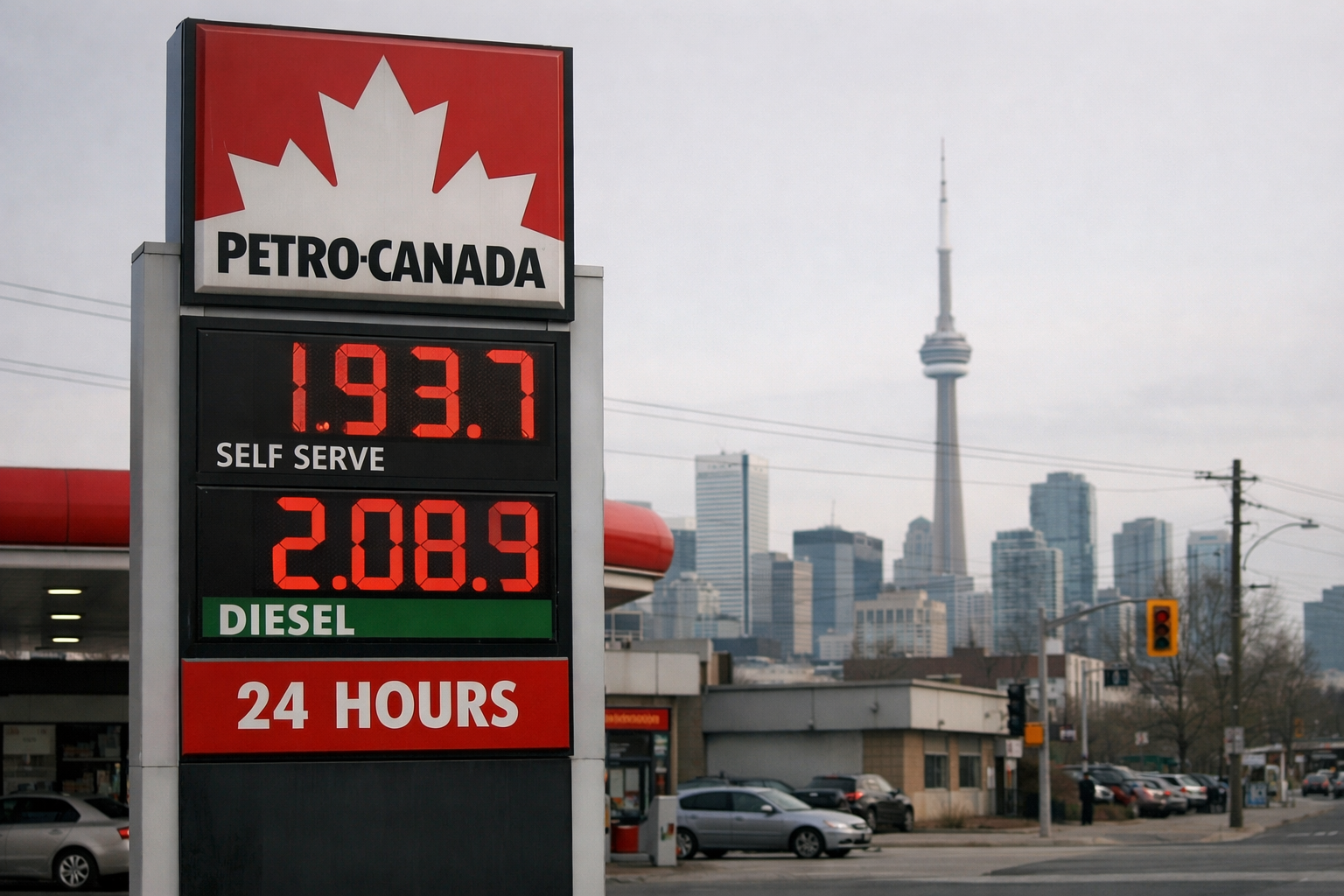
Gasoline prices across Canada are showing sharp regional differences this week, with drivers in Western and Atlantic markets paying significantly more than those in the Prairies, and central Canadian cities sitting in the middle of the range.
A snapshot of major metropolitan areas suggests a national urban median of roughly $1.60 to $1.65 per litre for regular gasoline, though the spread between the highest and lowest markets remains substantial.
In Vancouver, prices are hovering between $1.90 and $2.05 per litre, the highest among major Canadian cities. Victoria is close behind, generally ranging from $1.88 to $2.00. At the other end of the spectrum, Calgary and Edmonton remain among the least expensive markets, with prices typically falling between $1.40 and $1.55 per litre.
Central Canadian cities such as Toronto, Ottawa, and Montreal continue to cluster in the middle range. In the Greater Toronto Area, prices are averaging between $1.55 and $1.65 per litre, while Ottawa and Montreal are slightly variable, generally sitting between $1.50 and $1.70 depending on local conditions and daily fluctuations.
In Atlantic Canada, prices remain elevated relative to central Canada. Halifax is currently seeing prices in the $1.65 to $1.75 range, while St. John’s can reach as high as $1.85 per litre. In many Atlantic markets, price regulation mechanisms create more gradual changes, but underlying costs tend to remain higher due to transportation and supply constraints.
Structural Differences Behind the Prices
The variation in gasoline prices across the country is not new, but it has become more pronounced in recent years due to a combination of structural, logistical, and policy factors.
On the West Coast, higher prices are driven in part by layered taxation, including provincial fuel taxes and carbon pricing, as well as limited regional refining capacity. British Columbia relies more heavily on imported fuel and constrained supply routes, which can amplify price pressures when supply tightens.
By contrast, Alberta benefits from proximity to oil production and a strong refining base. Lower provincial fuel taxes also contribute to consistently lower pump prices, making the province one of the most affordable jurisdictions for gasoline in Canada.
Central Canada occupies a middle position, supported by relatively stable refining and distribution infrastructure. However, higher population density and sustained demand can keep prices elevated even when crude oil costs are stable.
In Atlantic Canada, geographic factors play a significant role. Fuel must be transported over longer distances, and in some provinces, prices are set through regulatory frameworks that adjust on a scheduled basis. While this can reduce volatility, it does not necessarily lower overall costs.
Market Forces and Current Conditions
Beyond regional structural differences, several broader market forces are shaping current gasoline prices.
Global crude oil prices remain a primary driver. While oil has not seen extreme volatility in recent weeks, it has maintained a level that supports current gasoline price ranges. Any upward movement in crude tends to translate quickly into higher pump prices.
Refining capacity is another key factor. Seasonal maintenance cycles at refineries, particularly in the spring, can tighten supply and push prices upward even in the absence of major changes in crude oil markets.
The transition to summer gasoline blends also contributes to seasonal price increases. These blends are more expensive to produce and are required to meet environmental standards, particularly in urban areas.
Taxation, including carbon pricing, continues to be a component of the final retail price. The impact varies by province, depending on local tax structures and how carbon pricing is applied.
Short-Term Outlook
Looking ahead, analysts expect modest upward pressure on gasoline prices in the near term.
Spring maintenance at refineries and the shift to summer fuel formulations typically result in incremental increases, often in the range of five to fifteen cents per litre over several weeks. If global oil prices remain stable, increases are expected to be gradual rather than sharp.
Regional disparities are likely to persist. British Columbia is expected to remain the highest-cost market, while Alberta will likely continue to offer the lowest prices among major urban centres.
Any significant disruption in global oil supply or refining capacity could alter this outlook, but current projections point to steady, incremental changes rather than sudden spikes.
Broader Economic Impact
Gasoline prices continue to have a direct impact on Canadian households and businesses.
For commuters, higher fuel costs translate into increased weekly expenses, particularly in regions where prices are already elevated. The effect is more pronounced for those who rely heavily on personal vehicles due to limited access to public transportation.
Businesses, particularly those involved in transportation and logistics, face higher operating costs when fuel prices rise. These costs can be passed along through supply chains, contributing to broader inflationary pressures.
Regional disparities also highlight differences in cost of living across the country. Drivers in higher-cost markets can pay significantly more per tank than those in lower-cost regions, creating uneven financial pressures depending on location.
A Persistent National Divide
The current landscape of gasoline prices underscores a broader pattern within the Canadian economy, where geography plays a defining role in everyday costs.
While national averages provide a general benchmark, the experience of consumers varies widely from one region to another. As long as differences in taxation, infrastructure, and supply logistics remain in place, these gaps are expected to continue.
For now, Canadians across the country are navigating a familiar reality, where the price at the pump reflects not only global energy markets, but also the structural characteristics of the regions in which they live.