


As by-elections push the Liberals closer to majority territory, the outrage over floor crossings is exposing a deeper problem, a system where voters demand a say, but don’t always accept the outcome, and where results rarely reflect the full will of the country.
That possibility is hanging over everything right now, including the growing outrage around floor crossings and the renewed calls for by-elections whenever an MP switches parties.
As Canadians head to the polls in today’s by-elections, the Liberal Party of Canada appears poised to strengthen its position, with multiple projections suggesting the party is edging closer to majority territory.
On the surface, the argument feels straightforward. If voters chose someone under one banner, then maybe they should have the final say if that person changes teams. There’s a fairness instinct in that position, and it’s not hard to understand where it comes from.
But there’s a question sitting just underneath it that almost nobody is willing to answer directly.
If the Prime Minister calls a general election tomorrow, and Canadians go to the polls, and the result, as current projections suggest, is a stronger Liberal mandate, what happens then?
Do people accept that outcome?
Or do they move the argument somewhere else?
Because it can’t work both ways. You can’t insist that the people must decide, and then dismiss the decision when it doesn’t line up with what you hoped it would be. At some point, the principle either holds or it doesn’t.
And this is where the conversation starts to widen beyond floor crossings.

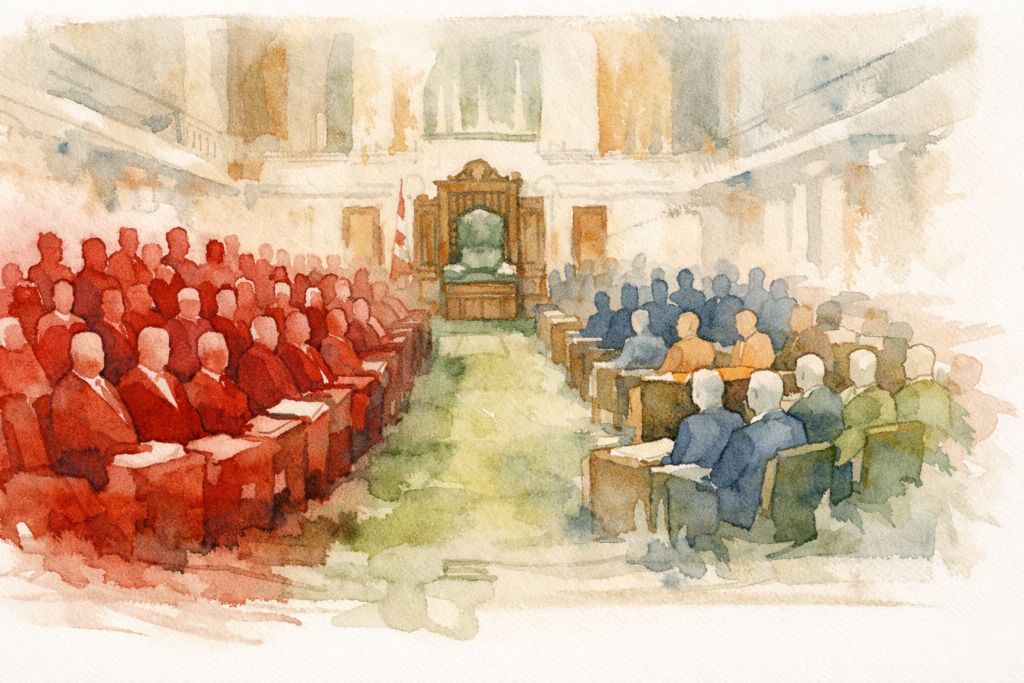
The discomfort people are feeling right now isn’t only about individual MPs changing parties. It’s about something deeper in how the system itself translates votes into power.
Canada operates under a first-past-the-post model. In a country with multiple parties, that creates a consistent pattern where one party can secure a majority of seats with only a plurality of the vote. In practical terms, that means a government can hold near-unchecked authority without having the support of most voters.
That’s not a fringe concern. It cuts across the spectrum.
There are Canadians who don’t want a Conservative policy direction under Pierre Poilievre. There are others who feel the country has been under Liberal dominance for too long, now under Mark Carney. Both of those frustrations can exist at the same time, and they often do.
The system doesn’t resolve that tension. It amplifies it.
When millions of votes don’t meaningfully translate into representation, people start to question the legitimacy of the outcome, even when the process itself is technically sound. That’s where the anger comes from. Not just losing, but feeling like the structure never gave your vote a real chance to matter in the first place.
And that leads to a more fundamental question.
What is the point of having multiple parties if the system consistently compresses them into majority governments that don’t reflect the full spectrum of voter intent?
A healthier Parliament would look different. It would more closely mirror the country itself, region by region, perspective by perspective. It would force cooperation, not as a political talking point, but as a requirement for governing. Decisions would have to be negotiated, not imposed.
That’s not about supporting one party over another. It’s about whether Canadians want a system where their vote actually carries weight, regardless of where they live or who they support.
Because if today’s by-elections move the country one step closer to another majority, the reactions we’re seeing right now won’t fade.
They’ll intensify.
And until the structure itself is addressed, the argument is going to keep repeating, just with different players each time.