
Economy
The 2.25% Stasis: Why the Bank of Canada is Choosing Caution Over Contraction

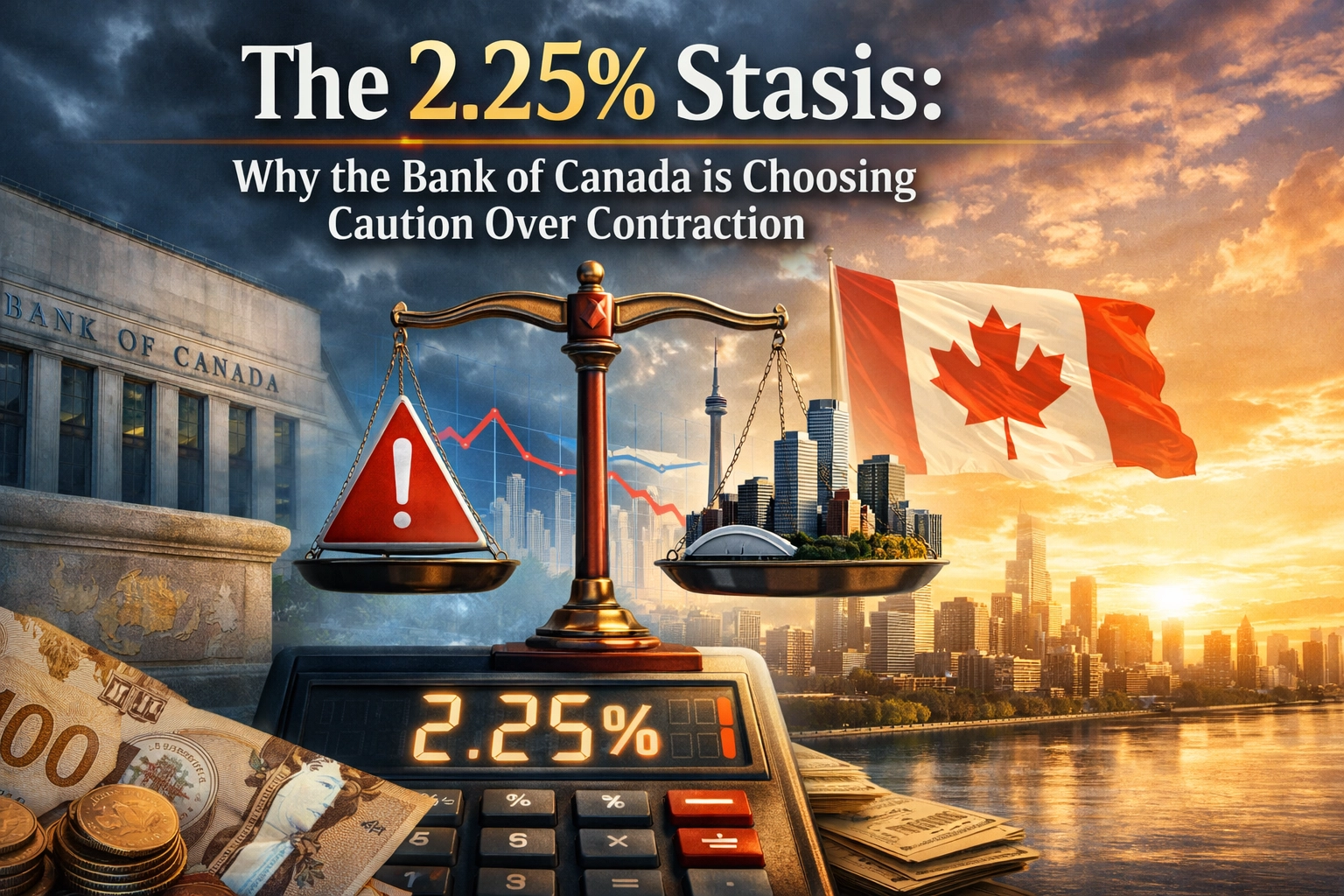
The number is 2.25%.
On March 18, 2026, the Bank of Canada decided that this specific figure represents the temporary gravity of the Canadian economy.
It is a choice defined by what it is not: it is not a cut to stimulate a flagging GDP, nor is it a hike to curb the renewed threat of energy-driven inflation.
Instead, it is a deliberate stasis.
The machinery of the national economy is currently caught between competing gears of domestic cooling and international heat.
And for the Governing Council, the safest path forward is to remain perfectly still.
1. The Paradox of the 1.8% Floor
Inflation has settled at 1.8%.
In a traditional vacuum, this would be a clear signal for a policy shift toward easing.
But the current environment is far from a vacuum.
The Bank is navigating three distinct pressures: cooling consumer demand, escalating global volatility, and a structural softening in the domestic labor market.
To lower rates now would be to ignore the external shocks currently percolating in the Middle East.
And to raise them would be to ignore the fact that the Canadian consumer is already reaching a breaking point.
The 1.8% figure is technically below the 2% target, yet it feels precarious.
It is not low because of a return to pre-pandemic stability, but because of a sharp contraction in domestic purchasing power.

2. The Machinery of Contraction
The fourth quarter of 2025 revealed a 0.6% contraction in GDP.
This is the friction in the system that cannot be ignored.
The economy is no longer just slowing down; it is actively shrinking in real terms.
But the Bank is not reacting with the usual toolkit of aggressive cuts.
This is not because they are indifferent to the recessionary signals, but because the "machinery" of the economy is being hit by a different kind of torque.
The 6.7% unemployment rate represents a significant rise in labor market slack.
And yet, this slack is not resulting in the immediate downward pressure on wages that the Bank might have expected.
There is a disconnect between the output of the system and the cost of maintaining it.
thecanadianist.news has tracked these shifts closely, observing how a cooling economy often leaves the most vulnerable sectors exposed first.
The Bank is watching this contraction with a detached sobriety, knowing that a premature cut could ignite a housing market that is already on a hair-trigger.
3. The Energy Variable
Oil prices are climbing again.
The conflict in the Middle East has introduced a variable that the Bank of Canada cannot control but must respond to.
Rising energy costs act as a shadow tax on the Canadian public.
And they also threaten to push that 1.8% inflation rate back toward the 3% ceiling.
The Bank sees a triple-threat environment: rising transportation costs, increased fertilizer prices, and potential bottlenecks in the Strait of Hormuz.
This is the "global volatility" component of the Rule of Three.
If energy prices spike, the cost of everything from groceries to home heating follows.
But a central bank cannot solve a geopolitical oil shortage by adjusting interest rates in Ottawa.
The policy rate is a blunt instrument, and right now, the Bank is worried that using it might break something else.
4. Labor and the Immigration Infrastructure
Unemployment at 6.7% is a clinical indicator of systemic friction.
It suggests that the rapid expansion of the labor force is finally outstripping the economy’s ability to generate new positions.
We see this friction reflected in the broader discourse surrounding the immigration system and its recent reforms.
The machinery of growth has relied heavily on population increases to mask underlying productivity weaknesses.
But when the GDP contracts despite a growing population, the underlying math begins to fail.
And the Bank knows that interest rates have a limited impact on this specific structural problem.
There is a growing sentiment that provincial control over these levers might offer more localized precision.
However, the Bank must operate at the federal level, managing the macro-equilibrium.
It is a narrow lens, focused on leadership and the maintenance of a disciplined message.

5. Credit Where It’s Due: The Pragmatic Middle
One must acknowledge the difficulty of the Governing Council's position.
It is easy to demand a cut to rescue the 6.7% who are out of work.
It is equally easy to demand a hike to protect the currency against rising oil costs.
But the Bank has chosen the pragmatic middle.
This is the sensible alternative to the ideological extremes of "stimulate at all costs" or "crush inflation at all costs."
They are maintaining the 2.25% stasis to buy time.
And time is the only commodity that allows for the collection of more data.
The "fair point" here is that the Bank is actually listening to the signals of uncertainty rather than pretending to have a definitive solution.
They are acknowledging that the breadth and duration of global conflicts are unknowns.
That kind of framing matters.
6. The Absence of Momentum
What is absent from the current economic landscape is momentum.
We are seeing a lack of investment, a lack of consumer confidence, and a lack of clear fiscal direction.
The Bank’s decision to hold at 2.25% is an admission that they cannot provide that momentum on their own.
The system is currently idling.
And while an idling engine doesn't move the vehicle forward, it also doesn't stall.
The Bank is prioritizing the prevention of a stall over the pursuit of speed.
But this leaves the Canadian public in a state of suspended expectation.
Mortgage holders are waiting for relief that is not coming.
Businesses are waiting for a signal to expand that is not being sent.
The machinery is functional, but it is not productive.

7. The Equilibrium of Uncertainty
Interest rates are often described as the "price of money."
At 2.25%, the price is neither cheap nor prohibitive.
It is a neutral stance designed to weather a storm that hasn't fully made landfall.
If the Middle East conflict escalates, the 2.25% rate provides a buffer to hike if energy costs explode.
If the Q4 contraction turns into a deep recession in Q1 2026, the 2.25% rate provides room to cut.
But for now, the Bank is refusing to move first.
They are waiting for the system to settle into a new consensus.
This is the "pragmatic middle" in action: a refusal to be swayed by the immediate noise of the headlines.
It is a sober, detached approach to a very messy reality.
For those looking for a deeper framework on how Canada might navigate these structural challenges, The Case for Canadianism offers a lens through which to view these macro-economic shifts.
The Bank is doing its part to maintain the "calm alternative" in a fractured global landscape.
8. A Philosophical Reflection on the Long-Term
What does it mean to be in a state of stasis?
In physics, an object at rest stays at rest unless acted upon by an external force.
The Bank of Canada is currently that object.
They are waiting for the external forces: oil, labor, and GDP: to provide a clear direction.
But perhaps the "equilibrium" we are looking for is not a return to the low-rate environment of the past decade.
Perhaps the long-term reality is one where 2.25% is the new normal.
It is a level that balances the need for growth with the necessity of stability.
And while it offers little comfort to those caught in the friction of the current contraction, it provides a foundation for the machinery to eventually reset.
The goal of a central bank is not to create prosperity, but to ensure the environment where prosperity is possible remains stable.
At 2.25%, the Bank is betting that stability is the most valuable asset we have.
Whether the rest of the machinery agrees remains to be seen.
But for now, the hold is the message.
And the message is caution.
