


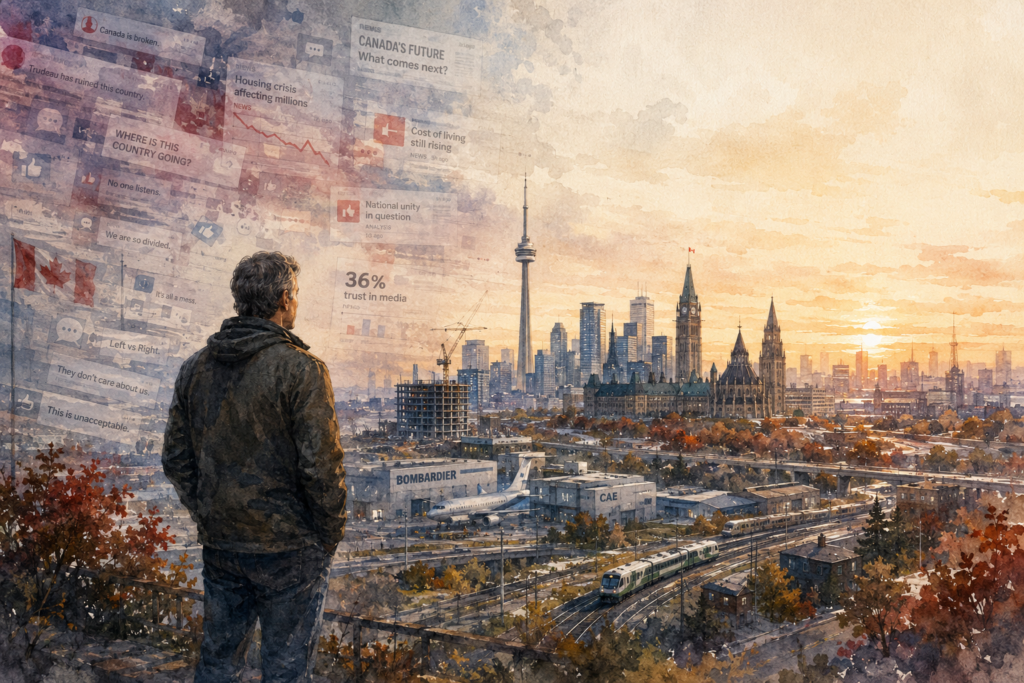
Spending too much time online lately can leave a person with the impression that Canada is coming apart at the seams. The national conversation increasingly feels trapped inside an endless cycle of outrage, where frustration feeds more frustration and every political disagreement immediately turns existential. After a while, it stops feeling like citizens debating the future of their country and starts feeling more like people exhausting themselves in public.
Part of the problem is that the internet was never designed to reward perspective or proportion. It rewards emotional intensity. Anger travels faster than patience. Cynicism spreads faster than optimism. Once the algorithms learn what keeps people reacting, they continue feeding the same emotional loop back into the conversation until everything begins to feel darker, more hopeless, and more hostile than it may actually be in everyday life.
That doesn’t mean the underlying concerns are imaginary. Canadians are under real pressure right now. Housing affordability has deteriorated badly. The cost of living is exhausting people. Trust in institutions has weakened. Many younger Canadians are uncertain about their future in ways previous generations rarely experienced. Those concerns deserve serious attention and serious leadership.
At the same time, there is a growing tendency in Canada to interpret every setback as evidence that the country itself is failing beyond repair. That mindset distorts reality just as much as blind optimism does.
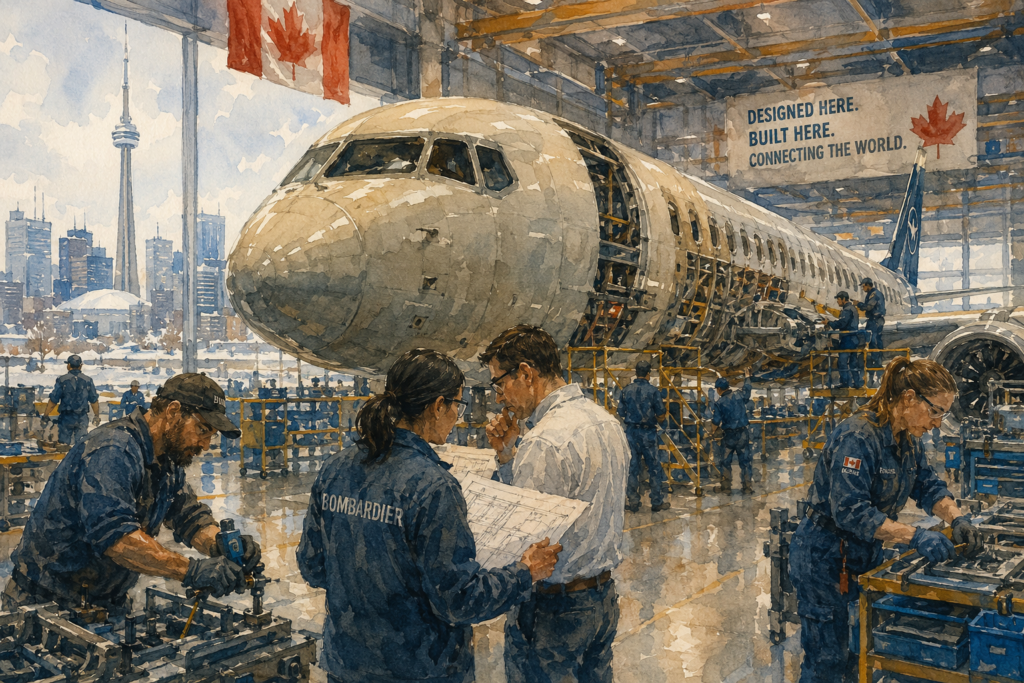
Yesterday, Prime Minister Mark Carney announced what is being described as the largest commercial aircraft order in Canadian history, tied to a major expansion involving Montreal-based aerospace giant Bombardier and broader investment connected to Canada’s aerospace sector. Regardless of what one thinks of Carney politically, the announcement was a reminder of something Canadians increasingly seem to forget about themselves.
This country still builds things.
Canada still produces advanced engineering, manufacturing, aerospace technology, research, skilled labour, and globally respected industrial expertise. Thousands of Canadians still wake up every morning and quietly contribute to industries that remain world-class. That reality rarely dominates the online conversation because competence and stability do not generate the same emotional reaction as outrage does.

One of the unintended consequences of living inside highly politicized digital spaces is that people begin encountering their country primarily through conflict instead of through lived experience. Canadians start seeing each other less as neighbours and more as representatives of competing political tribes, generations, regions, or ideologies. Before long, even positive developments become filtered through suspicion, cynicism, or partisan reflex.
That environment slowly changes how people think about the country itself.
The danger is not simply political division. Democracies have always contained disagreement. The deeper danger is the gradual erosion of national confidence, the quiet belief that nothing works anymore, nobody is acting in good faith, and decline is inevitable. Once that mindset takes hold deeply enough, societies begin talking themselves out of their own future.
Canada has real structural problems that need to be addressed honestly. Pretending otherwise would be foolish. But there is also a difference between recognizing problems and becoming psychologically consumed by collapse narratives.
A country that can still design aircraft, attract investment, educate skilled workers, maintain social stability, absorb immigration, and sustain democratic institutions is not a country on the verge of disappearance. It is a country struggling through a difficult period of transition and uncertainty while still retaining many of the strengths that built it in the first place.
That distinction matters.
The internet increasingly encourages Canadians to experience their country as a permanent state of crisis. Real life often tells a more complicated story. Outside the algorithms and outrage cycles, millions of Canadians still go to work, raise families, build businesses, volunteer in communities, help neighbours, and continue constructing ordinary lives together.
That is still Canada too.