


1. Executive Summary: The Presale Stagnation
1.1 Market Status
- Current Inventory Absorption: Record lows in major urban centers.
- Project Cancellations: Increasing frequency in GVA and GTA.
- Developer Insolvency: Rising filings for protection.
- Investment Sentiment: Negative.
1.2 The Systemic Risk
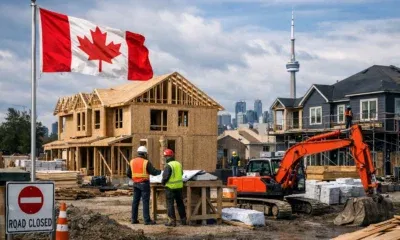
The Canadian housing supply chain relies almost exclusively on the "presale model." Under this framework, lenders require 70% to 80% of units to be sold before construction financing is released. When buyers withdraw, the supply chain halts. This is not a temporary market dip; it is a structural failure.
2. Variables of Decline
2.1 Macroeconomic Pressures
- Interest Rate Volatility: High carrying costs for developers.
- Mortgage Qualification: Stress tests limiting end-user capacity.
- Capital Flight: Shift toward liquid assets or international REITs.
2.2 Construction Cost Index
- Material Inputs: Persistent inflation in concrete and steel.
- Labor Scarcity: Wage growth exceeding productivity.
- Regulatory Fees: Increased municipal levies and development charges.

3. The Finance Gap: Why Projects Fail to Launch
3.1 Lender Rigidity
Traditional Tier-1 banks maintain strict presale thresholds. These requirements were designed for a stable, low-interest-rate environment. In the current 2026 climate, these benchmarks have become insurmountable barriers for mid-sized developers.
3.2 Investor Withdrawal
Historically, 40% to 60% of condo presales were purchased by investors. Current metrics show:
- Negative Cash Flow: High mortgage rates vs. market rents.
- Capital Gains Uncertainty: Stagnant price appreciation forecasts.
- Opportunity Cost: Higher yields available in fixed-income markets.
Explore more on the broader economy and how these financial shifts impact national stability.
4. Shadow Cabinet Assessment: The Policy Failure
4.1 Government Misalignment
The current administration has focused on demand-side subsidies and symbolic zoning changes. While these policies garner headlines, they fail to address the fundamental risk in the construction cycle.
- Failure 1: Excessive reliance on private sector presales for social housing goals.
- Failure 2: Lack of direct capital injection for "shovel-ready" projects stalled by financing.
- Failure 3: Inability to coordinate municipal fee reductions during high-interest cycles.
4.2 The "Missing Middle" Illusion
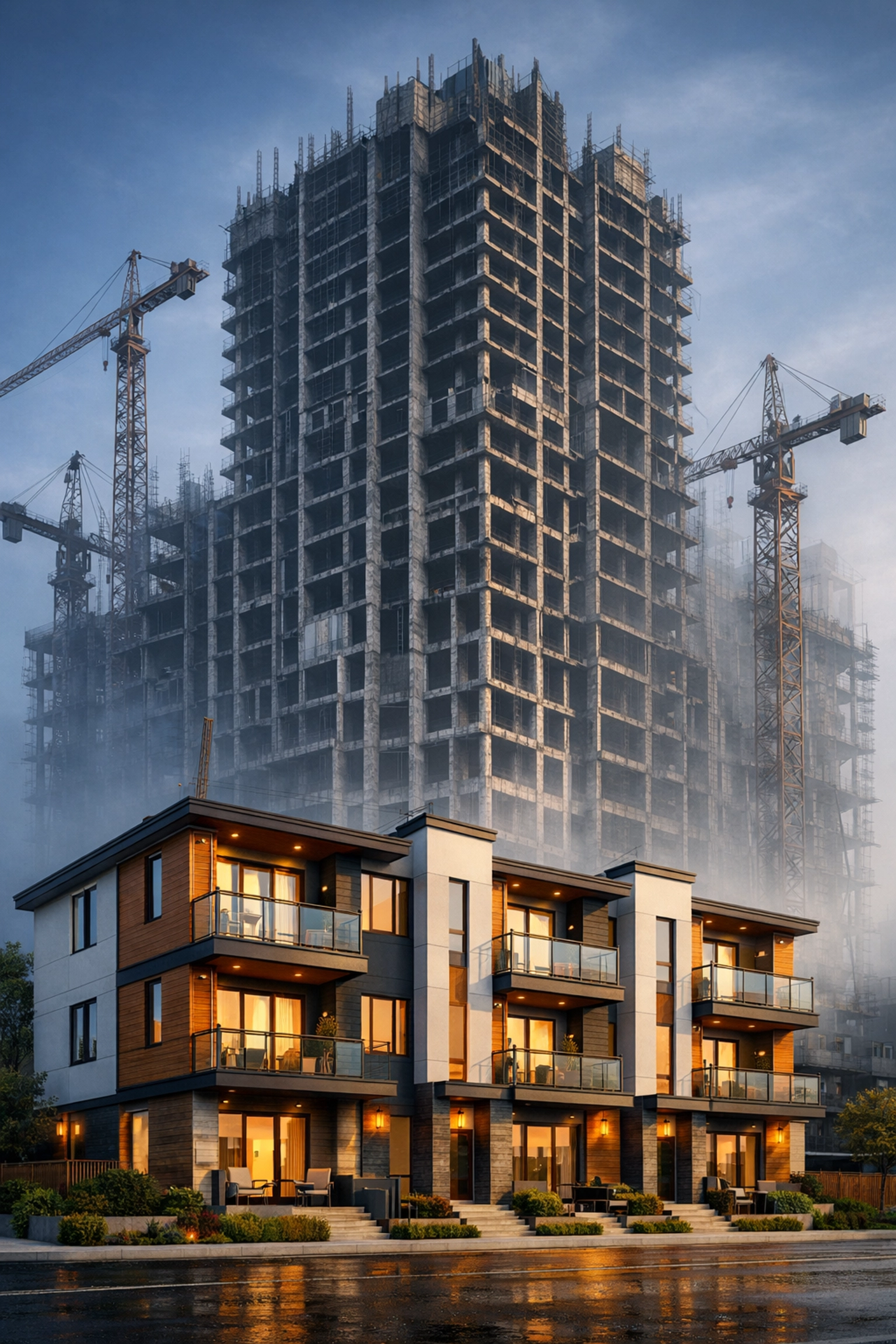
Policy focus on "fourplexes" and "laneway homes" provides insufficient volume. Large-scale multi-residential density is required to meet population growth, yet this is the exact segment currently paralyzed by the presale collapse.

5. Structural Vulnerabilities by Region
5.1 Greater Toronto Area (GTA)
- Status: High inventory, zero absorption.
- Impact: Deferred starts for 2027-2029 delivery dates.
- Risk: Acute rental shortage in 36 months.
5.2 Greater Vancouver Area (GVA)
- Status: Pricing resistance.
- Impact: Pivot to purpose-built rentals, currently stalled by high financing costs.
- Risk: Permanent loss of skilled construction labor to other sectors.
5.3 Emerging Markets
- Calgary/Edmonton: Temporary resilience due to inter-provincial migration.
- Risk: Over-saturation as developers flee coastal markets.
Visit our featured section for regional deep-dives on urban development trends.
6. The "Better Way" Framework: A Strategic Pivot
6.1 Direct Public Investment
The state must act as the "Lender of Last Resort" or "Equity Partner" for stalled projects.
- Mechanism: Government-backed guarantees for construction loans.
- Outcome: Breaking the 70% presale requirement.
6.2 Risk Mitigation for Developers
- HST Reform: Permanent removal of HST on all multi-family construction, not just rentals.
- Fast-Track Permitting: Legislative mandates for 30-day approval cycles on high-density projects.
6.3 Modernizing the Model
- Industrialized Building: Shift toward modular and off-site construction to lower labor risk.
- Financing Innovation: Introduction of "rent-to-own" presale structures backed by federal insurance.

7. Comparative Analysis: Global Models
7.1 International Standards
- Singapore Model: Direct state involvement in land and development.
- European Model: Higher percentage of institutional, non-profit, and cooperative housing.
- Middle East Model: Rapid scale deployment through sovereign wealth fund backing.

7.2 Lessons for Canada
The Canadian reliance on small-scale retail investors to fund national infrastructure (housing) is a historical anomaly. Transitioning to an institutional or state-supported model is a requirement for long-term stability. Read more about these structural shifts in our latest publication, The Case for Canadianism.
8. Data Points: The 2026 Forecast
8.1 Completion Crag
- 2024-2025: High completions (projects started in 2021).
- 2026-2028: Projected 40% drop in new deliveries.
- Result: Upward pressure on rents despite high interest rates.
8.2 Employment Impact
- Trades: Looming layoffs as current projects finish and new projects fail to break ground.
- Secondary Industries: Impact on architectural firms, real estate law, and urban planning consultancies.
9. Call to Action: Immediate Interventions
9.1 Stakeholder Requirements
- Federal: Implement the National Construction Loan Guarantee program.
- Provincial: Override municipal zoning delays and freeze development charges.
- Municipal: Digitize and automate the building permit process.
9.2 Engagement
- Review our sitemap for technical white papers.
- Analyze historical trends in finance.
- Connect with our policy team for further briefing.
10. Conclusion: Rationalizing the Crisis
The death of the condo presale is the canary in the coal mine. It signals that the current market-led, investor-funded housing strategy has reached its logical limit. Without a fundamental shift toward state-backed risk mitigation and direct investment, the housing deficit will transition from a crisis to a permanent state of economic decline.
The data is clear. The solution is structural. The time for incrementalism has passed.
- Category: Politics
- Topic: Economy
- Archive: Canadianist News
Document Metadata
- File ID: HOUSING-2026-03-28
- Classification: Analytical / Opinion
- Author State: Shadow Cabinet Perspective
- Geographic Focus: Canada-wide (GTA/GVA focus)