


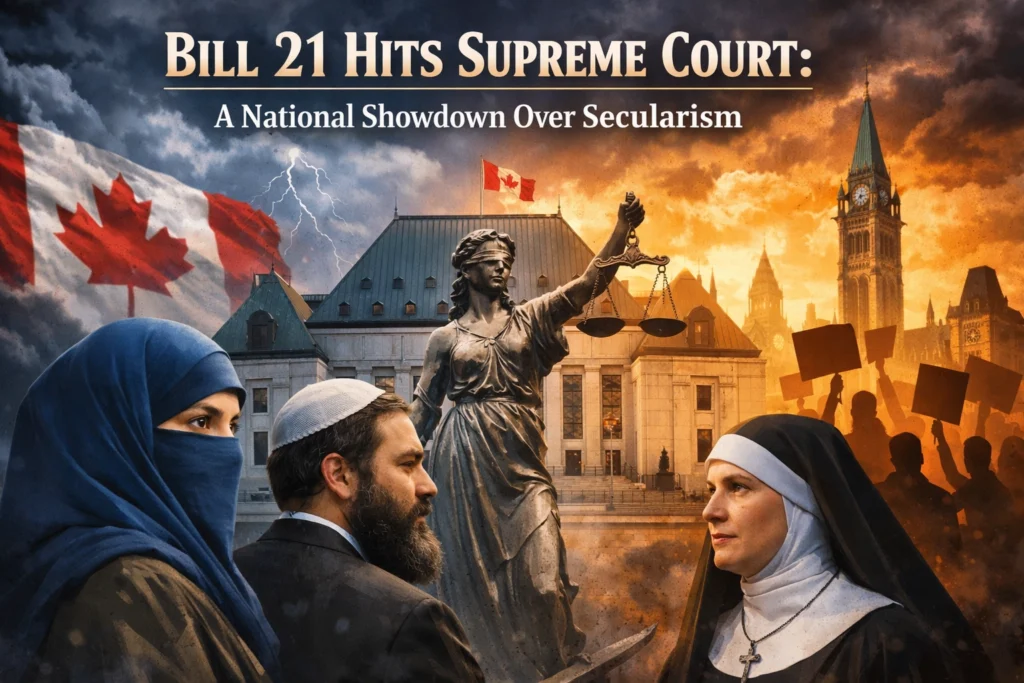
The date is set. On March 23, the Supreme Court of Canada will begin hearing arguments on the most divisive piece of legislation in modern Canadian history: Quebec’s Bill 21. This is not just another legal challenge. It is the final collision between two irreconcilable versions of the Canadian experiment. On one side, a vision of individual rights protected by a supreme Charter. On the other, a vision of collective identity and provincial autonomy maintained through legislative supremacy.
The stakes are systemic. The friction is palpable.
For years, Bill 21: the Act respecting the laicity of the State: has functioned as a political lightning rod. It prohibits certain public-sector employees, including teachers, police officers, and government lawyers, from wearing religious symbols such as hijabs, turbans, crosses, and yarmulkes while on duty. To its proponents, it is a necessary safeguard for secularism. To its critics, it is a state-sanctioned tool of exclusion.
But as the case moves to the highest court in the land, the focus is shifting. The debate is no longer just about what people wear. It is about how the country is governed.
The Shield: The Preemptive Use of Section 33
The central mechanism of this conflict is Section 33 of the Canadian Charter of Rights and Freedoms: the notwithstanding clause.
When the Quebec government passed Bill 21 in 2019, they did something that fundamentally altered the constitutional landscape. They didn't wait for a court to find the law unconstitutional. They invoked the notwithstanding clause preemptively. This move effectively signaled that the government was aware the law violated fundamental rights but intended to proceed regardless.
This is not a minor procedural detail. It is a structural pivot.
Traditionally, the notwithstanding clause was viewed as a "nuclear option": a rare emergency measure to be used only in the most extreme circumstances. By using it as a routine legislative tool, Quebec has challenged the very idea of rights as universal and inalienable. If a government can bypass the Charter before a judge even reads the filing, the balance of power shifts from the judiciary to the legislature.
The Supreme Court must now decide if this "preemptive strike" is a legitimate use of power or a subversion of the constitutional order.

The Legal Strategy: Finding the Backdoor
Because the notwithstanding clause shields Bill 21 from challenges based on freedom of religion (Section 2) and equality rights (Section 15), challengers have had to get creative. The World Sikh Organization, the English Montreal School Board (EMSB), and various civil liberties groups are searching for the "un-shieldable" cracks in the legislation.
One of the most potent arguments involves Section 23 of the Charter, which protects minority language education rights. Crucially, Section 23 is not subject to the notwithstanding clause. The EMSB argues that Bill 21 interferes with their right to manage and control their schools by restricting whom they can hire.
It is a fascinating legal maneuver. Not a direct defense of religious freedom, but a defense of administrative autonomy. This "not this, but that" framework defines the current legal reality: since the front door of religious rights is locked, the opposition is trying to enter through the side door of linguistic governance.
The World Sikh Organization's involvement adds another layer of national gravity. For the Sikh community, the turban is not a choice; it is an article of faith. By barring observant Sikhs from teaching or serving in the police, the law creates a permanent class of "second-class" citizens in the eyes of the state. The Supreme Court must weigh this human cost against the provincial government’s claim to secular neutrality.
The 2026 Election: Identity as a Wedge
The timing of this Supreme Court showdown is not accidental. The legal proceedings will cast a long shadow over the upcoming 2026 Quebec election.
For Premier François Legault and the Coalition Avenir Québec (CAQ), Bill 21 is a cornerstone of their political identity. It represents the "consensus" of the majority: a bulwark against perceived threats to Quebec’s secular culture. For the CAQ, a loss in court would not just be a legal setback; it would be a political gift. It would allow them to frame the federal judiciary as an "outsider" force meddling in Quebec’s internal affairs.


This is the "slow narrowing" of the political center. We are seeing a move away from a pan-Canadian consensus toward a more fractured, province-first model of governance. If the Supreme Court strikes down even parts of the law, expect a swift and aggressive response from Quebec City. The narrative of "Ottawa vs. Quebec" is a reliable voter-turnout machine.
Conversely, if the Court upholds the law, it sets a precedent that could embolden other provinces. We have already seen Ontario experiment with the preemptive use of Section 33. If Quebec succeeds, the notwithstanding clause could become the default option for any provincial government looking to bypass the Charter.
For more on how these provincial shifts are impacting federal sentiment, see our analysis of provincial control over immigration.
A Question of Institutional Health
At CANADA, we view these developments through the lens of institutional health. The question is not whether secularism is "good" or "bad." The question is whether the system can withstand this level of internal friction.
The Canadian federation relies on a delicate balance of "mushy" compromises. Bill 21 is the opposite of mushy. It is hard, declarative, and uncompromising. By pushing the Supreme Court to rule on the limits of Section 33, the Quebec government is forcing a clarity that the framers of the Constitution likely wanted to avoid.
What happens when the "safety valve" of the notwithstanding clause becomes the "engine" of legislation?
- Stability: The predictability of the legal system is undermined when rights are subject to five-year sunset clauses.
- Practicality: Hiring shortages in schools and police forces are exacerbated by excluding qualified candidates based on their attire.
- Consensus: The national divide between Quebec and the rest of the country on the definition of "secularism" is hardening.
The Supreme Court is being asked to do more than interpret the law. It is being asked to stabilize the foundations of the country.


The National Ripple Effect
The outcome will resonate far beyond the borders of Quebec. Pierre Poilievre and the federal Conservatives have often walked a fine line on this issue, balancing their "freedom" brand with a need to court Quebec voters. Justin Trudeau’s Liberals have expressed opposition but have been hesitant to intervene directly until now.
This case forces everyone’s hand.
If the Court limits the use of the notwithstanding clause, it will be hailed as a victory for human rights but a disaster for federal-provincial relations. If the Court allows it, the Charter of Rights and Freedoms effectively becomes a "Charter of Suggestions" for any province with a majority government.
This is the "not this, but that" of our current era. It is not a battle of ideas; it is a battle of jurisdictions.
For a look at how other national figures are framing these debates, check out our piece on Poilievre’s media strategy.
The "So What"
Why does this matter to the average Canadian?
Because the Supreme Court’s decision will define the "default option" for the next generation of Canadian politics. If the state can dictate what a teacher wears, can it dictate what a private citizen says? If a province can ignore the Charter today on secularism, can it ignore the Charter tomorrow on property rights, speech, or due process?
We are witnessing the slow narrowing of the credible center. The Supreme Court hearing on March 23 isn't just a legal procedure; it is a diagnostic test for the health of the Canadian federation.
The results will tell us if the system is still functional, or if the friction has finally become too great for the machinery to hold.
For the latest updates on this and other political shifts, visit our latest news section or listen to The Canadianist Podcast.