


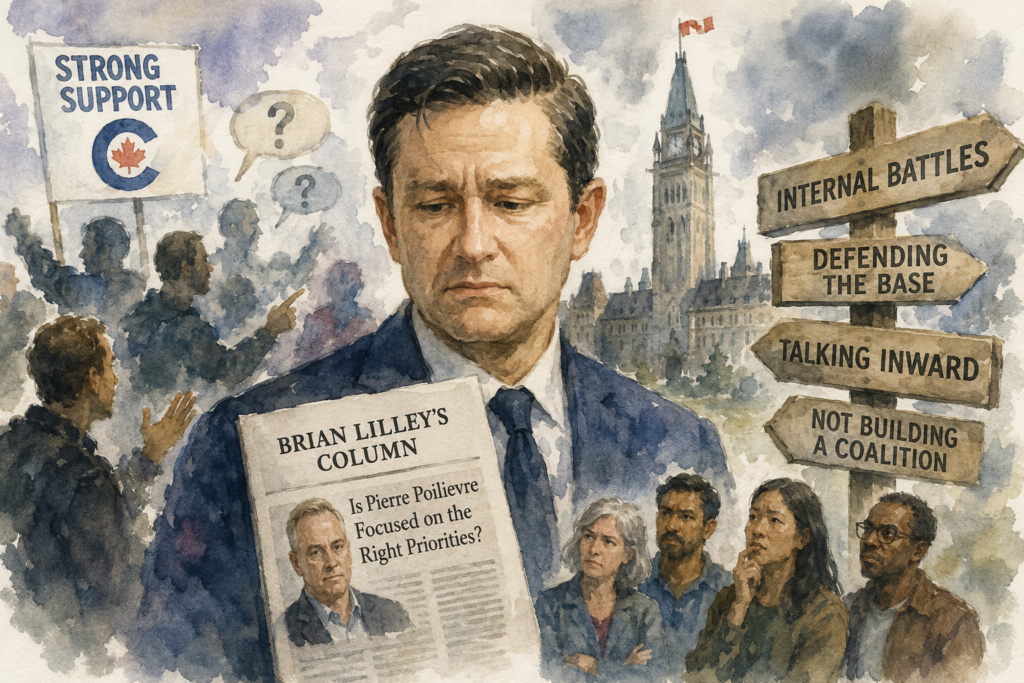
One of the most interesting political columns this week wasn’t really about Pierre Poilievre. It was about what happens when even some of a leader’s strongest public supporters begin asking uncomfortable questions.
Brian Lilley, who has been clear for years that he wants Pierre Poilievre to become Canada’s next prime minister, published a column questioning whether Poilievre is focused on the right priorities. His criticism wasn’t ideological. It wasn’t a call for a new leader. It was a frustration that Poilievre continues to spend political capital on internal battles instead of doing what it takes to build a governing coalition.
The column is significant, not because of the criticism itself, but because of who it came from.
For many Canadians, however, none of this should come as a surprise.
The warning signs didn’t begin this week.
They began long before the election.
For more than a year, the Conservatives held what looked like an almost insurmountable lead in the polls. Then they lost the election. Pierre Poilievre lost his own seat. Since then, Conservative MPs have left the caucus, internal disagreements have become increasingly public, and national polling has continued to move in the Liberals’ favour. Even commentators who have consistently supported Poilievre are beginning to question the direction of the party.
Viewed individually, each of those events can be explained away. Politics is full of unusual circumstances, personalities, and unexpected developments.
Taken together, they form a pattern.
And patterns are the responsibility of leadership.
Leadership isn’t simply about taking credit when things go well. It’s about accepting responsibility when they don’t. If a political party wins, the leader is celebrated. If it loses after holding a commanding lead, if the organization begins showing visible strain, if experienced voices inside and outside the movement begin expressing concern, the leader owns that as well.
That’s not unique to politics. It’s true of every organization.
For months, I have argued that the Conservative challenge wasn’t simply messaging. Canadians had already heard the message. The larger problem was persuasion.
Winning elections requires expanding beyond the people who already agree with you. It requires persuading voters who didn’t support you last time. It requires stepping into uncomfortable conversations and earning the confidence of people who are skeptical of your ideas.
That’s how governing coalitions are built.
Instead, the Conservative Party increasingly appears to be speaking inward. Critics are often dismissed as enemies. Internal disagreements become public disputes. Political energy is spent defending the existing coalition rather than expanding it.
No political party can grow indefinitely by talking only to its most committed supporters.
This isn’t an argument that Conservatives should abandon conservative principles. Every major political movement deserves representation, and many of the concerns raised by Conservative voters are legitimate. Housing affordability, productivity, government spending, public confidence in institutions, and economic opportunity all deserve serious attention.
But winning government requires more than energizing people who already support you.
It requires convincing people who don’t.
That is the question the Conservatives have yet to answer.
Brian Lilley’s column didn’t create that question.
It simply acknowledged that it can no longer be ignored.