


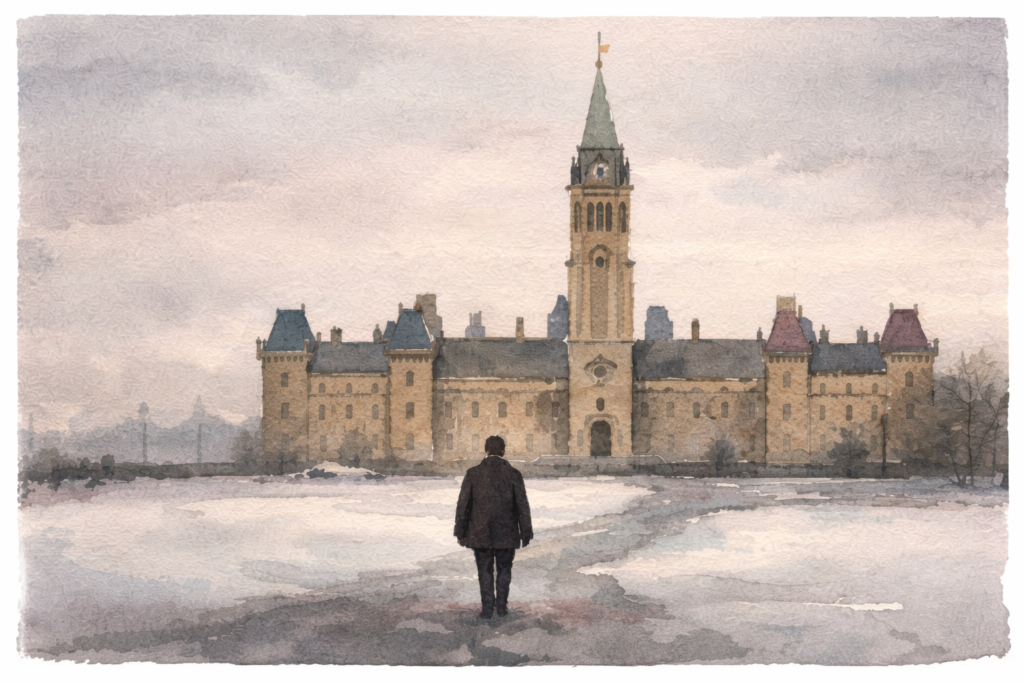
The country hasn’t failed, but the connection between people, systems, and outcomes is no longer as clear as it once was.
By Christopher M. Michaud
Canada still works, and that’s precisely why the problem is harder to see.
There is no collapse to point to, no single moment where things clearly went wrong. By most conventional measures, the country remains stable and functional. But stability can mask a different kind of issue, one that develops gradually and rarely announces itself. What has begun to change is not whether Canada functions, but how well it reflects itself while doing so.

A gap that doesn’t announce itself
That gap shows up in subtle ways. Election outcomes often feel only partially representative of how people actually voted. Regions appear politically uniform in ways that don’t match lived reality. People speak about voting less as an expression of belief and more as a calculation. None of this carries the tone of crisis. It carries the tone of something that no longer quite fits.
When politics simplifies what shouldn’t be simplified
The political environment has contributed to this drift. Many of the central debates are framed as oppositions that don’t reflect how the country operates in practice. Economic growth is placed against environmental responsibility. Immigration is positioned against housing capacity. National unity is set against regional identity. These framings simplify complex systems into choices between sides, even when those systems are interdependent.
Once issues are reduced in that way, the focus shifts. Instead of asking how systems can be coordinated, the conversation becomes about which position to defend. The structure of the debate encourages conflict over alignment. In a country where major challenges cross jurisdictions and sectors, that shift has real consequences. Housing, healthcare, infrastructure, and labour do not operate independently of one another, and treating them as separate problems makes them harder to resolve.
The shift in tone
At the same time, the tone of politics has changed. It has become more immediate, more absolute, and more performative. That shift did not originate within Canadian political culture, but it has been absorbed and normalized. The result is a system where visibility often depends on intensity rather than effectiveness. Clarity is replaced by volume, and attention becomes a proxy for relevance.
Who no longer sees themselves in it
This has altered how many Canadians relate to politics. A significant number remain engaged and attentive but no longer feel represented by the choices in front of them. Their views are not ideological in the rigid sense, and they are comfortable holding positions that don’t fit neatly into partisan categories. They expect public systems to function, support policies that are workable, and resist framing complex issues as binary decisions.
When those positions are forced into narrower options, participation changes. Voting becomes strategic rather than expressive. Support becomes conditional rather than aligned. In some cases, engagement recedes, not out of indifference, but because the available choices do not accurately reflect how people think.
Not division, but distortion
This is often described as division, but that description misses something important. What Canada is experiencing is less a breakdown between groups than a weakening of how clearly the country is represented through its institutions. The structure remains intact, but the reflection is less precise than it once was.
A country that was always complex
Canada has always been complex. Its regional differences, cultural diversity, and economic variations are longstanding features, not recent developments. What has changed is the degree to which that complexity is visible and the extent to which existing systems capture it accurately. For much of the country’s history, this was managed through a shared civic understanding that emphasized restraint, cooperation, and a practical approach to governance. It was not formally articulated, but it was widely understood.
Over time, that understanding was assumed rather than reinforced. Under increasing pressure from demographic shifts, economic strain, and institutional demands, the absence of a clearly stated framework has become more apparent. The underlying values have not disappeared, but the structure that connected them to decision-making has become less defined.
Defining the framework
Canadianism is an attempt to describe that structure in practical terms. It is not an ideology or a partisan position, but a way of outlining how a country like Canada functions when its systems are aligned. It emphasizes behaviour over identity and coordination over confrontation. It places responsibility alongside rights and treats governance as a process that depends on systems working together rather than in opposition.
Within that framework, respect is understood as the ability to operate within disagreement without reducing it to contempt. Responsibility is tied to the expectation that institutions function and are evaluated based on outcomes. Coordination reflects the reality that most national challenges extend across jurisdictions. Restraint allows disagreement to be managed without escalation. Contribution recognizes that citizenship involves participation in maintaining the systems people rely on.
Where the system no longer fits
These are not abstract concepts. They reflect patterns that have been present in Canada at its most effective. What has changed is not their relevance, but the clarity with which they are applied.
That lack of clarity is most visible in the political system itself. The current structure compresses a wide range of perspectives into a limited number of options. It was developed in a context that was less complex than the one that exists today. As a result, it can produce outcomes that feel only partially representative of the electorate.
This does not indicate a failure of the system, but it does suggest that its ability to reflect the country accurately has weakened. When that happens, the gap between participation and outcome widens gradually. People continue to engage, but with less certainty that their engagement translates directly into results.

A moment of recognition
Canada is not at a point of crisis. It is at a point where recognition becomes necessary. The country continues to function, but the alignment between its people, its institutions, and its outcomes is less consistent than it needs to be.
Addressing that does not require redefining the country. It requires bringing its systems back into closer alignment with the reality they are meant to represent.
If this got you thinking, I urge you to go deeper. I’ve made three of my books that directly address these issues available for a limited time, free in both ebook and audiobook formats on Apple Books and Google Books. This isn’t about selling copies. It’s about making sure Canadians can access the ideas, understand what’s happening, and see that there is a serious, workable alternative.
Free PDF versions compatible with all e-readers here