


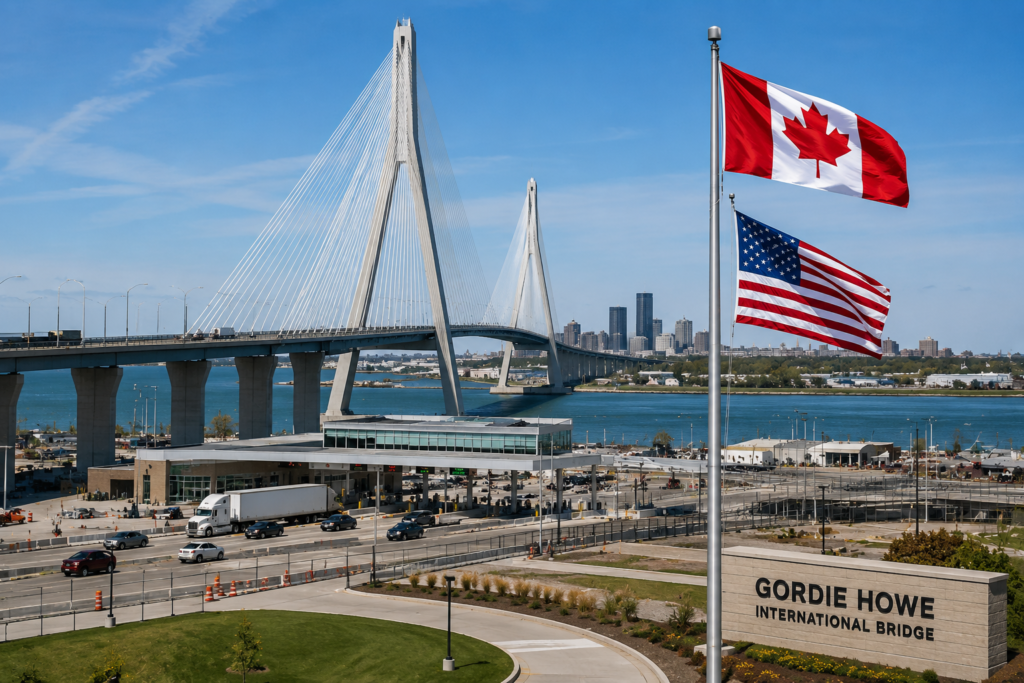
OTTAWA — Canada and the United States have reached a new agreement governing the financial operation of the Gordie Howe International Bridge, ending a long-running dispute over how the crossing’s future toll revenues will be shared once the bridge opens later this year.
The agreement has quickly become the focus of political debate in Ottawa, with the federal Conservatives accusing Prime Minister Mark Carney’s government of giving away part of an asset that Canadian taxpayers fully financed. The government maintains the agreement protects Canada’s financial interests while resolving an issue that could have complicated the bridge’s launch.
At the centre of the debate is how revenue from the bridge will be distributed.
Under the original arrangement negotiated when the project began, Canada would collect toll revenues to recover the approximately $6.4-billion cost of constructing the bridge before future revenues would eventually be shared. The new agreement instead provides for the United States to receive 50 per cent of the bridge’s net operating profits for a 15-year period after operating expenses and debt servicing have been paid.
That distinction has become a key point of contention.
Opposition Conservatives have characterized the agreement as Canada giving away half of the bridge’s revenues or half of an asset that Canadians paid for.
The federal government disputes that characterization.
Prime Minister Mark Carney has said toll revenues will first be used to operate the bridge and service the debt incurred to build it. Only after those obligations are met would any remaining net profits be shared between the two countries during the agreement’s 15-year term.
“There isn’t going to be a lot of net to split,” Carney told reporters while defending the agreement.
The Gordie Howe International Bridge is one of Canada’s largest infrastructure projects and will provide a second major commercial crossing between Windsor, Ontario, and Detroit, Michigan. Canada financed the bridge’s construction after the project was negotiated under the previous Conservative government, with the expectation that toll revenues would recover the investment over several decades.
The bridge is expected to carry a significant share of the more than $300 billion in annual trade that crosses the Canada-U.S. border through the Windsor-Detroit corridor.
Supporters of the new agreement argue that resolving outstanding governance issues before the bridge opens provides certainty for both countries and removes a potential source of friction in the broader Canada-U.S. relationship.
Critics argue Canada should not have agreed to share future profits after assuming the full cost and financial risk of construction.
The agreement comes as the Carney government continues broader negotiations with the United States on trade and economic issues following months of tensions with the Trump administration.
While the bridge agreement is separate from those negotiations, opposition parties have questioned whether Canada made unnecessary concessions in an effort to improve bilateral relations.
At this stage, the long-term financial impact of the agreement remains unclear.
Its ultimate cost to Canada will depend on traffic volumes, operating expenses, debt repayment schedules, and the amount of net profit generated once the bridge enters service.
The Gordie Howe International Bridge is expected to open to traffic later this year, marking the completion of one of the largest infrastructure projects ever undertaken between Canada and the United States.