


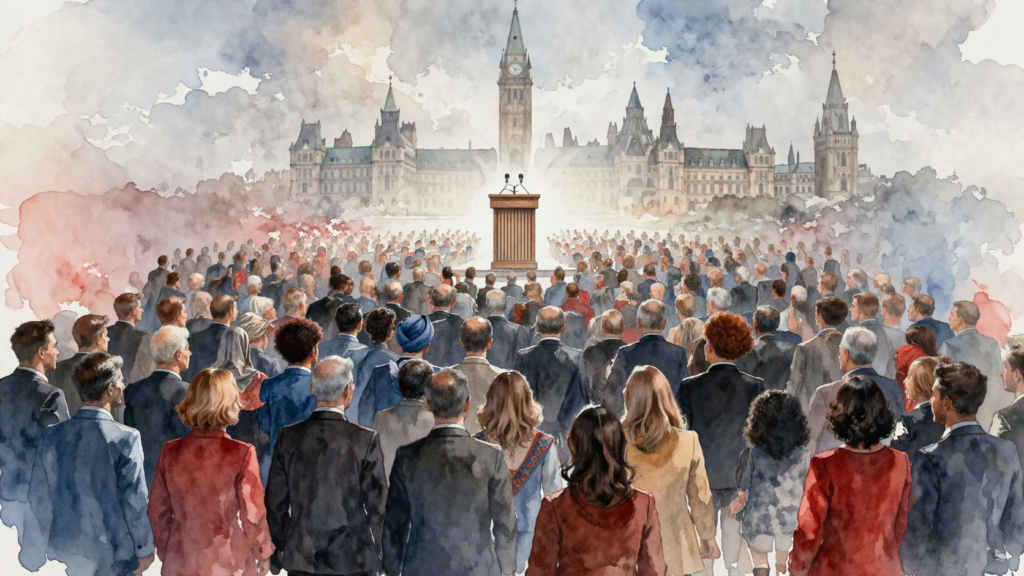
A majority can be manufactured at the ballot box, but it can also be assembled afterward. As floor crossings reshape Parliament in real time, the question isn’t just how governments are elected, it’s what they become once they have power.
By The Canadianist
One of the things we’ve been talking about at The Canadianist is the idea of the artificial majority. It comes up again and again in our work, because it sits at the centre of how Canada’s political system actually functions.
Under first-past-the-post, a party can win a majority of seats without winning a majority of votes. In many ridings, the winning candidate doesn’t even reach 50 percent. The vote is split, the seats are awarded, and when that pattern repeats across the country, it produces a government that looks dominant in Parliament but doesn’t actually reflect a majority of Canadians.
That’s the version most people are familiar with.
What hasn’t been getting the same level of attention is what happens after the election.
Over the past several months, we’ve seen a steady stream of floor crossings. Not isolated, not rare, but consistent. Roughly one a month, coming from different parts of the political spectrum. Some from within the Conservative Party, including figures like Marilyn Gladue, others from very different ideological ground, including former NDP representation. All of it feeding into a Liberal caucus that was originally elected under a very different composition.


What makes this more than routine political movement is where these MPs are coming from. This isn’t just ideological diversity. It’s geographic. Atlantic Canada, Alberta, Ontario, different regions with different economic pressures and different priorities. Those differences are not abstract. They shape how MPs think about energy, federal spending, development, and the basic direction of the country.
When all of those perspectives are folded into a single governing caucus after the fact, the question isn’t whether it strengthens the government on paper. It does. The question is whether it still reflects what voters actually chose.
If the Liberals secure a working majority through by-election wins and continued floor crossings, it will be presented as stability. That’s how our system reads a majority. It suggests clarity, control, the ability to govern without obstruction. But that label assumes something important, that the majority is built on a shared mandate.
In this case, it isn’t that simple.
You’re looking at a caucus made up of MPs who ran under different banners, different platforms, and in some cases, entirely different political philosophies. That creates a tension that can’t be ignored. Either those MPs adjust themselves to fit the Liberal agenda, which raises real questions about representation, or the leadership adjusts the agenda to accommodate them, which raises questions about coherence. One way or another, the idea of a clear mandate starts to blur.
This is where the concept of the artificial majority needs to be expanded.
It’s not just about how a government is elected. It’s about how that government evolves once it has power. When a party builds its numbers by absorbing MPs from across the spectrum and across the country, it creates a majority that no longer reflects a single electoral outcome. It reflects a series of decisions made after voters have already cast their ballots.
At that point, the majority isn’t just artificial in how it was elected. It’s artificial in how it’s maintained.
None of this means MPs shouldn’t have the right to change affiliations. They should. Politics isn’t static, and neither are the people in it. But when those changes begin to reshape the balance of power itself, it exposes a gap between what voters chose and what Parliament becomes.
That gap is exactly why this conversation matters.
A proportional system wouldn’t eliminate disagreement or movement, but it would make representation more consistent. Instead of pulling different viewpoints into a single dominant caucus after the election, those viewpoints would remain where voters placed them. Cooperation would still be required, but it would happen openly, between parties, rather than internally within one.
What we’re seeing right now isn’t just about party strategy or political survival. It’s a sign that the system is under strain. Canada is more diverse, more regionally complex, and more politically fragmented than the structure we’re using to represent it. That tension doesn’t disappear after an election. It shows up in exactly this kind of realignment.
We’ve been told that majority governments bring stability. Sometimes they do. But when those majorities are built on partial support and then reshaped again inside Parliament, what they really offer is the appearance of stability, not necessarily the substance of it.
And that’s the problem electoral reform is meant to solve. Not to weaken government, but to bring it back in line with what voters actually decided.