


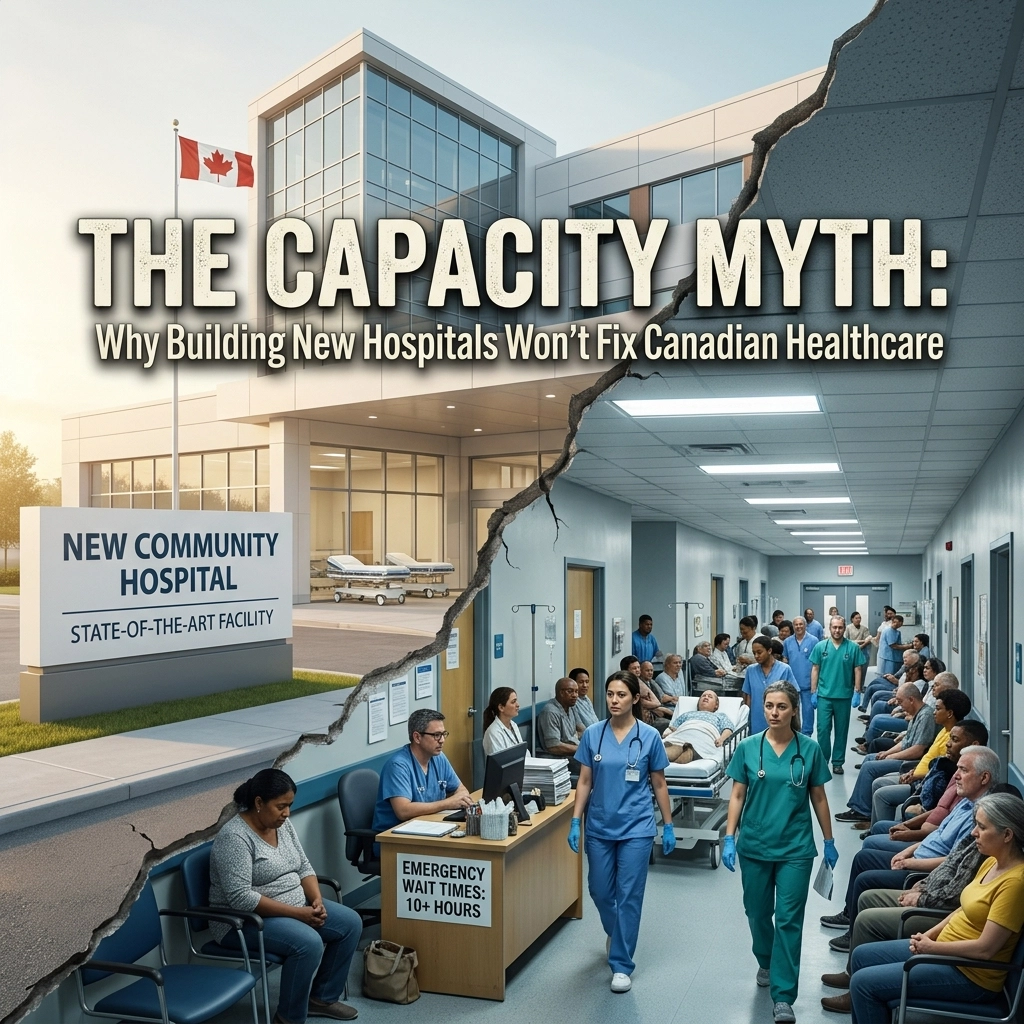
Political strategy in Canada frequently prioritizes infrastructure. New hospital announcements serve as visible markers of government action. Ribbon-cutting ceremonies provide high-impact media opportunities. These physical structures suggest a tangible solution to growing public anxiety regarding healthcare access. However, the reliance on bricks-and-mortar expansion as a primary fix for hospital capacity Canada issues is a fundamental miscalculation of systemic needs.
The current crisis within the Canadian healthcare system is not primarily defined by a lack of square footage. It is defined by operational stagnation and a failure in resource allocation. Building a new facility without addressing the underlying flow of patients and the availability of specialized personnel merely distributes existing inefficiencies over a larger geographical area.
The Static Bed Fallacy
A hospital bed is not simply furniture. In a clinical context, a "bed" represents a functional unit of care consisting of a physical space, specialized equipment, a registered nurse, and attending physician oversight. Increasing the number of physical beds without a commensurate increase in healthcare human resources results in "unfunded" or "unstaffed" beds. These units remain dormant. They do not contribute to actual capacity.
Canada maintains a policy of running hospitals near maximum capacity to optimize cost-efficiency. Research indicates that high occupancy rates: often exceeding 95%: are standard. While this maximizes the utility of the building, it leaves zero margin for surges in demand. When a system operates at peak capacity, any disruption leads to immediate "access block." Patients cannot move from the emergency department to an inpatient ward because the ward is full. This creates the backlog seen in urban centers across the country.


Access Block and Patient Flow
The primary bottleneck in Canadian healthcare is not the "front door" of the hospital but the "back door." Access block occurs when the exit flow from acute care facilities is restricted. Patients who have completed their acute treatment phase but are unable to be discharged due to a lack of community support are categorized as Alternative Level of Care (ALC) patients.
ALC patients occupy acute care beds while waiting for placements in long-term care, rehabilitation, or home-based support systems. Statistics suggest that on any given day, a significant percentage of hospital beds in Canada are occupied by individuals who do not require hospital-level medical intervention. Building a new hospital to house ALC patients is a fiscally irresponsible solution. The cost of maintaining an acute care bed is exponentially higher than the cost of a long-term care bed or home care services.
From an analytical perspective, the solution is not more hospitals. The solution is more "exit points." Without a robust secondary layer of care, new hospitals will quickly fill with ALC patients, and the same wait-time issues will persist.
Wait Times as Systemic Rationing
Healthcare wait times Canada are a byproduct of a system designed for stability rather than speed. The Canadian model rations care based on clinical priority rather than price. While this ensures equity, it necessitates a queue. The issue arises when the queue becomes unmanageable due to inefficient bed management.
The focus must shift from "bed count" to "bed days." Improving throughput: the speed at which a patient safely moves through the system: provides more effective capacity than adding more physical rooms. This requires investments in digital bed-management systems, enhanced diagnostic turnaround times, and 24/7 discharge capabilities. Currently, many hospitals see a significant drop in discharge activity during weekends, which causes a predictable surge in emergency department congestion every Monday morning.


The Human Resource Constraint
The Canadian healthcare system faces a severe shortage of healthcare professionals. This includes family doctors, specialists, nurses, and laboratory technicians. Infrastructure projects do not create staff. In many cases, new facilities cannibalize the staff of existing nearby facilities. This creates a zero-sum game where one region’s gain is another region’s loss.
Policy must prioritize the recruitment and retention of personnel over the construction of facilities. This involves streamlining the accreditation of internationally trained professionals and expanding residency slots. Addressing the doctor shortage is a prerequisite for any meaningful increase in capacity. A hospital without a doctor is a warehouse.
Transitioning to Community-Based Care
To offload pressure from acute care centers, Canada must pivot toward an integrated community-based care model. This aligns with the "government-in-waiting" perspective of looking at systemic design rather than temporary fixes. High-functioning healthcare systems globally emphasize primary care and outpatient services.
Chronic disease management should occur in the community, not in the emergency room. When primary care is inaccessible, patients utilize the hospital for non-emergent issues. This is an inefficient use of high-cost resources. By strengthening the primary care network, the system can prevent the acute crises that lead to hospital admissions.
Integrated care also involves the use of technology to monitor patients at home. "Hospital-at-home" programs allow stable patients to receive acute-level monitoring in their own residences. This frees up hospital beds for patients who strictly require intensive, on-site intervention.


Fiscal Realities and Federal Dynamics
The financial burden of healthcare is the single largest line item in provincial budgets. Continued investment in capital-heavy hospital projects threatens the long-term sustainability of provincial finances. Fiscal responsibility dictates a move toward lower-cost care settings.
Federal health transfers are often tied to specific outcomes. There is a growing need for these transfers to be linked to operational efficiency metrics rather than just facility construction. The federal-provincial deadlock regarding healthcare accountability must be resolved by focusing on data-driven results: reduced wait times, lower ALC rates, and higher primary care attachment.
For more analysis on national priorities and the intersection of policy and economics, visit our sections on Politics and the Economy.
Proposed Strategic Framework
A rational approach to Canadian healthcare capacity involves three pillars:
- Optimizing Existing Assets: Implementing advanced logistical software to track patient flow in real-time. Eliminating discharge delays by ensuring community supports are ready the moment acute care ends.
- Expanding Post-Acute Capacity: Prioritizing the construction of long-term care and assisted living facilities over new acute care hospitals. These facilities are cheaper to build and operate and directly address the ALC crisis.
- Strengthening Primary Care: Moving toward a model where every Canadian has access to a multidisciplinary primary care team. This reduces the reliance on emergency departments for routine care.

Conclusion
The "Capacity Myth" persists because it is easier to explain a new building to voters than it is to explain a complex reorganization of patient flow. However, the data is clear. Bricks and mortar do not treat patients; people and processes do.
If the goal is to fix Canadian healthcare, the focus must shift from the size of our hospitals to the efficiency of our system. Until the "back door" of the hospital is cleared through better community care and long-term care integration, the "front door" will remain blocked, regardless of how many new hospitals are built.
Connect with us.
thecanadianist.news