

The Canadianist | Blog
Is the CFL Losing What Makes It Canadian?
On the eve of the Grey Cup, Canadian football faces a familiar question: why do we keep looking south for validation of things we’ve built ourselves?

On the eve of the Grey Cup, Canadian football faces a familiar question: why do we keep looking south for validation of things we’ve built ourselves?
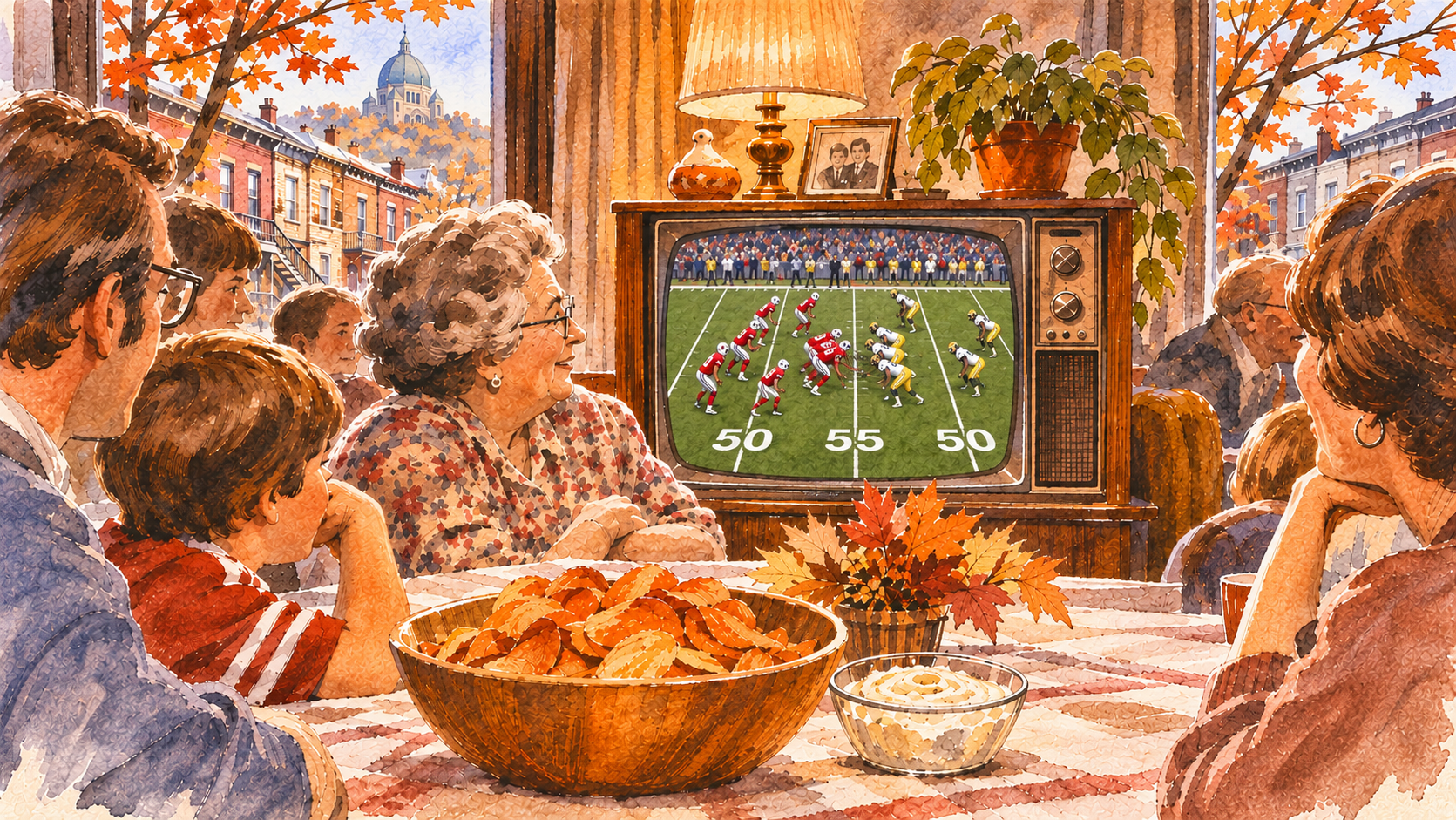
Some of my earliest memories of Canadian football have nothing to do with sitting in a stadium. They go back to Sunday afternoons when my father’s side of the family would gather at my aunt Claudette’s. She was the family matriarch, and her home was where we came together for holiday dinners, Thanksgiving and other family occasions.
There was always a wooden bowl of Humpty Dumpty barbecue chips in the middle of the table, accompanied by that dreadful French onion dip everybody seemed to eat anyway.
Humpty Dumpty was practically an institution in Montreal in those days. Its factory sat alongside Highway 20 in Lachine, and I can still remember driving past and smelling the chips being made. You could smell them throughout the surrounding neighbourhood. In the 1970s, Humpty Dumpty was part of the everyday culture of growing up in Montreal.
The adults would be talking, people would be coming and going, and somewhere in the room, a Canadian Football League game would be playing on television.
I don’t remember the scores or even who was playing most of those afternoons. I remember the atmosphere. Football was simply part of the occasion, as familiar as the food and the family around the table.
Years later, I worked in sports radio at Montreal’s The Team 990, the station that eventually became TSN Radio 690. I came to understand professional sports from another perspective, including the business pressures, audience expectations and constant competition for people’s attention.
So I understand why the Canadian Football League is looking for ways to grow. I just question whether it understands what it risks losing in the process.
This Sunday, the Montreal Alouettes and Edmonton Elks will meet in Calgary for the 113th Grey Cup. It’s a fitting occasion to consider where Canadian football is headed, because the game they’ll play will soon look somewhat different.
Beginning in 2027, the CFL will shorten its field from 110 yards to 100. End zones will shrink from 20 yards to 15, and the goalposts will move from the goal line to the back of the end zone.
The league argues these changes will encourage touchdowns, improve sightlines, increase safety and make the game more entertaining. Some of those arguments have merit. Moving goalposts out of the field of play, for example, is a reasonable safety consideration.
But the decision to shorten the field raises a different question.
Why?
Canadian football has always been different from American football. Three downs instead of four. Twelve players instead of eleven. A wider and longer field, more motion before the snap, and a kicking game with its own peculiarities.
Those differences shaped the character of the game. They weren’t defects waiting to be corrected.
The CFL insists that the essential elements of Canadian football will remain. And technically, that’s true. A shorter field won’t suddenly turn the league into the NFL. But I wonder whether the people making these decisions are paying enough attention to the cumulative effect of gradually making Canadian football resemble its American counterpart.
The league has been down a version of this road before.
In the 1990s, the CFL attempted to expand into the United States, establishing franchises in markets including Sacramento, Las Vegas, Shreveport, Birmingham, Memphis and Baltimore. The experiment was over by 1996, with Baltimore proving the notable success before its franchise relocated to Montreal.
There were plenty of business and operational reasons for that failure, and it would be unfair to blame the entire episode on American audiences rejecting Canadian football. Still, it demonstrated how difficult it is to establish a Canadian football product in a marketplace already dominated by American football.
The NFL has an enormous financial advantage, extraordinary television reach and a cultural presence that extends well beyond the United States. The CFL cannot realistically compete with it on those terms.
And I don’t believe it should try.
If someone wants NFL football, there’s already an NFL. Why would they choose a smaller Canadian version of essentially the same product?
I would rather see the CFL invest its energy in making Canadian football more successful on its own terms.
That might mean improving the broadcast experience, making games more accessible to younger audiences, strengthening community relationships or finding better ways to introduce new Canadians to the sport. There’s no shortage of possibilities that don’t require changing the dimensions of the game itself.
And this is where a football story begins to resemble a much larger Canadian conversation.
The Imported Noise
Canada is currently confronting some uncomfortable realities about its economic relationship with the United States.
Trade tensions, tariffs and the uncertainty surrounding our access to the American market have forced Canadians to reconsider assumptions we’ve lived with for decades. We’re being encouraged to buy Canadian, strengthen domestic industries, diversify our trading relationships and reduce the vulnerabilities created by excessive dependence on a single neighbour.
The underlying argument is sensible. Canada needs the confidence and capacity to act in its own interests, even when those interests differ from American priorities.
Yet in other areas of Canadian life, we continue to behave as though American standards represent the natural destination for Canadian progress.
I have written about this in my work on Canadianism, particularly the influence of what I call imported noise.
Canada lives beside the world’s largest cultural and economic megaphone. American politics, media, entertainment and public arguments spill across our border every day. We absorb so much of it that we sometimes begin discussing Canadian problems using American assumptions, even when our circumstances are substantially different.
We see it in political debates that borrow American language and divisions. We see it when Canadian public institutions are judged against models developed for another country. And we see it in the persistent tendency to equate greater American resemblance with greater sophistication or success.
Canadianism, as I understand it, isn’t about rejecting American ideas or pretending that Canada exists in isolation. We’re neighbours, trading partners, allies and friends, and there is an enormous amount we can learn from one another.
But learning from someone doesn’t require becoming them.
A country confident in itself should be capable of examining an outside idea, deciding whether it serves Canadian interests and rejecting it when it doesn’t.
That’s as true of football as it is of economic policy.
Modernization Without Losing Ourselves
There is a reasonable counterargument to all of this.
The CFL needs to attract new audiences. Its existing supporters won’t be around forever, and tradition alone doesn’t pay salaries, fill stadiums or sustain television contracts. League executives have a responsibility to ensure that Canadian football remains financially viable.
I agree.
I’m also not convinced that preserving tradition requires preserving every rule indefinitely. Sports evolve. Canadian football has changed many times over its history, and some of those changes have improved the game.
But when the league announces that it is shortening its field, I want to know what evidence suggests this will bring in new viewers.
Are Canadians who currently ignore the CFL really going to start watching because the field is ten yards shorter? Are American football fans waiting for precisely that adjustment before embracing a league they’ve previously overlooked?
Perhaps the league has compelling research. If so, I’d like to see it.
I would also like to know how it has weighed the potential gains against the attachment existing fans have to the game they’ve supported for generations.
There is a danger in treating loyal audiences as guaranteed customers while chasing hypothetical ones.
The people who attend games, buy merchandise, follow their teams through difficult seasons and pass their enthusiasm along to their children are not obstacles to modernization. They’re the foundation on which the league’s future depends.
The same principle applies more broadly to Canada.
We’re being told, with good reason, that we need to build greater economic resilience and stop assuming that our future will always be secured by proximity to the United States. But economic independence will mean relatively little if we lack the cultural confidence to value what we’ve created ourselves.
Canadian identity doesn’t have to be defined in opposition to America. It should be strong enough to stand without constantly referring to America at all.
Our differences are not automatically virtues, of course. Sometimes another country has a better approach, and we should be intelligent enough to recognize it.
But neither should difference be treated as a problem simply because the Americans do something another way.
A Grey Cup Worth Remembering
On Sunday, Canadians will gather in living rooms, sports bars and stadium seats to watch the Grey Cup. Some will have followed every game this season. Others will tune in because it’s the Grey Cup, an annual occasion that still carries a sense of national familiarity.
I’ll be thinking about those Sunday afternoons at Claudette’s house, the Humpty Dumpty chips, the French onion dip and the football playing while the family carried on around it.
Nobody in that room was debating whether Canadian football would be more successful if we made it resemble the NFL. We were watching our game, played by our teams, within traditions that belonged to us.
I don’t expect the CFL to recreate my childhood, and I wouldn’t want it to try. Nostalgia is a poor substitute for a business plan.
But I do expect the people entrusted with Canadian institutions to understand what makes those institutions worth preserving before they begin changing them.
The CFL has every reason to pursue a stronger future. It should be ambitious, commercially intelligent and willing to innovate.
I’d simply like that ambition to begin with a little more confidence in Canadian football.
After all, we’re spending a great deal of time these days discussing how Canada can become less dependent on the United States.
It would be a shame if, in the middle of that conversation, we forgot how to appreciate something that was already our own.