


The Canadianist | Blog
Brampton Is a Warning: Canada Doesn’t Control Its Car Plants
As Carney and Joly fight to preserve Canada’s auto industry, workers remain caught between public investment and decisions made beyond our borders.

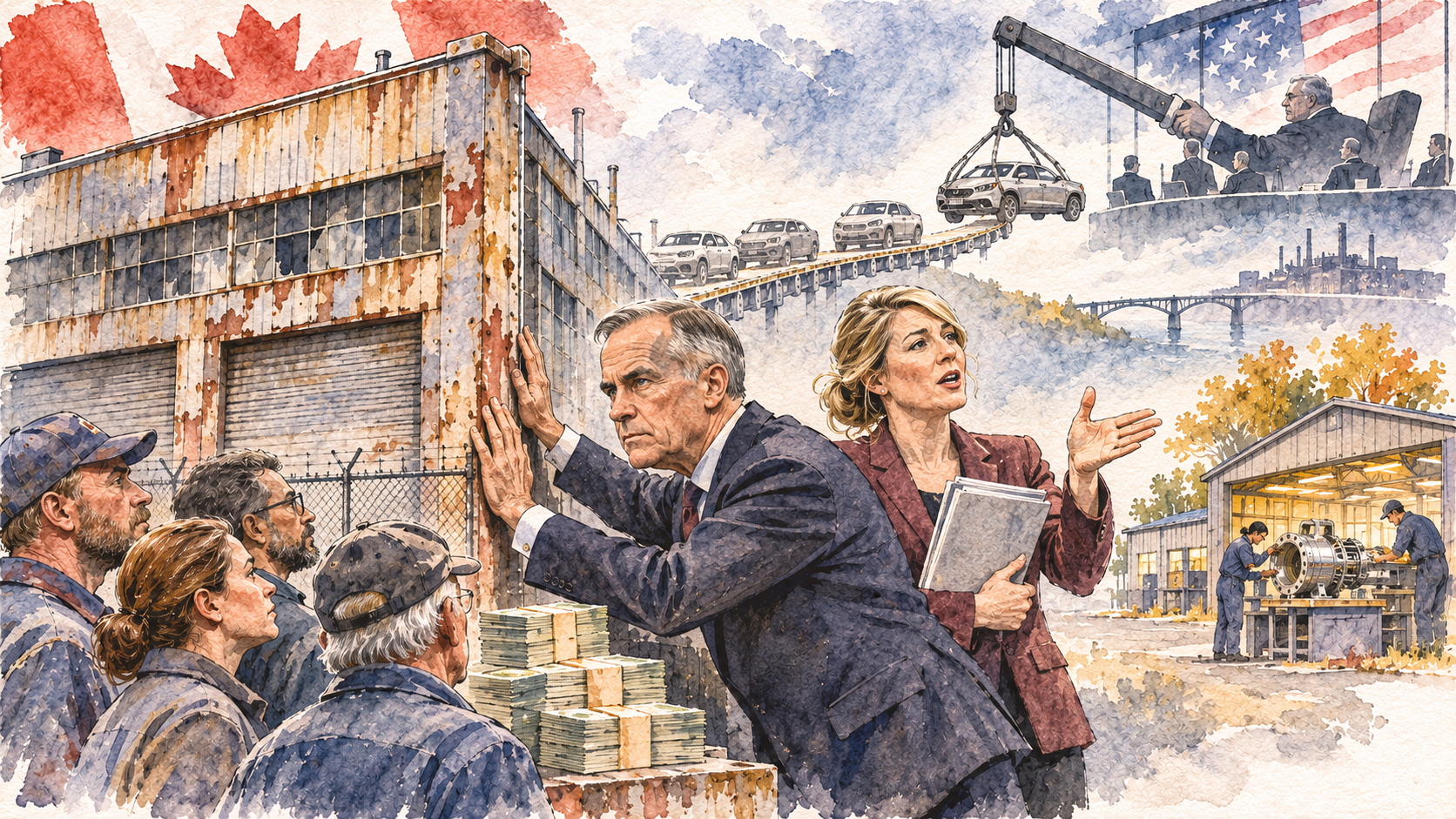
Canada wants to depend less on Washington. Its auto policy keeps leaving whole communities at the mercy of decisions made somewhere else.
I’ve owned businesses that I probably should have closed long before I did. One was a restaurant. I poured everything I had into keeping it alive. When business slowed, I worked harder. When the numbers didn’t add up, I made another plan, and when that didn’t work, I found more money, changed something else and convinced myself the next adjustment would finally turn things around. Sometimes it did, for a while.
But eventually I had to face something I didn’t want to admit. I wasn’t building a successful business anymore. I was spending money trying to preserve one. Anyone who’s owned a struggling business knows the feeling. You’ve put in so much time and money that walking away feels like admitting defeat, and the longer you fight, the harder it gets to see that the fight itself is costing you your future.
I’ve been thinking about that lately, because I suspect Canada is making a similar mistake on a much larger scale.
The American Contradiction
For months, Prime Minister Mark Carney has been talking about reducing Canada’s economic dependence on the United States: diversifying our trade, strengthening the domestic economy and making the country less vulnerable to decisions made in Washington. There’s considerable logic behind that.
Being integrated with the American market isn’t the problem in itself. A Canadian plant can be productive, competitive and woven into American supply chains, and many are. The problem is concentrated dependence: whole communities whose futures hinge on a handful of decisions made outside the country, with very little bargaining power on our side.
So the question isn’t whether Canada should build cars. It’s whether we keep paying to protect an arrangement in which the decisions that matter most are made somewhere else. I’m not arguing for less automotive manufacturing. I’m arguing for an economy in which a boardroom outside Canada can’t put an entire community’s future in doubt with a single product announcement.
What Brampton Shows
On November 9, Stellantis signed an agreement to sell its idled Brampton Assembly Plant to Roshel, the Canadian armoured vehicle maker, ending the automaker’s own plans to build cars there. The plant has been dark since December 2023, and more than 2,200 workers have spent that time on layoff, waiting for a retooling that never came. Ottawa says Stellantis broke commitments tied to public support (up to $529 million from Ottawa and up to $513 million from Ontario, pledged in 2022 to retool Brampton and Windsor) and wants the company to reopen the plant or pay the money back. Pierre Poilievre wants Industry Minister Mélanie Joly fired. Everyone is arguing about accountability. Fewer people are noticing that the whole episode is the contradiction in miniature.
I can’t tell you the plant was a winner (Stellantis executives had openly doubted whether a 40-year-old facility fit their plans), but the decision that finished it wasn’t made here. Stellantis paused the Brampton retooling in February 2025 as American tariffs arrived, then moved the Compass to Illinois as part of a $13-billion push to expand production in the United States. Its Canadian president told a Commons committee the plan changed because of market dynamics that began with the tariffs, and Carney himself called the move a direct consequence of them. Ottawa had a signed agreement and hundreds of millions of dollars on the table, and it couldn’t change the outcome.
Saving a Plant Isn’t the Same as Saving an Industry
Going after Stellantis is the right call. A company that takes public money in exchange for commitments should be held to them, and if Ottawa can recover what it’s owed, it should. But recovering money isn’t the same thing as having a plan for what that money, or the next round of it, is supposed to build.
There’s a serious case for the government’s approach, and it deserves more than a nod. An idle plant with a skilled workforce and a supplier network around it can be worth keeping ready even when nothing is being built inside, because losing those people and suppliers for good can cost far more than holding the option open. If that’s the reasoning, it may well be sound. But then Canadians deserve to see the case, the cost and the conditions under which the government would finally change direction.
Governments carry a responsibility I didn’t. They’re dealing with whole communities, skilled workers and supplier networks, and those costs don’t fit on a balance sheet. But they don’t justify spending without a destination, either.
The Roshel Question
Roshel’s plans matter to a lot of families, but the numbers need care. The company has spoken of more than 2,000 jobs at the site, while its own estimate of how many laid-off Stellantis workers it could take on has been 700 to 1,000. Armoured vehicles are built at a fraction of the volume of passenger cars, and Unifor argues the sale can’t replace the assembly jobs that were lost.
The link to public procurement isn’t speculation. Roshel is one of two finalists for a Canadian military contract worth up to $4.9 billion to build light utility vehicles, and those vehicles would be made at the Brampton plant. When the deal was first floated, Roshel said it could reactivate the facility quickly if it won. That doesn’t mean Ottawa can hand the company its future, since the contract runs through a competitive process and nothing has been awarded. But if anticipated government orders are a large part of what makes this acquisition worth doing, it’s fair to ask how much of the investment depends on them and what taxpayers get in return in jobs, exports and staying power.
Defence manufacturing in Canada can be a genuine strategic asset, and the two companies have said they’ll explore working together on vehicle technology and defence services. But a defence plant can also become another factory whose future rides on a single customer’s budget, only this time the customer is us. Trading dependence on a foreign automaker for dependence on our own procurement calendar is a change, but it isn’t necessarily progress.
Why We Keep Ending Up Here
I remember when General Motors closed its Sainte-Thérèse plant in Quebec in 2002. More than two decades later, we’re having the same conversation: a threatened factory, public money, broken corporate commitments and workers wondering whether their livelihoods will survive another restructuring. The parties change, the plant changes, and the pattern holds.
Part of the reason is structural. Canada assembles vehicles for five foreign-owned automakers and has no major carmaker of its own, so every assembly plant in the country builds whatever a head office elsewhere assigns it. When governments put money on the table, what they’re really buying is a product mandate, and a mandate can be reassigned. The 2022 agreement came with commitments attached, and the Compass went to Illinois anyway. The politics reinforce the structure. A visible rescue pays off within an election cycle, while a plan to broaden the industrial base of the same communities pays off years later, often to someone else’s credit. That’s why replacing a minister wouldn’t change much, because her successor would inherit the same structure and the same incentives.
Knowing When to Change Direction
Looking back on my own businesses, I don’t regret fighting to make things work. What I regret is not recognizing sooner when I needed to change direction. There’s a difference between giving up and understanding that the future you want may require a different road from the one you’ve been on.
Canada needs that conversation about its auto industry. It isn’t about abandoning the industry or its workers, or surrendering manufacturing skill we’ve spent generations building. It’s about the difference between rescuing a plant and reducing the vulnerability that keeps making rescues necessary. A less vulnerable auto economy would still build vehicles and parts, but its work would be spread across enough employers and markets that no single carmaker’s product plan could decide a town’s future. It would also treat a plant’s skilled workforce and supplier network as assets that can be pointed at new products, not only at the one they were built around.
A worker in Brampton wants their job back. I understand that completely, and in their position I’d be fighting for it too. But that worker deserves more than another temporary reprieve followed by another uncertain future.
Saving today’s jobs matters. But if every rescue leaves us just as exposed to the next decision made somewhere else, we aren’t securing our industrial future. We’re paying to preserve our past.















Pingback: Canada Today | Manufacturing Strength and Who Controls It – United Canadian Centrist Party