The Canadianist: Journeys
Ontario’s OSAP Crisis: A Devastating Birthday Surprise for One Student
In her late 50s, Sophia returned to school to build a new career after the pandemic ended her years in the restaurant business. Now, with her education nearing completion, Ontario’s OSAP freeze has put her family’s carefully laid plans in jeopardy.

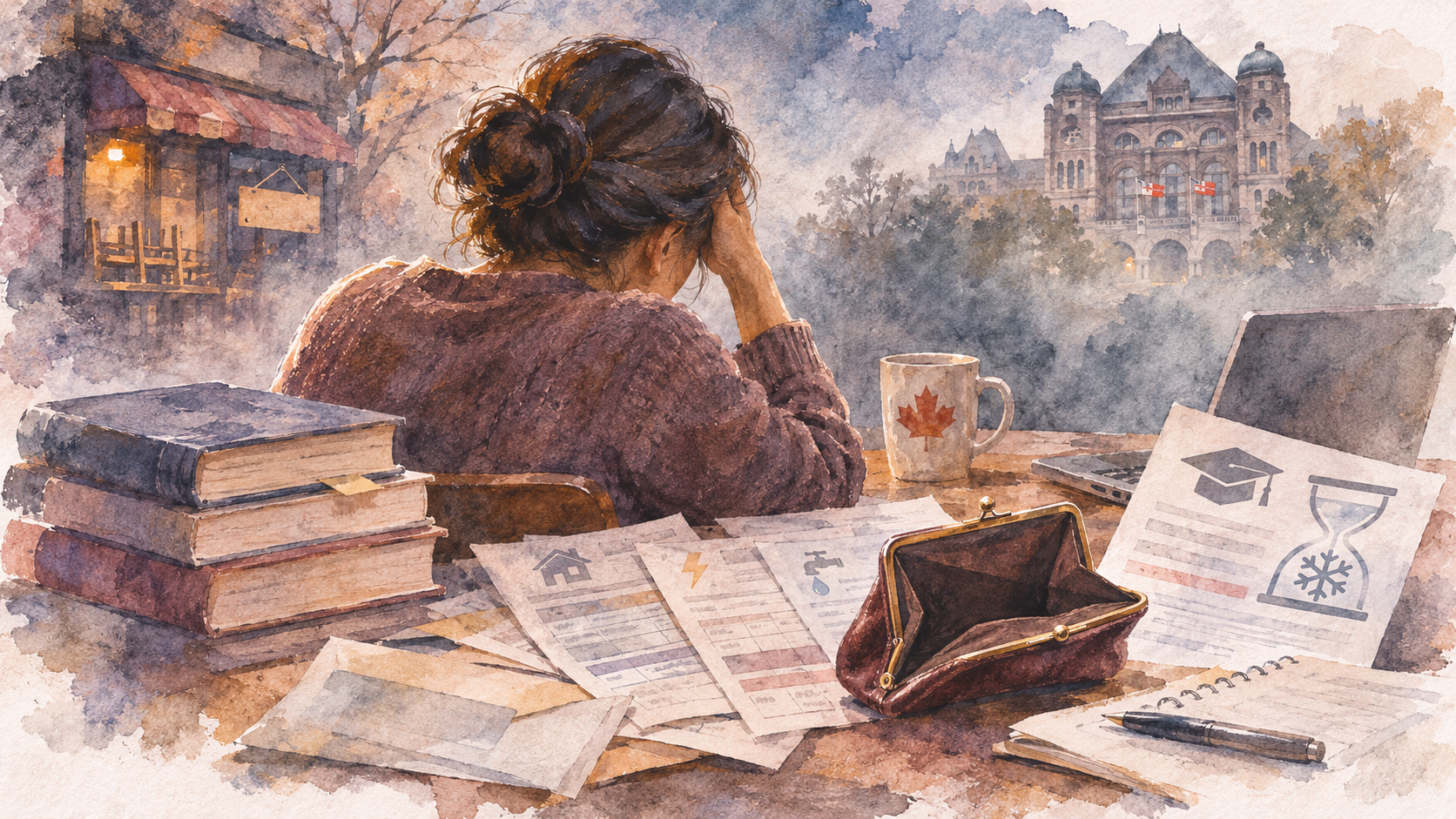
In her late 50s, Sophia returned to school to build a new career after the pandemic ended her years in the restaurant business. Now, with her education nearing completion, Ontario’s OSAP freeze has put her family’s carefully laid plans in jeopardy.
By Christopher M. Michaud | The Canadianist
Editor’s Note — Protecting Our Sources
The stories in this series are real-life accounts shared directly with The Canadianist through personal, one-on-one interviews. To protect the identities and privacy of those who have agreed to speak with us, names and certain identifying details have been changed. All events and circumstances are reported factually, without dramatization or embellishment.
On February 12, 2026, Sophia celebrated her birthday. That same day, the Ontario government announced a sweeping restructuring of the Ontario Student Assistance Program, shifting a substantially greater share of educational assistance from grants to repayable loans.
Some birthday present.
For Sophia, the announcement was particularly unwelcome. She was already more than a year into an accelerated training program in health and therapeutic services, having made a considerable personal and financial commitment to starting a new career at an age when many Canadians are beginning to think about retirement.
She had no intention of retiring. She had plans.
Sophia came to Canada nearly two decades ago and later became a Canadian citizen. She worked hard, built a life here and eventually opened a restaurant with her partner.
For several years, the business performed well. Like so many independent restaurateurs, they invested enormous amounts of time and energy into making it successful.
Then came COVID-19.
The pandemic fundamentally changed the economics of the restaurant business. Between government restrictions, interrupted operations, rising costs and the difficult recovery that followed, the business they had worked so hard to establish became increasingly difficult to sustain.
They fought to keep it going, eventually deciding that the sensible course was to close that chapter of their lives and look toward something new.
In her late 50s, Sophia returned to school.
A Plan for a Better Future
Sophia enrolled in an accelerated 22-month program in health and therapeutic services at a private career college in Ontario.
It was a demanding schedule. There was no traditional summer vacation. Classes continued throughout the year, with just two weeks off near the end of August and a short spring break.
She approached the commitment seriously, maintaining grades consistently in the 85 to 90 per cent range and frequently higher.
At home, Sophia and her husband had agreed on a plan. He would continue working as a rideshare driver and supporting the household while she concentrated on completing her education.
Her OSAP assistance would cover tuition and provide a contribution toward household living expenses. Both understood that the arrangement would require sacrifices.
The objective was to get through two financially difficult years and emerge with Sophia qualified to enter her chosen healthcare profession, opening the door to a more stable future with two sources of employment income.
It was a modest ambition, and a familiar one. Families invest in education every day because they believe that temporary sacrifices can improve their long-term circumstances.
Then came the February announcement.
Under the new rules, provincial grants for private career college students would be eliminated for programs beginning on or after August 1, 2026. The prospect of a significantly greater future debt burden introduced another complication into the family’s plans.
The precise application of those changes to continuing students depends on their program and funding circumstances. For Sophia, the announcement nevertheless added uncertainty to an undertaking already financed with little room for error.
She continued studying.
Her spring OSAP payment arrived as expected. She completed another semester, maintained her grades and proceeded through the summer, while her husband continued working.
Later, she applied for the next period of assistance needed to complete the final stretch of her education.
Her application was approved.
Then, on October 6, Ontario suspended OSAP payments across the private postsecondary sector while the province investigated suspected misuse of the program.
Approved, But Not Paid
Sophia’s situation is particularly difficult to reconcile with the government’s approach.
She is not a new applicant whose circumstances are unknown. She has already completed more than a year of intensive study, received assistance under the established program and demonstrated consistent academic performance.
Her latest application was approved.
She continued attending school, meeting her responsibilities and progressing toward graduation.
Yet the expected money never arrived.
Her college has not, to her knowledge, been publicly identified as an institution suspected of wrongdoing. In fact, the government has not released comprehensive institution-by-institution findings that would allow students to understand precisely where their schools stand.
For the moment, the college has told students it will work with them while the funding situation remains unresolved. That has relieved some of the immediate pressure surrounding tuition.
It has not resolved the financial pressures at home.
OSAP assistance is intended to help eligible students with educational costs and living expenses. For many mature students, those living expenses include their contribution to an existing household budget.
Sophia’s family had planned around that contribution.
Her husband’s rideshare income was intended to cover the greater share of household costs while she studied. It was already a difficult balancing act, made more challenging by the rising cost of living and the financial consequences of several years of economic disruption.
The missing OSAP payment has created a substantial gap in a budget that had very little flexibility to begin with.
There is a considerable difference between a household deliberately accepting two years of financial hardship and finding that the arrangements underpinning that decision have been changed without a workable alternative.
For families already struggling, that missing payment can be the difference between remaining financially afloat and falling into arrears.
And once the bills begin accumulating, restoring the original payment does not necessarily undo the damage.
Students Caught in an Investigation They Did Not Cause
Ontario has legitimate reasons to investigate suspected OSAP fraud. The government has reported troubling application patterns, weaknesses in student verification and concerns involving some institutions.
Those matters deserve investigation and, where wrongdoing is established, appropriate enforcement.
But Sophia’s experience illustrates the difficulty with a sector-wide suspension.
A student can satisfy the requirements of her program, maintain strong academic standing, have her financial assistance approved and still find herself without the money she was expecting because of concerns involving institutions elsewhere.
The government has not publicly established that Sophia engaged in any wrongdoing. Nor has it identified her college as one of the institutions responsible for the suspected abuses.
Nevertheless, her household is living with the consequences of the province’s response.
Private career colleges occupy an important place in Ontario’s educational system. They provide training in healthcare, personal services, technical occupations and other fields, often offering schedules and programs suited to mature students changing careers.
These institutions are subject to provincial regulation, and eligible programs have been permitted to participate in OSAP.
Ontario recognizes the value of that training through the very system now under investigation.
Students like Sophia are pursuing occupations the province needs. Their education should be subject to appropriate standards and oversight, but their financial stability should not become an incidental casualty of investigations into misconduct they had no part in creating.
Another Month, Another Promise
On November 4, Premier Doug Ford said KPMG, the accounting firm conducting the investigation, would prioritize colleges considered lower-risk so that funding could resume as quickly as possible.
He did not provide a date.
For a student with an approved application and bills already coming due, that announcement offers little practical reassurance.
Sophia has spent much of her adult life working, contributing and trying to build a secure future in Canada. When the restaurant business became unsustainable, she adapted. She returned to school, accepted the demands of an accelerated program and continued performing well.
After years of navigating the economic consequences of COVID-19, she and her husband believed they had found a practical way forward.
The province’s February restructuring added another consideration. They adjusted and continued.
October’s suspension removed the funding they were depending on.
The school remains supportive, but the uncertainty continues. Sophia goes to class, studies, completes her assignments and prepares for a profession she has worked hard to enter.
At home, the financial obligations continue to accumulate.
Her story is one example of a problem affecting students across Ontario, although the province has yet to publish a verified count of those whose approved disbursements have actually been interrupted.
There are other circumstances to examine: single parents, students nearing graduation, career changers, families supporting more than one student and people whose education is their best opportunity to recover from earlier financial hardship.
Their situations will differ, but they share one immediate concern.
They cannot plan around a payment date the government will not provide.
For Sophia, February 12 was supposed to be an ordinary birthday, spent looking ahead to completing her education and beginning a new chapter of her working life.
Instead, it became the date of the first major OSAP announcement affecting her plans.
Eight months later, the payments stopped.
A birthday gift that keeps on giving, indeed.
This article is part of The Canadianist’s continuing examination of Ontario’s OSAP suspension and its consequences for students and families.